
Puck's Glen
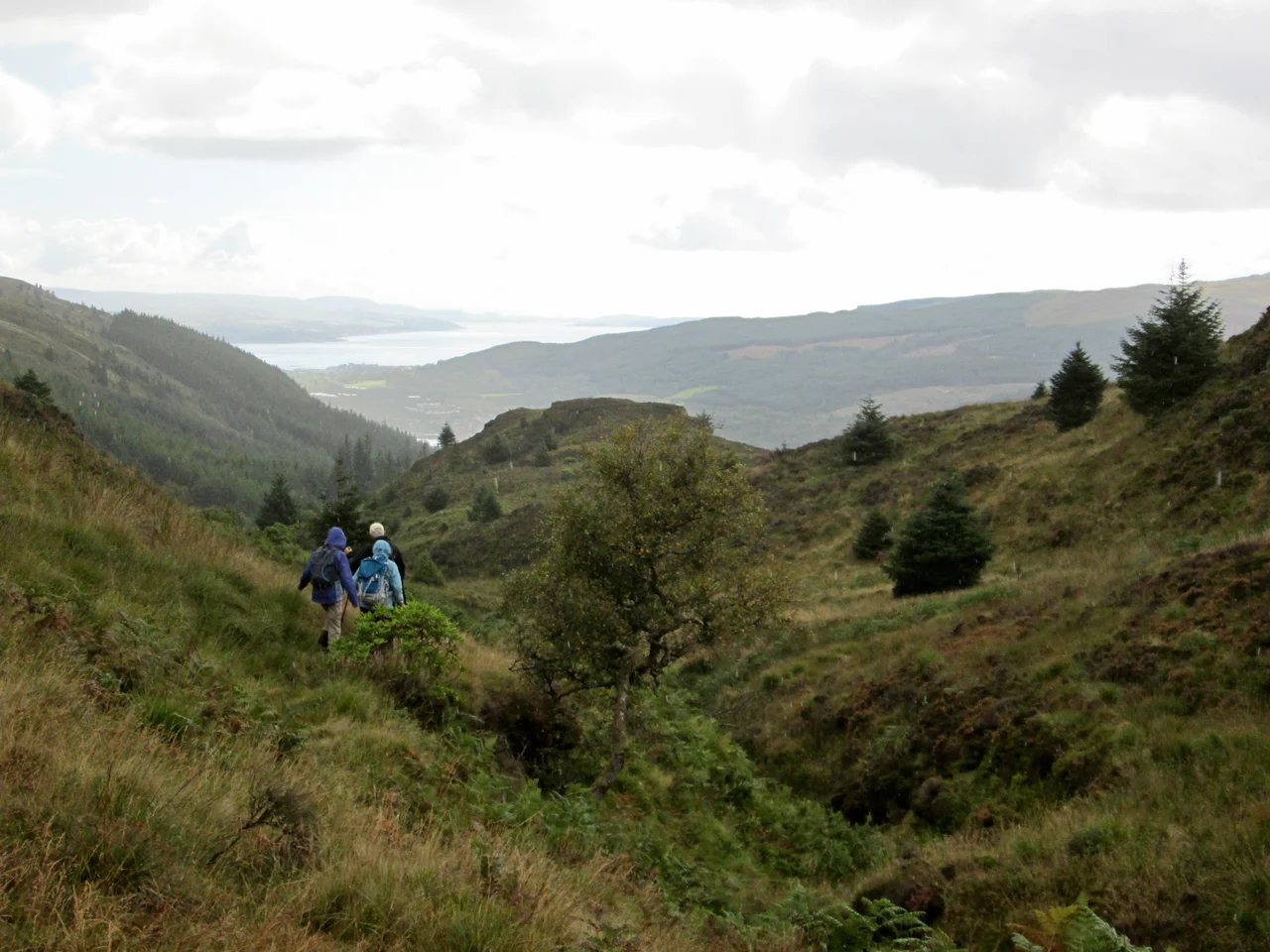
Step off the A815 road about ten kilometres north of Dunoon, leave the car park, and within minutes you are walking up the cleft of one of the most theatrical small glens in Scotland. The path follows the Eas Mor, Gaelic for big waterfall, as it tumbles from one polished basin to the next between near-vertical walls of schistose rock cushioned with moss. Bridges crisscross the stream every few hundred metres. Conifers close overhead. In 1918, the Anchor Line Staff Magazine described Puck's Glen as a place where an amber stream cuts a channel through moss-draped schistose rock, tumbling from one silver rock-chalice to another. A century later the description still fits. Whoever named the gorge after the trickster fairy of A Midsummer Night's Dream had the right instinct.
From Hunting Ground to Improved Estate
The land here belonged for centuries to the Campbells of Ballochyle, who used it as hunting ground. Forestry plantation on the Benmore Estate began around 1820, and the first detailed map of the area, an Ordnance Survey sheet from 1865, shows the Eas Mor gorge as a small wooded ravine cutting up into open moorland. James Piers Patrick, an American who bought Benmore in 1862, began garden improvements, but the man who really shaped Puck's Glen was his successor. James Duncan, a Greenock sugar refiner and philanthropist, bought the estate in 1870 and added the neighbouring Kilmun and Bernice estates. He planted more than six million trees and cut paths up the ravine that turned it into a destination for Victorian walkers. The trees and paths he left behind outlasted his fortune.
The Hut Above the Gorge
Henry Younger of the Edinburgh brewing family bought Benmore in 1889 and, with his son Harry George Younger, made many further improvements. In commemoration of Duncan's earlier work, the Youngers commissioned Sir Robert Lorimer to design a small memorial hut above the gorge. The Bayley Balfour Memorial Hut, known as Puck's Hut, was dedicated to the botanist Sir Isaac Bayley Balfour. The interior was panelled with samples of every species of timber then growing at Benmore. The Gardeners Chronicle, reporting on the dedication ceremony in fine September weather in 1928, described the site as commanding beautiful views above a gorge where, in the words quoted, the singing waters fall to the Eachaig River from lofty heights, with Beinn Mhor visible through a faint blue haze. The hut was moved in 1968 to the walled garden at Benmore and listed as a Grade C building in 1992.
A Temperate Rainforest
Puck's Glen lies within Argyll Forest Park and, since 1929, within an area also adjoining the Royal Botanic Garden Edinburgh's first outstation at Benmore. The Cowal climate, very wet and relatively mild, creates conditions for temperate rainforest: mossy understorey, hanging lichens, ferns in every crevice. Acid soils favour the conifers, and the Forestry Commission has planted them in numbers along the sides of the glen, which runs through Uig Wood. In the 1930s the Commission established the Kilmun Arboretum just to the south, planting large groups of single species rather than individual specimens for study. Mature Californian redwoods, Douglas fir, and Western hemlock stand alongside the trail. The Forestry Commission's National Forest Park Guide of 1947 described Puck's Glen as a rocky cleft beside a rushing stream, leading up to a fine viewpoint, which may be visited without charge or formality. Free admission and no formality remain the rule today.
Closure, Disease, and Recovery
The path needs constant care. After the original Victorian routes deteriorated, a major restoration in May 1986 rebuilt the bridges and reopened the trail. In 2020, the glen and adjoining trails closed temporarily. The reasons stacked: COVID-19 restrictions, concerns about the stability of the gorge walls, and the need to fell larches infected with Phytophthora ramorum, the so-called larch disease. The closure was a reminder that this is a working forest as much as a scenic one, vulnerable to pathogens spreading through plantations across Scotland. Forestry and Land Scotland, which now manages the area, describes Puck's Glen as one of the most magical forests in Scotland, with a delightful trail along a rocky gorge. The walk connects to the Black Gates Trail starting at Benmore Botanic Garden and to the Upper Puck's Glen Loop heading further uphill, threads through woodland to viewpoints over the Holy Loch and Dunoon and the Firth of Clyde beyond.
From the Air
Puck's Glen sits at approximately 56.013 north, 4.961 west, in the Cowal Peninsula, about ten kilometres north of Dunoon on the A815 road. From altitude the glen is a narrow dark line running roughly north-south down toward the River Eachaig and the Holy Loch. Beinn Mhor rises to the west. EGPF Glasgow lies about 30 nautical miles east-southeast; EGPK Prestwick is roughly 40 nautical miles south-southeast. Recommended viewing altitude 2,000 to 3,500 feet for the Cowal valleys. Expect low cloud and orographic rain over Beinn Mhor; the wetness here is what makes the temperate rainforest possible.
Nearby Stories
- Loch Katrine 3.4 km away
- Dumbarton 4.4 km away
- Easdale 5.1 km away
- Stewarton 5.9 km away
- Gigha 9 km away
- Loch Awe 9.4 km away
- HMS Dasher (D37) 12 km away
- Jura, Scotland 13 km away