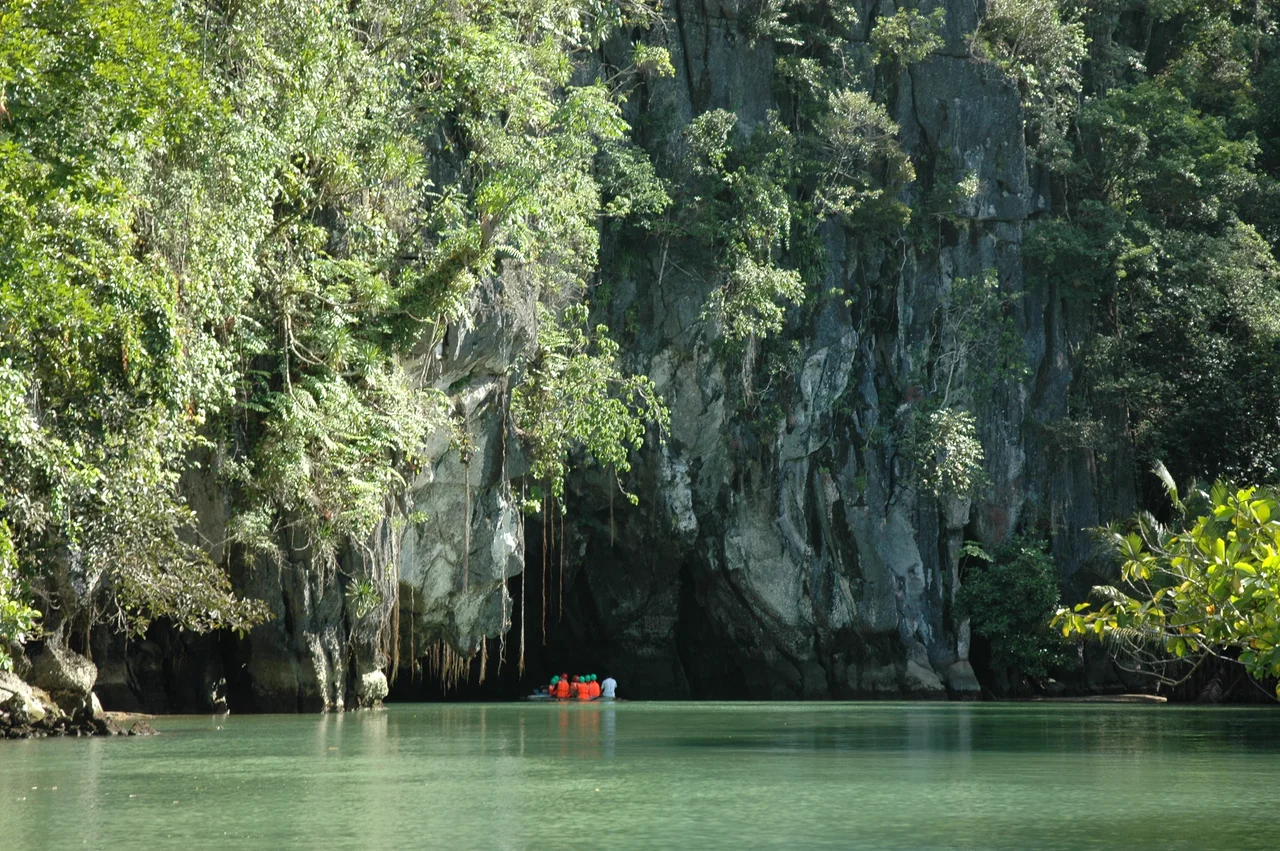

Puerto Princesa Subterranean River National Park
Deeper in the cave, the air thins. Oxygen levels drop to the point where further exploration becomes dangerous, and the river continues into passages that no human has fully mapped. This is the Puerto Princesa Subterranean River -- an underground waterway that flows for more than eight kilometers through a limestone mountain on Palawan's western coast, navigable by boat for 4.3 kilometers from the sea before the darkness and the lack of breathable air turn visitors back. The cave system includes chambers so vast they generate their own weather patterns, with a dome measured at 300 meters above the river and the Italian's Chamber spanning approximately 2.5 million square meters in volume -- one of the largest cave rooms in the world.
Mountain to Sea
The national park sits in the Saint Paul Mountain Range, about 80 kilometers north of Puerto Princesa city. What makes it ecologically extraordinary is the completeness of its ecosystems. The site contains a full mountain-to-sea gradient: from montane forest at elevation, through lowland evergreen tropical rainforest, riverine forest, freshwater swamp forest, beach forest, and finally mangrove forest at the coast. Thirteen of the forest types found in tropical Asia are represented here. Researchers have cataloged more than 800 plant species from 300 genera and 100 families, including at least 295 tree species dominated by dipterocarps. In the lowland forest, towering dao, ipil, dita, amugis, and apitong trees form a canopy so dense that the ground below stays in perpetual shade. The park was inscribed as a UNESCO World Heritage Site on December 4, 1999, recognized for both its geological formations and its biodiversity.
Wings and Water
Of the 252 bird species known to occur on Palawan, 165 have been recorded within the park's boundaries -- including all 15 of Palawan's endemic species. Blue-naped parrots flash through the canopy. Palawan hornbills, with their casqued bills and booming calls, are among the most charismatic residents. White-breasted sea eagles patrol the coastline. Thirty mammal species inhabit the park, the most visible being the long-tailed macaque, often spotted feeding along the shoreline at low tide. The Palawan bearded pig, the bearcat, the Palawan stink badger, and the Palawan porcupine round out the mammal roster. Nineteen reptile species have been identified, eight of them endemic. Inside the cave itself, large colonies of bats cling to the ceilings of chambers where stalactites and stalagmites have been forming for millennia, and the lower six kilometers of the river are subject to tidal influence from the sea.
A Second Floor
In 2010, a team of environmentalists and geologists made a discovery that expanded what anyone thought the cave contained. The underground river had a second level -- an upper passage with its own waterfalls cascading down to the main river channel below. The team also found new rock formations, deeper water holes, previously unknown river channels, and another deep cave entirely. Marine creatures were documented in areas where they had not been expected. The discovery underscored how much of the cave system remained unexplored, limited by the oxygen deprivation that makes deeper penetration hazardous. Until 2007, when a longer underground river was discovered in Mexico's Yucatan Peninsula, the Puerto Princesa Subterranean River was considered the longest in the world.
Seven Wonders and Eighty Million Votes
The story of how the underground river became one of the New Seven Wonders of Nature is also a story about national mobilization. On November 11, 2011, the site was provisionally selected alongside the Amazon Rainforest, Halong Bay, Iguazu Falls, Jeju Island, Komodo Island, and Table Mountain. Confirmation came on January 28, 2012. President Benigno Aquino III had personally urged the country's 80 million cellphone subscribers to vote for the river via text message, and the campaign succeeded -- though not without criticism that the voting procedure allowed unlimited repeat voting, making results susceptible to organized campaigns. Managed by the Puerto Princesa city government since 1992 and designated a Ramsar Wetland Site in 2012, the park is most commonly accessed through the seaside village of Sabang, where bangka boats carry visitors into the cave mouth. On June 30, 2019, Google celebrated the river with a Doodle -- a small honor, perhaps, for a geological wonder that stretches for kilometers beneath a mountain and has not yet revealed all its secrets.
From the Air
Located at 10.17°N, 118.92°E on the western coast of Palawan, about 80 km north of Puerto Princesa. Best viewed from 5,000-10,000 feet. The Saint Paul Mountain Range is visible as a limestone karst formation rising from the coastal plain, with the river mouth emerging at the coast near Sabang village. Nearest airport: Puerto Princesa International Airport (RPVP), about 80 km to the south. The park's coastline and mountain backdrop are distinctive from the air.
Nearby Stories
- Puerto Princesa 31 km away
- San Vicente, Palawan 33 km away
- Tabon Caves 83 km away
- Tubbataha Reef 106 km away
- Japanese Cruiser Maya 140 km away
- Fort Cuyo 170 km away
- Cuyo, Palawan 182 km away
- 2019 Reed Bank Incident 224 km away