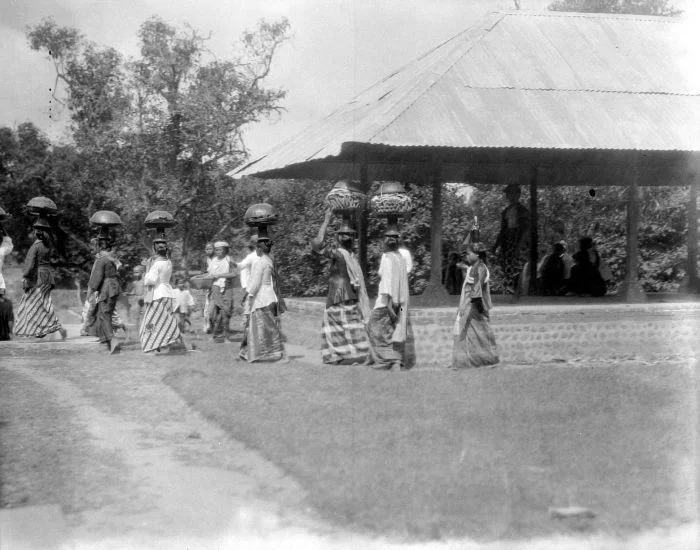

Pura Lingsar
Once a year, at the temple complex of Pura Lingsar, Hindus and Muslims line up facing each other and throw rice cakes as hard as they can. The ketupat - woven palm-leaf packets of compressed rice - fly back and forth in a cheerful barrage, splattering and bouncing off shoulders while both sides laugh. When it is over, the combatants from both faiths walk through the scattered wreckage together, collecting the battered rice cakes and carrying them to their fields to be buried in the soil. The ritual is called Perang Topat, the Ketupat War, and it has been practiced here for centuries as a prayer for rain and fertile harvests. It is not a reenactment of conflict. It is a celebration of what happens when two religions decide that sharing ground matters more than claiming it.
A Clear Revelation
Pura Lingsar was built in 1714 by Anak Agung Ngurah of the Karangasem dynasty, the Balinese Hindu rulers who controlled Lombok for centuries. The name Lingsar derives from the Sasak language and means 'clear revelation from God' - an apt name for a place built around a natural spring whose water has been considered sacred since long before the temple existed. The complex sits 15 kilometers from Mataram, Lombok's capital, surrounded by rice paddies and the lush vegetation that the spring sustains. Its original grounds covered 40,000 square meters, though encroachment has reduced the complex to roughly half that size. Three large ponds still anchor the site, fed by the spring that drew worshippers here three centuries ago. The water flows cool and constant, a gift of Lombok's volcanic geology, filtered through the porous rock of Mount Rinjani's slopes before emerging here as something the Sasak people recognized as holy.
Two Temples, One Ground
What makes Pura Lingsar extraordinary is not its age or its architecture but its structure of coexistence. The complex contains two distinct religious buildings side by side. The upper temple, Pura Gaduh, serves Balinese Hindu worshippers with the familiar split gates, shrines, and offerings of Balinese temple architecture. Below it stands the Kemaliq, a prayer site for followers of Wetu Telu - the indigenous Sasak faith that blends Islam with older animistic and Hindu traditions. Wetu Telu practitioners pray not toward Mecca but toward the sacred spring, recognizing in its water something older than any imported theology. The two buildings share the same compound, the same spring water, the same festival calendar. Worshippers from both traditions visit on the same days, perform separate rituals, and then come together for the Topat War. It is syncretic in the truest sense: not a merging of faiths into one, but an arrangement where different faiths occupy the same sacred space without demanding that the other change.
The Rice Cake Battle
The Topat War takes place after the festival at Pura Lingsar, which is held on the sixth full moon of the Balinese Saka calendar and the seventh full moon of the Sasak calendar - a scheduling arrangement that itself reflects the negotiation between two systems of sacred time. After prayers are completed separately in the Pura Gaduh and the Kemaliq, both communities gather in the open ground between them. They form two lines, facing each other. And then the ketupat begins to fly. The battle is brief, exuberant, and entirely without malice. Children throw alongside grandparents. The rice cakes are soft enough to be harmless, firm enough to be satisfying projectiles. When the last ketupat has been thrown, the two sides mingle to gather the scattered remains. These are not discarded as waste but carried reverently to rice fields and buried in the earth, an offering meant to ensure the rains come and the harvest flourishes. The logic is intuitive: food returned to the soil feeds the next season. What is shared cannot be hoarded.
Sacred Water, Living Faith
Beyond the festivals and the famous rice cake war, Pura Lingsar functions as a living religious site visited throughout the year. The spring-fed ponds serve as public baths, a practical function that does not diminish their sacred status. Eels inhabit the pools around the Kemaliq, and local tradition holds them sacred - feeding them hard-boiled eggs is considered an act of devotion. The Wetu Telu faith that finds its most visible expression here is itself a remarkable survival. While orthodox Islam has made deep inroads across Lombok, particularly since Indonesian independence, Wetu Telu persists in pockets, maintaining practices that predate the arrival of either Islam or Hinduism on the island. Its adherents pray three times daily rather than the orthodox five, observe modified fasting during Ramadan, and maintain ancestor veneration rituals that would be familiar to Lombok's earliest inhabitants. Pura Lingsar is their anchor, the place where the spring still flows and the old ways still hold, not as museum relics but as lived practice.
From the Air
Located at 8.58°S, 116.18°E, approximately 15km east of central Mataram on Lombok. The temple complex sits amid rice paddies and tropical vegetation in the Lingsar district of West Lombok Regency. Lombok International Airport (WADL) is roughly 35km to the south-southwest near Praya. From approach altitude, the complex is identifiable by its large ponds and the surrounding irrigated rice fields that the temple's spring water feeds. Mount Rinjani (3,726m) rises dramatically to the northeast. The site is inland, roughly 10km from the west coast. Weather is tropical with reliable dry season April-October; the annual Topat War festival typically falls between October and December depending on the lunar calendar.
Nearby Stories
- Ujung Water Palace: The Garden at the Edge 7.8 km away
- Mandalika: The Racetrack That Summoned a Shaman 17 km away
- The Village That Lets Its Dead Return to the Earth 26 km away
- Museum Pasifika 48 km away
- Forty-Five Men and Thirty-Six Depth Charges 85 km away
- The Island Diana Chose 93 km away
- Satonda: The Island That Remembers Earth's First Ocean 122 km away
- The Island That Shook the World 136 km away