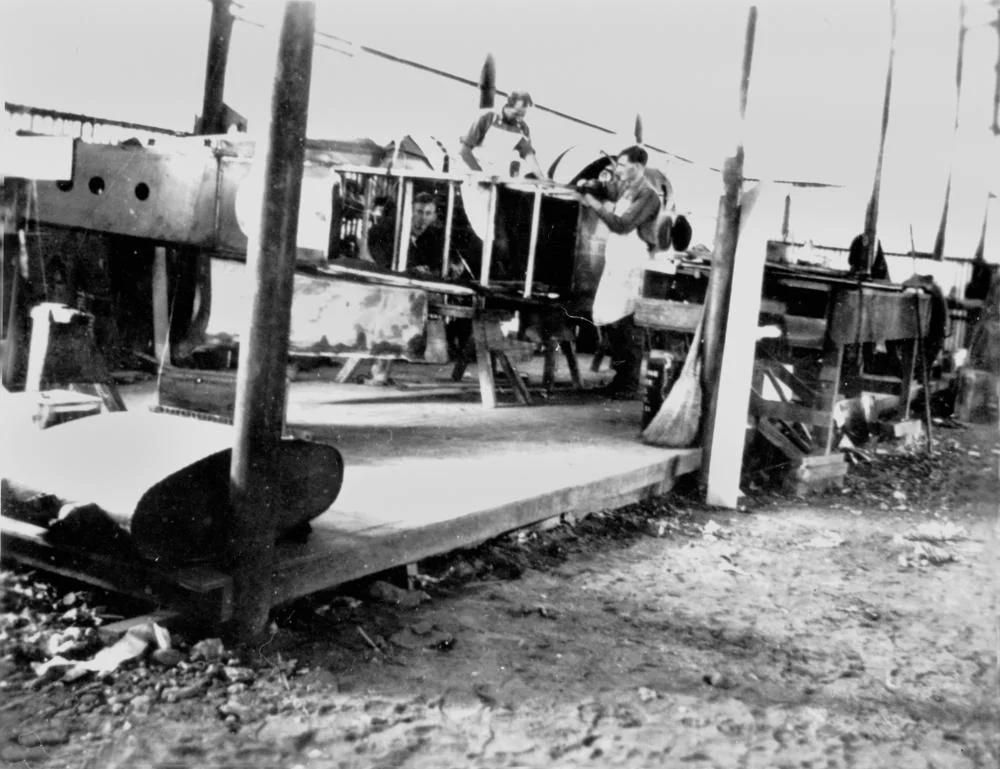

Qantas Hangar, Longreach
Before Qantas crossed oceans, it built airplanes by hand in a corrugated-iron shed on the edge of a Queensland sheep town. The hangar still stands at Longreach, completed in August 1922 and now recognized as the oldest civil aviation building in the country. Walk inside and the scale surprises you: a single open bay, raw timber trusses overhead, the same floor where mechanics once wheeled biplanes out into the western sun. This is where one of the world's great airlines learned to fly.
A Company Born on the Flat Country
Longreach was a railway terminus, gazetted in 1887 where the line from Rockhampton finally ran out of track on the open black-soil plains. Flat, remote, and central to the vast grazing runs of western Queensland, it suited an aviation experiment that needed long horizons and not much else. The Queensland and Northern Territory Aerial Services, soon shortened to Qantas, was registered in November 1920 after grazier Fergus McMaster agreed to back the venture. The company moved its base to Longreach because it sat conveniently between the towns it hoped to link. Business was slow at first. Most of the early money came from joy flights, which in those years were expensive and genuinely dangerous, before a government mail contract from Charleville to Cloncurry, won in February 1922, gave the fledgling airline its purpose.
Built by Hand in the Outback
The hangar's most remarkable chapter began in 1926, when Qantas started building aircraft inside it under licence from Britain's de Havilland. Between 1926 and 1929, the airline constructed seven de Havilland DH.50 airliners and a single DH.9 here, fitting wood, fabric, and engines together a thousand miles from any city. The DH.50 was the first proper airliner Qantas flew, the first with a fully enclosed passenger cabin rather than an open canopy. One of those Longreach-built machines made history in May 1928 when it became the first aircraft of the Royal Flying Doctor Service, carrying medicine and rescue to people scattered across country too big to cross any other way.
Arthur Baird and the Men Who Made It Work
Engineering, not glamour, kept Qantas alive in those years, and that engineering had a name: Arthur Baird. He had rejoined founders Hudson Fysh and Paul McGinness as the company's mechanic and quickly became its backbone, the man who could keep temperamental engines running and improvise repairs where no spare part existed within a week's travel. The hangar was Baird's workshop and proving ground. Out on the apron, pilots learned to read the heat haze and the dust; inside, the craftsmen turned imported drawings into flying aircraft. It was unglamorous, painstaking work, and it built the trust that a passenger airline ultimately depends on.
The War Years
Aviation kept finding Longreach useful long after Qantas had grown up and moved on. During the Second World War, the town's airfield briefly became a base for United States Army Air Forces B-17 bombers in 1942, the heavy four-engined Flying Fortresses staging through the same flat country where Qantas had once test-flown its hand-built biplanes. It was a strange echo: the remote interior, chosen decades earlier for its long horizons and isolation, now valued for exactly those qualities in a wider and more dangerous theatre. For a moment, the quiet grazing town on the Tropic of Capricorn sat on a thread of the global war.
What the Hangar Became
In June 1930, Qantas ended its time at Longreach and moved its headquarters to Brisbane, then onward toward the international routes that would define it. The hangar might have been forgotten, left to rust on the plains. Instead it endured. Added to the Queensland Heritage Register on 21 October 1992 and the National Heritage List in 2009, it now anchors the Qantas Founders Outback Museum, where restored aircraft sit beside the building that helped launch them. Standing in that open bay, you feel the unlikely distance between this dusty shed and the jets that carry the airline's name across the world today.
From the Air
The Qantas Hangar sits at 23.44°S, 144.27°E, on the Landsborough Highway at the eastern edge of Longreach on Queensland's open western plains, almost exactly on the Tropic of Capricorn and roughly 690 km west of Rockhampton. Longreach Airport (ICAO: YLRE, IATA: LRE) lies about 1.5 nautical miles northeast, with two runways and scheduled service to Brisbane and Townsville; the museum and its preserved aircraft are visible just south of the field. Barcaldine Airport (ICAO: YBAR) lies roughly 100 km east along the highway and rail line. The terrain is famously flat, so a low approach from the south offers a clear line over the museum, the historic hangar, and the silver gleam of corrugated iron against red and black soil. Visibility in the dry season is excellent; watch for afternoon heat haze and summer thunderstorms.
Nearby Stories
- Bexley Station 1.2 km away
- Central Queensland 4.7 km away
- Wellshot Station 22 km away
- Alice River (Barcoo River tributary) 33 km away
- Aramac Tramway Museum 48 km away
- Lochern National Park 73 km away
- Bladensburg National Park 97 km away
- Warbreccan 134 km away