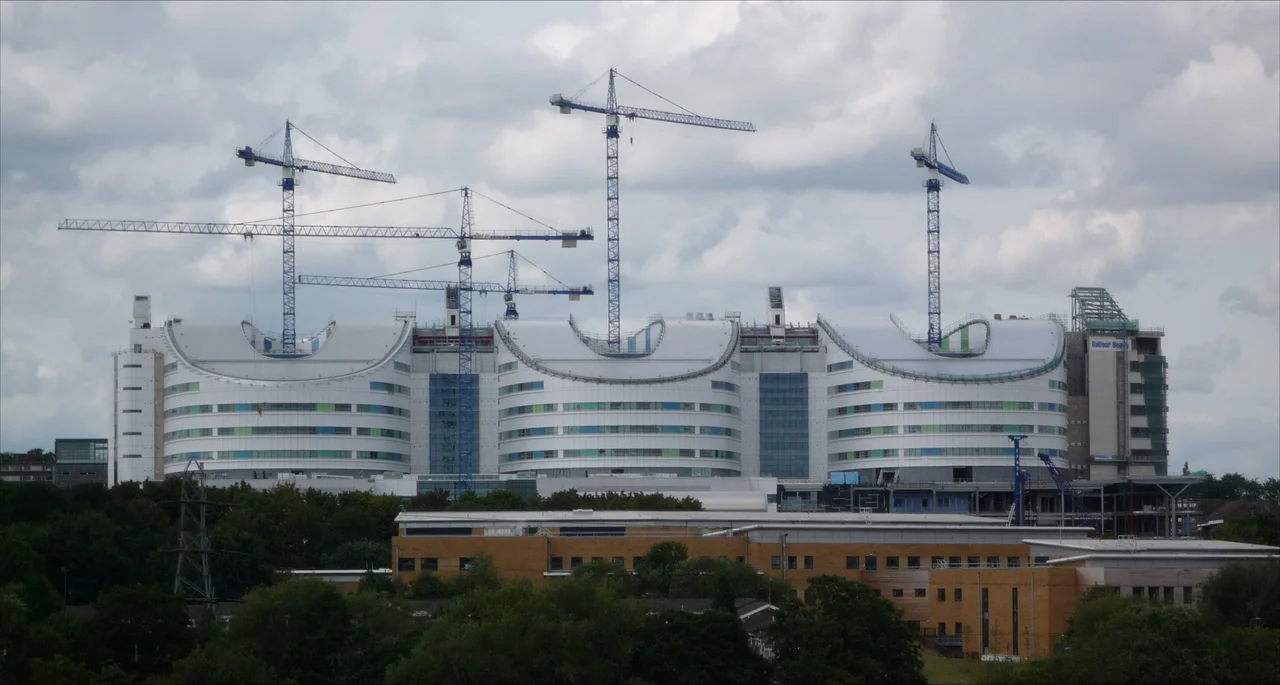

Queen Elizabeth Hospital Birmingham
Most large hospitals are anonymous. Three cylindrical glass and steel towers rising sixty-three metres above Edgbaston are not. The Queen Elizabeth Hospital Birmingham opened on 16 June 2010 as the first acute hospital built in the city since 1937. Inside its 1,215 beds, surgeons perform more solid organ transplants in a year than any other hospital in Europe. The country's largest single-floor critical care unit, 100 beds spread across one continuous level, runs around the clock. Every British soldier, sailor, and airman wounded in combat zones is flown here for treatment. The hospital exists, in a sense, because Britain still puts its young people in harm's way and has decided to bring them all to one place to mend.
The Surgeon Who Started It All
In 1840, a young Birmingham surgeon named William Sands Cox founded Queens Hospital, a teaching institution chiefly aimed at training local medical students. Birmingham at that point had no medical school. Cox built one. Over the next forty years, the city accumulated a constellation of small charitable hospitals, from the Orthopaedic Hospital in 1817 to the Birmingham and Midland Skin and Lock Hospital in 1881. In 1884, these institutions, including Cox's school, merged into Mason College, which later became the University of Birmingham. The Queen Elizabeth Hospital traces its lineage through that consolidation, named in the twentieth century after Queen Elizabeth the Queen Mother, the consort of George VI. By the time the present building opened, the queen who gave it her name had been dead for eight years.
Three Glass Cylinders
BDP Architects designed the new hospital as three identical sixty-three-metre towers, each nine storeys tall, linked by an entrance atrium and bridges. Balfour Beatty built it under a Private Finance Initiative contract signed in early 2006. The cost was £545 million. A sky bridge connects one of the towers to retained parts of the original Queen Elizabeth Hospital, giving access to oncology, pharmacy, and the Wellcome Research Centre. Six MRI scanners, five CT scanners, four gamma cameras, eight ultrasound rooms. The patient capacity matched the combined output of the old Queen Elizabeth Hospital and the Selly Oak Hospital, both of which closed and merged into this single site between June 2010 and November 2011. The Ministry of Justice ruled that no word could precede a Royal Title, which is why the building is called Queen Elizabeth Hospital Birmingham rather than the originally intended Birmingham Queen Elizabeth Hospital. Bureaucracy has its protocols, and even hospitals must obey.
The Royal Centre for Defence Medicine
The hospital is home to the Royal Centre for Defence Medicine, opened by the Princess Royal in 2001 and granted its Royal prefix the following year. Every British service member injured in Iraq, Afghanistan, or any subsequent operational theatre passes through its doors. Military doctors, nurses, and therapists work side by side with NHS staff, treating both military and civilian patients. Some of the wounded who came home from Helmand spent months relearning how to walk in the hospital's rehabilitation suites. A nineteen-year-old fundraiser named Stephen Sutton, who raised millions for the Teenage Cancer Trust through a list of things he wanted to do before dying, died of colon cancer at the hospital on 19 May 2014. His final months drew a national following. The wards have absorbed an enormous quantity of human pain. They keep absorbing more.
Things That Went Wrong
No large hospital escapes scandal. In 2013, a nurse was struck off the register after a Nursing and Midwifery Council panel proved more than seventy charges of incompetency. The same year, a consultant surgeon used an argon beam machine to burn his initials onto the livers of anaesthetised patients during transplants. He was convicted of assault, fined, and removed from the medical register. In 2016, an audit found the death rate among patients receiving cardiac surgery at the hospital was above the national average, and reports of a bullying culture had prevented staff from raising concerns. The Care Quality Commission rated the hospital as requires improvement in October 2021. The same institution that performs Europe's largest transplant programme has also been the site of decisions that no patient should have had to absorb. Both things can be true. The hospital, the regulator, and the patients live with the contradictions.
The Geography of Healing
The hospital sits at the southern edge of the University of Birmingham campus, adjacent to the Medical School and Birmingham Women's Hospital. University railway station on the Cross City Line is a five-minute walk from the entrance, and trains run to New Street every few minutes. The new £350 million Selly Oak retail centre and the Selly Oak bypass were built alongside the hospital as part of a £1 billion urban regeneration plan for Bournbrook and Selly Oak that transformed the south-west quarter of the city. On a clear evening, the three towers glow from inside, visible from the M5 and M42 motorways, a beacon to anyone arriving in Birmingham by road. The Queen Mother never saw it. The injured soldiers, the cancer patients, the transplant recipients, and the medical students who train here will.
From the Air
Coordinates 52.451689 N, 1.943072 W. Located in Edgbaston, immediately south-east of the University of Birmingham campus. Recommended viewing altitude 1,500 to 3,000 feet AGL. Look for three identical cylindrical glass towers, each 63 metres tall, the only buildings of that form in central Birmingham. The University clock tower (Old Joe) is a useful nearby landmark to the north. Nearest airports: Birmingham International (EGBB) 8 nm east-southeast; Wolverhampton Halfpenny Green (EGBO) 11 nm west-northwest; Coventry (EGBE) 16 nm east. Avoid low approaches to the south due to helipad operations; the hospital receives helicopter medical evacuations.
Nearby Stories
- Shepshed 8.5 km away
- Battle of Evesham 11 km away
- Hixon rail crash 12 km away
- Battle of Cropredy Bridge 12 km away
- Wenlock Priory 15 km away
- RAF Shawbury 16 km away
- Market Bosworth 17 km away