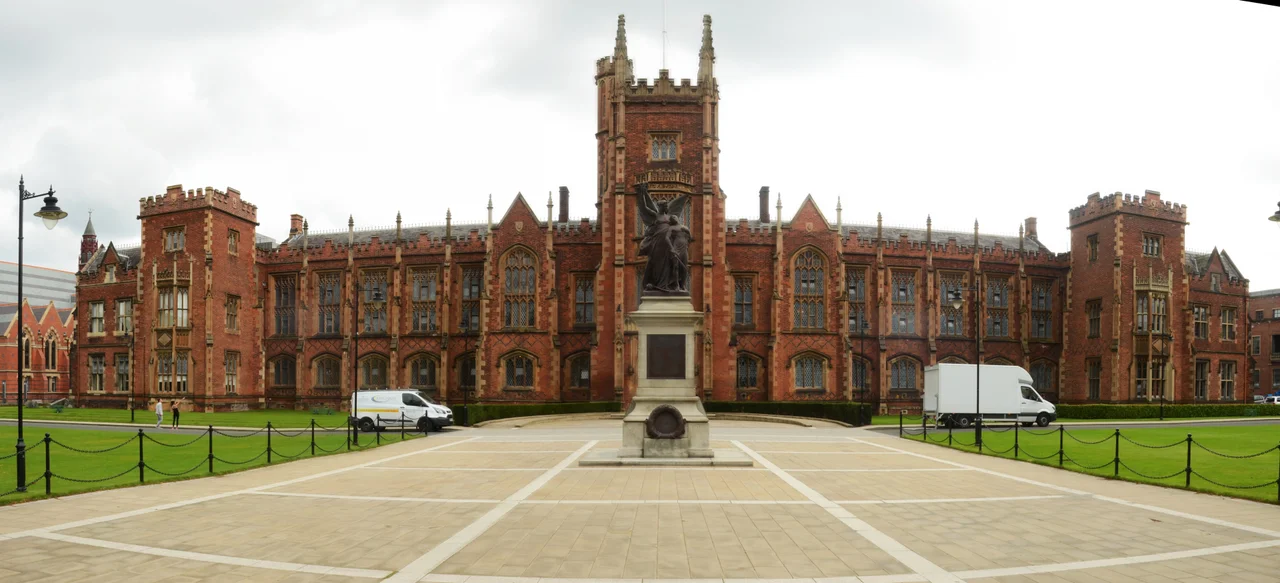

Queen's University Belfast
The most photographed building in Belfast is not a cathedral or a bank or a town hall. It is the Lanyon Building, the original 1849 quad of Queen's University Belfast, designed by Sir Charles Lanyon in red brick and pale Caen stone with Tudor Gothic crenellations modelled on Magdalen College, Oxford. The architecture is borrowed. The institution it houses is not. Queen's was conceived in 1845 as one of three colleges of the Queen's University of Ireland, an explicit attempt by Sir Robert Peel's government to create non-denominational higher education in Ireland - Catholic and Protestant students in the same lecture theatres - at a moment when most British universities still required Anglican religious oaths. The college opened in 1849 with 195 students. It is now a Russell Group university with nearly 25,000 students, two Nobel laureates among its alumni, and a chair where Liam Neeson sat his entrance exams in 1971.
Peel's Compromise
By the 1840s the Irish question was already pressing on every British government, and Sir Robert Peel believed that one part of the answer was education. Trinity College Dublin existed but in practice excluded Catholics. Maynooth trained priests but did not educate the laity. In 1845 Peel pushed through the Colleges (Ireland) Act, establishing three new 'Queen's Colleges' at Belfast, Cork and Galway, all explicitly non-denominational, all teaching the same curriculum, all federated under a new Queen's University of Ireland with its degree-granting headquarters in Dublin. Catholic bishops condemned the scheme as 'godless colleges' and discouraged Catholic enrolment. Belfast's Presbyterian community embraced it. The Belfast college's first cohort in 1849 included 134 Presbyterians, 36 Anglicans, 17 Catholics, and 8 others. The architecture by Lanyon - a graceful Tudor Gothic quadrangle facing what would become the Botanic Gardens - made an immediate visual statement: this was a serious institution, made to last.
From College to University
The federated Queen's University of Ireland struggled. It was dissolved twice and reorganised in 1880 as the Royal University of Ireland, a purely examining body. Then in 1908, after years of negotiations with the Catholic hierarchy, the Irish Universities Act split it again, creating the National University of Ireland (which absorbed Cork and Galway and added Dublin's University College) and elevating Belfast's college to independent university status as Queen's University Belfast. The 1908 reorganisation also formalised the religious arrangement: Queen's would remain non-denominational, but with Theology faculties supported separately by Presbyterian, Anglican and Methodist colleges nearby. The university grew steadily through the 20th century. Catholic enrolment, which had been just 22% in 1958, climbed to 27% by the late 1960s, 43% by 1979, and over 54% by the late 1990s - a steady ascent reflecting both increased Catholic participation and the tendency of middle-class Protestants to leave Northern Ireland for British universities.
The Nobel Laureates and the Famous Faces
Seamus Heaney studied English at Queen's from 1957 to 1961 and later taught here as a lecturer; he won the 1995 Nobel Prize in Literature. David Trimble, the Ulster Unionist Party leader and Northern Ireland's first First Minister, lectured in the Law School from 1968 to 1990; he won the 1998 Nobel Peace Prize, jointly with John Hume, for the Good Friday Agreement. Other alumni read like a phone book of Irish public life: Mary McAleese, eighth President of Ireland; the poet Paul Muldoon; the actors Liam Neeson and Stephen Rea; the broadcaster Annie Mac; the physicist John Stewart Bell, whose theorem reshaped quantum mechanics; Frank Pantridge, the cardiologist who invented the portable defibrillator that has since saved millions of lives; Sir Bernard Lovell of Jodrell Bank; Brian Faulkner, the last Prime Minister of Northern Ireland under the old Stormont parliament. The poet Philip Larkin worked as sub-librarian at Queen's in the early 1950s and wrote 'The Less Deceived' largely while based here.
Through the Troubles
Queen's sat in the middle of Belfast through thirty years of the Troubles. The campus was not a frontline but it could not avoid being affected: bomb scares regularly emptied the lecture halls, students from across the divide met each other for the first time in seminar rooms, the Students' Union became one of the few genuinely mixed social spaces in Belfast. Catholic and Protestant academics taught the same courses. Researchers in the conflict came from elsewhere - Paul Bew, John Whyte, Rupert Taylor - and many stayed. The university did not always handle the political pressures well. Internal debates over Irish-language signage, the wearing of paramilitary symbols, and how to discuss the conflict in classrooms recurred for decades. But the institution survived intact, kept its doors open during the worst years, and emerged in the late 1990s as one of the most ethnically and confessionally diverse universities in the UK.
The Campus Today
The university now spreads across most of south Belfast's Queen's Quarter, anchored by Lanyon's original quad but extending outward through the McClay Library, the new One Elmwood student centre opened in 2022, the Naughton Gallery, the Queen's Film Theatre (Northern Ireland's leading independent cinema), the Brian Friel Theatre, and the towering Riddel Hall. The undergraduate body is now around 18,000 with another 7,000 postgraduates; about two-thirds of the undergraduates are from Northern Ireland and the rest split between the Republic, the rest of the UK, and an international cohort drawn especially from China through Queen's Joint College with China Medical University in Shenyang. Queen's is one of two universities in Northern Ireland alongside Ulster University, sits in the Russell Group, and houses on University Road a small marble statue of Galileo by the 19th-century Italian sculptor Pio Fedi - portrayed not in triumph but deep in thought, gazing at a problem he cannot quite solve. It is a fitting mascot.
From the Air
Queen's University Belfast is located at 54.584°N, 5.934°W in south Belfast, one mile south of the City Hall, immediately south of the Belfast Botanic Gardens. From the air, look for the distinctive red-brick Tudor Gothic Lanyon Building - a long three-storey range with a central tower fronted by a small landscaped lawn at the corner of University Road and University Square. The Botanic Gardens with their Palm House glass conservatory lie immediately to the south, and the white limestone Ulster Museum sits within the gardens. Belfast City Airport (EGAC) is 2.5 nautical miles east-north-east; Belfast International (EGAA) is 13 nautical miles west-north-west. Recommended viewing altitude: 1,500-3,000 feet for the red-brick Lanyon quadrangle and the green block of the Botanic Gardens that frames the university's southern side.
Nearby Stories
- Larne 1.2 km away
- Ahoghill 3.5 km away
- Castleskreen 4.9 km away
- Lough Neagh 6.1 km away
- Kingsmill Massacre 14 km away
- Pasages (steam trawler) 23 km away
- Ballantrae Lifeboat Station 34 km away
- St Patrick's Isle 39 km away