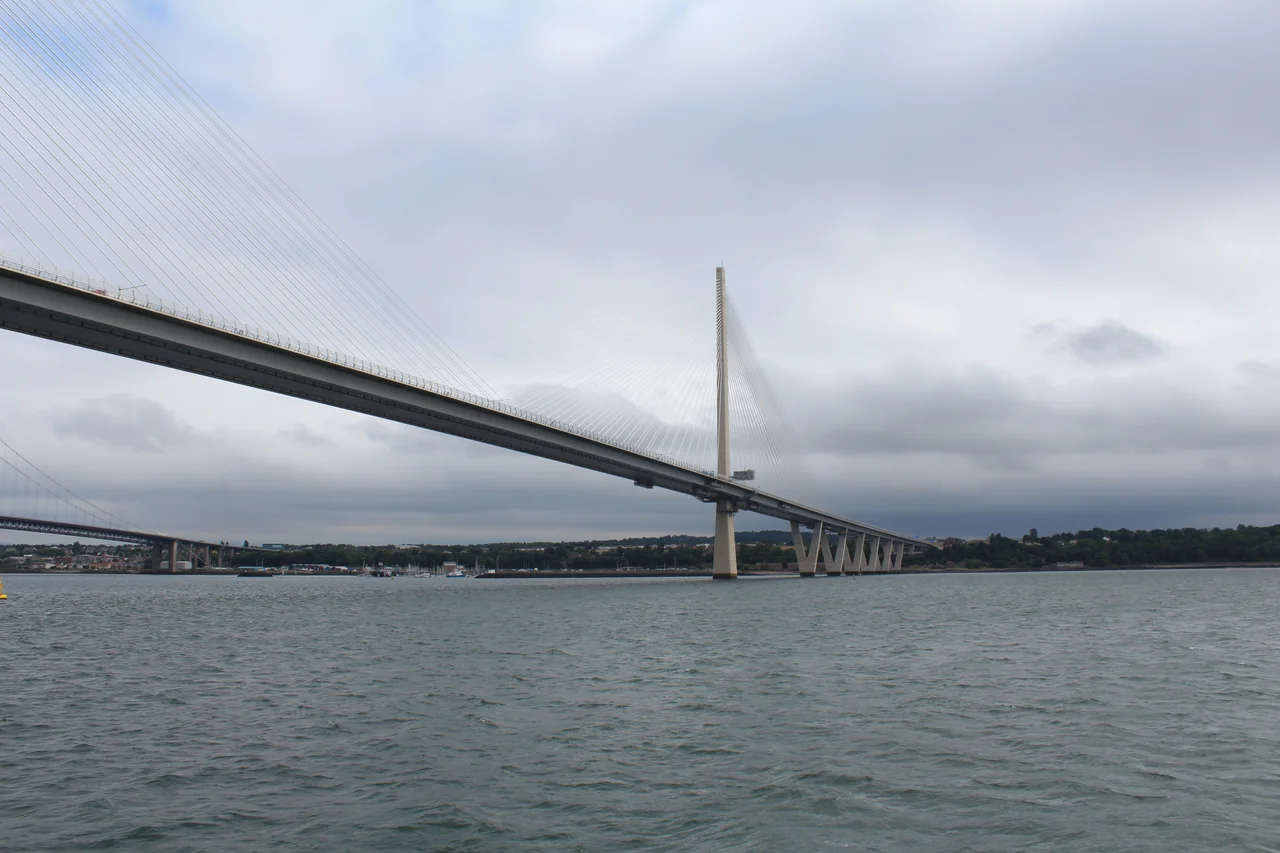

Queensferry Crossing
Three bridges stand side by side across the Firth of Forth, and from the air they read like a timeline of engineering. To the east, the wrought-iron lattice of the 1890 Forth Bridge crouches red and muscular over the water. In the middle, the 1964 Forth Road Bridge hangs from twin suspension cables. And to the west, three pale concrete towers rise from the firth like sails, holding up a deck on a fan of stay cables. That is the Queensferry Crossing, opened in 2017, and it exists because the bridge next to it was quietly running out of strength.
The Bridge That Was Wearing Out
By the early 2000s, the Forth Road Bridge was carrying more than twice the traffic it had been designed for. Inspectors threaded cameras into the main suspension cables and found something alarming: roughly eight to ten percent of the cable strength had already been lost to corrosion, and the rate was likely to accelerate. Worst-case projections suggested that by 2019, the bridge might need crippling weight restrictions or even closure. Scotland could not afford to lose its main road link between Edinburgh and Fife. A replacement was needed, and quickly. After studies weighing tunnels against bridges, planners settled on a cable-stayed crossing west of the existing bridge. The Forth Crossing Act received royal assent in January 2011, and by autumn the first ground was broken.
A Pier on a Rock in the Sea
The central tower of the Queensferry Crossing stands on Beamer Rock, a tiny islet that had carried a lighthouse for more than a century. Engineers removed the light and built directly on the bedrock the firth had been polishing for millennia. The two outer towers anchor on land. From these three concrete pylons, each rising 207 metres, a fan of stay cables holds up a deck assembled from 149 steel segments, each twelve metres long and forty wide, fabricated in China and Spain and shipped to the Forth by sea. When the towers reached 160 metres in August 2015, they became the tallest bridge in the United Kingdom. The completed structure stretches 2.7 kilometres from shore to shore.
Wind, Weather, and a Royal Opening
Scottish weather had opinions about the schedule. April and May of 2016 alone cost the project twenty-five working days to high winds, and another storm in March 2017 pushed the opening past its targeted May date. The bridge finally opened to traffic on 30 August 2017, and on 4 September Queen Elizabeth II cut the formal ribbon - exactly fifty-three years to the day after she had opened the Forth Road Bridge next door. Wind shielding built into the new bridge has largely eliminated the high-wind closures that plagued its predecessor. The first closure of any kind came in February 2020, when ice falling from the towers made the deck unsafe. The Forth Road Bridge, freed from heavy traffic, now carries buses, cyclists and pedestrians.
Eight Thousand Years on the South Bank
When archaeologists surveyed the approach roads on the south side, they found something they had not expected. In a field at Echline, beneath the future motorway, lay the floor of an oval pit-house roughly seven metres long, with the remains of a hearth, stone tools and animal bones still inside. Radiocarbon dating placed it at around 8300 BCE - the earliest known dwelling in Scotland, a thousand years older than anything previously documented. While construction crews shaped concrete and stayed cables overhead, archaeologists carefully recorded the Mesolithic camp beneath. A bridging place at Queensferry is not new. Queen Margaret of Scotland founded a free ferry here in the eleventh century to carry pilgrims north to St Andrews. The earliest people had simply found the same crossing nine thousand years before her.
Choosing a Name
The bridge nearly carried a different name. Five candidates went to public vote in 2013: Caledonia Bridge, Firth of Forth Crossing, Queensferry Crossing, Saltire Crossing and St Margaret's Crossing. Queensferry Crossing won with 12,039 of 37,000 votes - about thirty-two percent. Locals, with characteristic Scottish irreverence, sometimes call it Kevin instead. The name was a private joke that escaped onto the internet and stuck. The official name connects the bridge to the ferry St Margaret began nearly a thousand years ago, to the towns of South and North Queensferry on either bank, and to the queen whose name the burgh has carried since the Middle Ages. Three bridges, one crossing, a thousand years of getting people across the Forth.
From the Air
Located at 56.0047 N, 3.4125 W on the Firth of Forth, about 14 km west-northwest of Edinburgh city centre. The three-tower silhouette is unmistakable from altitude, especially when set against the red iron lattice of the 1890 Forth Bridge to its east. Nearest airports are Edinburgh (EGPH), about 10 km south, and Glasgow (EGPF) about 70 km west. Best viewed from 2,000-5,000 feet on clear days, when all three Forth crossings line up like a museum of bridge engineering.
Nearby Stories
- Ardoch Roman Fort 2.2 km away
- Craignethan Castle 3.1 km away
- Haddington 3.8 km away
- Balvaird Castle 4.3 km away
- Battle of Kilsyth 9.4 km away
- Siege of St Andrews Castle 9.9 km away
- Neidpath Castle 11 km away
- Melrose Abbey 15 km away