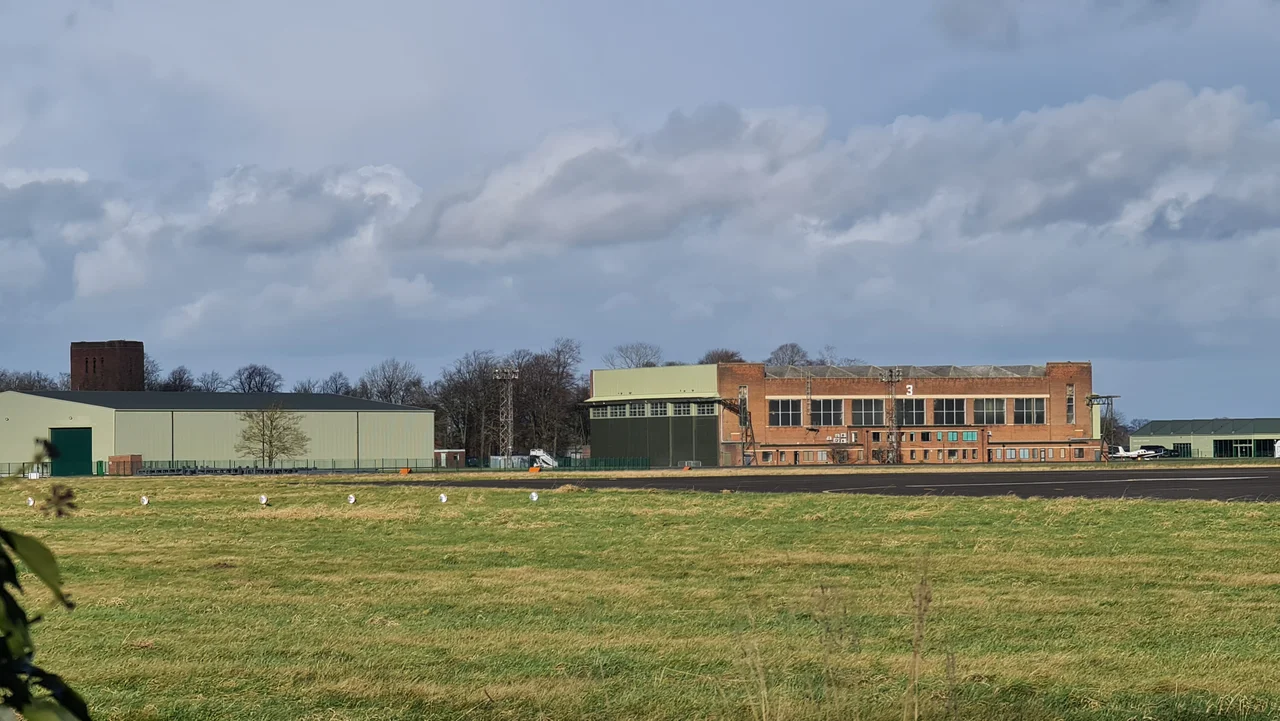

RAF Church Fenton
In June 1935 the farmers of Church Fenton protested. The Air Ministry wanted 260 acres of West Riding farmland for an airfield, and the farmers - reasonably enough - wanted to keep growing food. They lost. By 1940, the field they had failed to save was hosting the first American volunteers to fly for the RAF, the first all-Canadian squadron, and the first all-Polish squadron - three nationalities of young men who had come to Yorkshire because Britain was the place fighting the war they wanted to fight.
From Wheatfield to Fighter Base
Construction began in early 1936 on a mixed parcel of private and West Riding County Council land. On 1 April 1937 the station was declared open, and on 19 April Wing Commander W.E. Swann assumed command. Within two months, No. 71 Squadron RAF arrived with Gloster Gladiators - biplane fighters that already felt slightly dated, even before the Battle of Britain made them obsolete. Church Fenton sat in the strategic centre of industrial Yorkshire: Leeds, Bradford, Sheffield and the Humber estuary refineries all within easy fighter range. When the war came, the field's job was to keep German bombers off Britain's northern factories. It did, for the most part.
The Eagle, the Maple Leaf, and the Polish White Eagle
In September 1940 the airfield became home to No. 71 Squadron RAF in a new form: the first of the Eagle Squadrons, made up of American volunteers who had crossed the Atlantic to fight before their own country was in the war. They flew Brewster Buffalos for a month - a stubby American fighter that pilots disliked - then switched to Hawker Hurricanes. Meanwhile No. 242 Squadron, re-formed at Church Fenton in October 1939 with Canadian personnel, became the first all-Canadian RAF unit. And No. 306 Polish Fighter Squadron, formed at Church Fenton in 1940, became the first all-Polish one. The Polish pilots in particular brought a furious, focused experience the British had not seen - many had flown against the Luftwaffe in Poland in 1939 and had a personal account to settle. From the same Yorkshire field, three flags flew. Then 54 Operational Training Unit was formed here in 1940, the RAF's first night fighter OTU, and the de Havilland Mosquito began appearing on the apron.
Jets, Tornados, and Tucanos
After the war, Church Fenton stayed a fighter base. It was among the first stations to take the Gloster Meteor, Britain's first operational jet, and later the Hawker Hunter. In the 1960s it shifted into a training role and stayed there. The Royal Navy Elementary Flying Training School used Scottish Aviation Bulldogs here, returning between 1979 and 1992 when the Panavia Tornado entered RAF service. Church Fenton was the first station to receive the new Short Tucano T.1 turboprop trainer in the late 1980s. From 1998 to 2003 it was the RAF's main Elementary Flying Training airfield. The annual Battle of Britain air display drew 63,000 people in 1968 - a remarkable number for a working military base in rural Yorkshire.
Closure, Slow and Final
RAF Church Fenton's gates closed at noon on 31 December 1992 as a fully independent station. The officers' mess was demolished to save on maintenance. The married quarters were sold. But the runways stayed alive as a satellite of RAF Linton-on-Ouse, used as an Enhanced Relief Landing Ground for student pilots. Yorkshire Universities Air Squadron flew Grob Tutor light aircraft from here until 19 December 2013, when the airfield was finally closed. A NOTAM suspended the air traffic zone. The strange long ending - 21 years of partial life - meant Church Fenton was never quite finished while it was here, and never quite alive either.
Leeds East Airport
On 23 December 2014 the site was sold to Makins Yorkshire Strawberries. The new owners renamed it Leeds East Airport in February 2015, marketing it to business jet traffic and flying schools. The second series of ITV's drama Victoria was filmed in a hangar here in 2017 - the same buildings that had housed Spitfires now standing in for Buckingham Palace. The 2434 (Church Fenton) Squadron of the Air Training Corps remains on site, the last RAF-blue presence on what was a fighter base for 55 years. Three generations of children in Tadcaster and Selby grew up watching aircraft from Church Fenton overhead. Their grandchildren now watch Cessnas instead.
From the Air
RAF Church Fenton, now Leeds East Airport (EGCF), sits at 53.83°N, 1.20°W, in flat farmland 4.3 nm southeast of Tadcaster and 6.3 nm northwest of Selby. From the air, look for the two intersecting runways laid out across the rectangle of the original 1936 site - the layout has barely changed in 90 years. Leeds Bradford (EGNM) is about 14 nm northwest; the much larger ex-RAF Linton-on-Ouse is about 11 nm north. The site sits between the A1(M) and A19 corridors, with York rising on the horizon to the north.
Nearby Stories
- Scampston Hall 3.5 km away
- Salts Mill 4.7 km away
- Newburgh Priory 6 km away
- Brodsworth Hall 6.2 km away
- Coverham Abbey 16 km away
- RAF Leconfield 17 km away
- Macclesfield Canal 27 km away
- RAF Scampton 35 km away