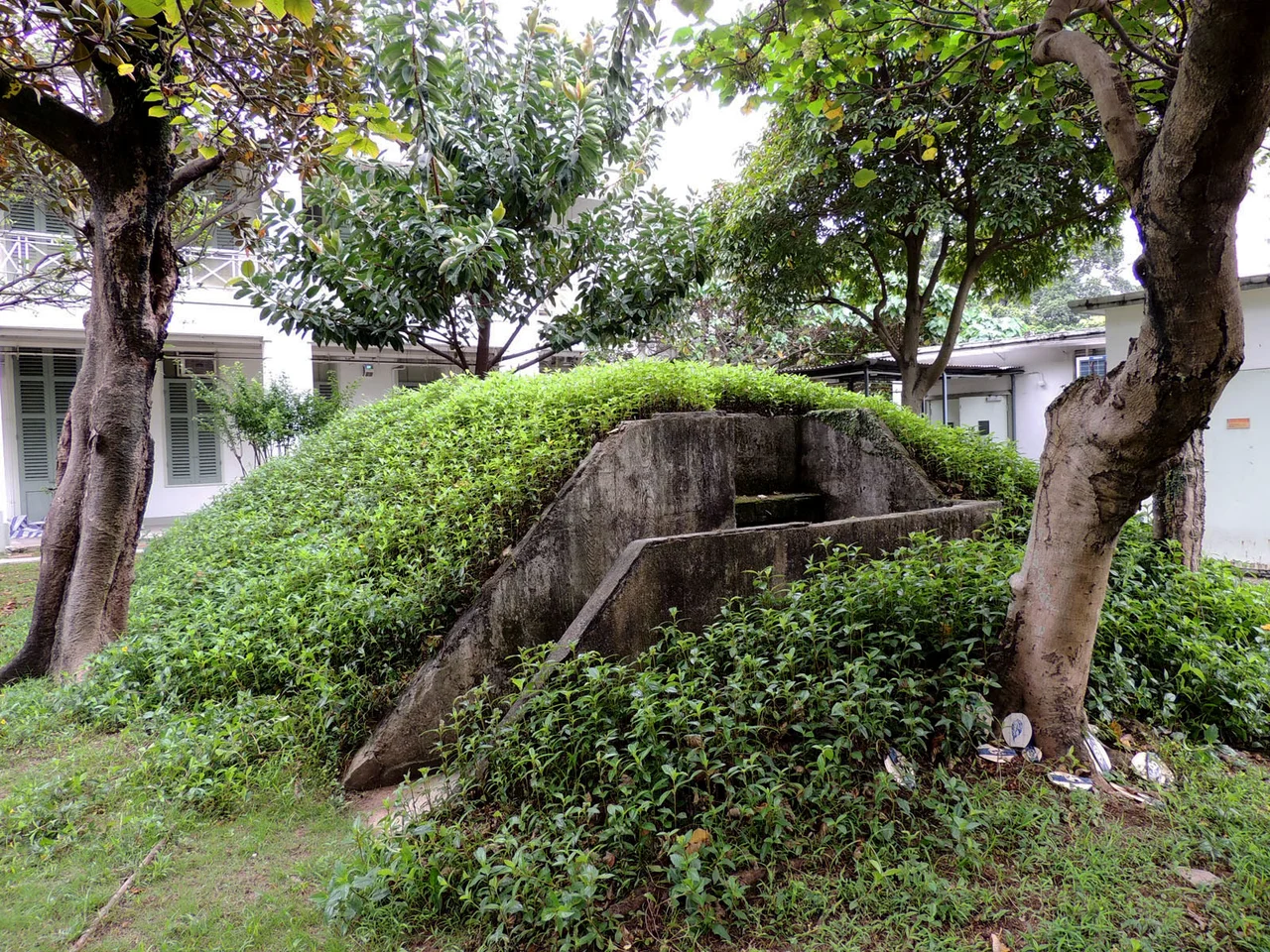
,_Officers%27_Quarters_2012_air_raid_shelter.JPG)
RAF Kai Tak
Long before Kai Tak Airport became famous for the approach that pilots described as the most terrifying in commercial aviation — dropping steeply between apartment blocks to land on a runway extending into Kowloon Bay — the site had already served as a military aerodrome for two decades. The Royal Air Force established its station here in 1927, initially for seaplanes operating over Hong Kong's harbour and surrounding waters. The land-based aircraft came later. The name RAF Kai Tak was always slightly misleading; what the RAF built there was less a conventional airfield than a layered military presence on a patch of ground that Hong Kong kept finding new uses for.
Seaplanes and the Garrison Mentality
The RAF arrived at Kai Tak in 1927 at a moment when seaplanes were still a credible instrument of imperial policing — capable of ranging across wide stretches of water, landing in bays and inlets, projecting British authority over territory that roads and rails had not yet reached. Hong Kong's harbour made it a natural base for such operations. The station operated a mix of land-based aircraft and spare aircraft for naval units, a dual role that reflected the RAF's position in Hong Kong: present, useful, but always secondary to the Royal Navy in a port city where sea power mattered most. The station's first decades were those of the colonial garrison era, defined by the rhythms of imperial administration rather than by combat.
After the War: MONABs, Dakotas, Flying Boats
The Second World War left its mark on Kai Tak in the form of HMS Nabcatcher — a Royal Navy Mobile Operational Naval Air Base, designated MONAB VIII — which operated at the site between 1945 and 1947. At the start of April 1947, Nabcatcher was decommissioned and immediately recommissioned as HMS Flycatcher; by the end of that December, Flycatcher too was officially decommissioned, though the Royal Navy retained lodger rights on the site. The postwar years were busy. No. 88 Squadron RAF flew Sunderland flying boats from Kai Tak from September 1946 through June 1951, after inheriting the role from No. 1430 (Flying Boat Transport) Flight. Dakotas operated by No. 96 and No. 110 Squadrons moved personnel and cargo across the theatre. A hangar on Choi Hung Road stored Supermarine Spitfires — fighters whose sleek elliptical wings looked incongruous alongside the lumbering flying boats on the water.
The Long Twilight
RAF Kai Tak was officially decommissioned on 30 June 1978. All RAF units and their responsibilities transferred to RAF Sek Kong, the airfield in the New Territories that would serve British Forces Overseas Hong Kong until the handover. The station's closure ended half a century of RAF presence at Kowloon Bay. But closure did not mean emptiness. The former Headquarters Building at No. 50 Kwun Tong Road was repurposed almost immediately: from 1979 to 1981 it housed the Kai Tak Vietnamese Refugee Camp, one of the reception facilities that Hong Kong opened as refugees fleeing Vietnam arrived by boat in large numbers. The building continued as a detention facility for Vietnamese refugees until 1997, the year of Hong Kong's handover to China. Since 2002 it has housed the Caritas Family Crisis Support Centre.
What the Buildings Remember
Three structures from RAF Kai Tak carry Grade I historic building status in Hong Kong: the Headquarters Building, the Officers Mess, and an Annex Block. Grade I classification signals outstanding historic significance but does not mandate preservation — a distinction that has shadowed these buildings through decades of uncertain futures. The Gray Block at No. 2 Kwun Tong Road, built in 1973, was converted into the New Horizons Building and now serves Christian Action. The rest of the compound retains a more ambiguous collection of structures: a former barrack office, a squash court, an air-raid shelter, a Nissen hut, a basketball court, and an incinerator. These are the physical residue of an institution that shaped the air over Kowloon for fifty years. Most visitors to the neighbourhood today are unlikely to notice them.
The Airport That Swallowed the Station
Kai Tak Airport — which RAF Kai Tak shared its site with, and which gradually became the dominant presence — operated until 1998, when it closed and was replaced by Hong Kong International Airport at Chek Lap Kok on Lantau Island. The legendary approach to runway 13, which required pilots to bank sharply right past the Checkerboard Hill marker at low altitude before straightening for touchdown over the water, is now part of aviation mythology. The site of the old airport and RAF station is currently being redeveloped as the Kai Tak Development, a large mixed-use urban project. The seaplanes are long gone. The Dakotas and flying boats are gone. What remains is a Grade I listed headquarters building on Kwun Tong Road and a basketball court where RAF personnel once played, waiting for their postings to move them on.
From the Air
RAF Kai Tak was located at approximately 22.33°N, 114.19°E on the northern shore of Kowloon Bay, in the Kowloon district of Hong Kong. The former airfield site — now the Kai Tak Development redevelopment zone — is visible from the air as a large area of reclaimed land extending into Kowloon Bay. The former runway, closed since 1998, is recognisable in aerial views as a long spit of land projecting southeast into the harbour. Hong Kong International Airport (VHHH) on Lantau Island, approximately 25 km to the west, handles all current commercial traffic. Shek Kong Airfield (VHSK) in the New Territories, roughly 20 km to the northwest, is the successor to many of the RAF's Hong Kong functions. The Checkerboard Hill navigational marker used in the famous Kai Tak curved approach was located on the hillside above Kowloon City.
Nearby Stories
- Chapel of St. Francis Xavier 3.5 km away
- Cuiheng 4.1 km away
- 2015 Shenzhen Landslide 16 km away
- Shunde 31 km away
- Wanshan Archipelago 37 km away
- Nanxiong Formation 96 km away
- Heyuan 149 km away
- Checheng Fu'an Temple 629 km away