
RAF Martlesham Heath
Almost every British military aircraft of the inter-war years passed through Martlesham Heath. The biplanes that defined the Royal Air Force in its first decades, the prototypes that would become the Battle of Britain's Hurricanes and Spitfires, the radar sets that would teach airmen to see in the dark - all of them came here first, to be evaluated by the Aeroplane and Armament Experimental Establishment, before any squadron pilot was allowed near them. For forty-six years, between 1917 and 1963, this stretch of Suffolk heath was where Britain decided whether its new aviation ideas worked. When the experimental establishment moved to Boscombe Down at the outbreak of war in September 1939, Martlesham simply became a fighter station instead. The names of the men who flew from it tell the next chapter.
The Experimental Years
Martlesham opened in 1917 as a Royal Flying Corps airfield - one of the great expansion stations built late in the First World War. That same year, the Aeroplane Experimental Unit moved in from Upavon, and the station's permanent role was set. In 1920 the unit became the Aeroplane Experimental Establishment (Home); in 1924 it took the longer name that would stick - the Aeroplane and Armament Experimental Establishment, the A&AEE. Through the 1920s and 1930s, A&AEE test pilots flew almost every type the British aircraft industry produced, evaluating handling, armament, climb rates, and what would happen when the things were used in anger. The work was patient and dangerous and largely invisible. By 1939, when the establishment relocated to Boscombe Down to escape any potential bombing, the foundations of British aviation in the Second World War had effectively been laid at Martlesham. The radar work in particular - the airborne sets that would let night fighters find German bombers - had been substantially proven on the Suffolk heath.
Hurricanes, Spitfires and a Squadron Leader Without Legs
After the A&AEE moved out, Martlesham became the most northerly station of No. 11 Group RAF Fighter Command - the southern fighter group that would bear the brunt of the Battle of Britain. Bristol Blenheim bombers, Hawker Hurricanes, Supermarine Spitfires and Hawker Typhoons all flew from the heath at various points in the war. The pilots based here included Robert Stanford Tuck, the dashing Hurricane ace who would survive being shot down over France and a German prisoner-of-war camp, and Squadron Leader Douglas Bader, the legless pilot who flew Hurricanes with prosthetic legs and commanded No. 242 Squadron from Martlesham. A young Ian Smith, decades before he became prime minister of Rhodesia, was at Martlesham for a time during the war. On 15 August 1940, in one of the more humiliating raids of the Battle of Britain, the experimental Luftwaffe fighter-bomber unit Erprobungsgruppe 210 slipped through the radar screen with nearly forty aircraft. They spent five minutes bombing and strafing the airfield. The Hurricanes of No. 17 Squadron, scrambled to intercept, were twenty miles out to sea looking for them. The damage took a full day to repair.
The Americans and the 356th
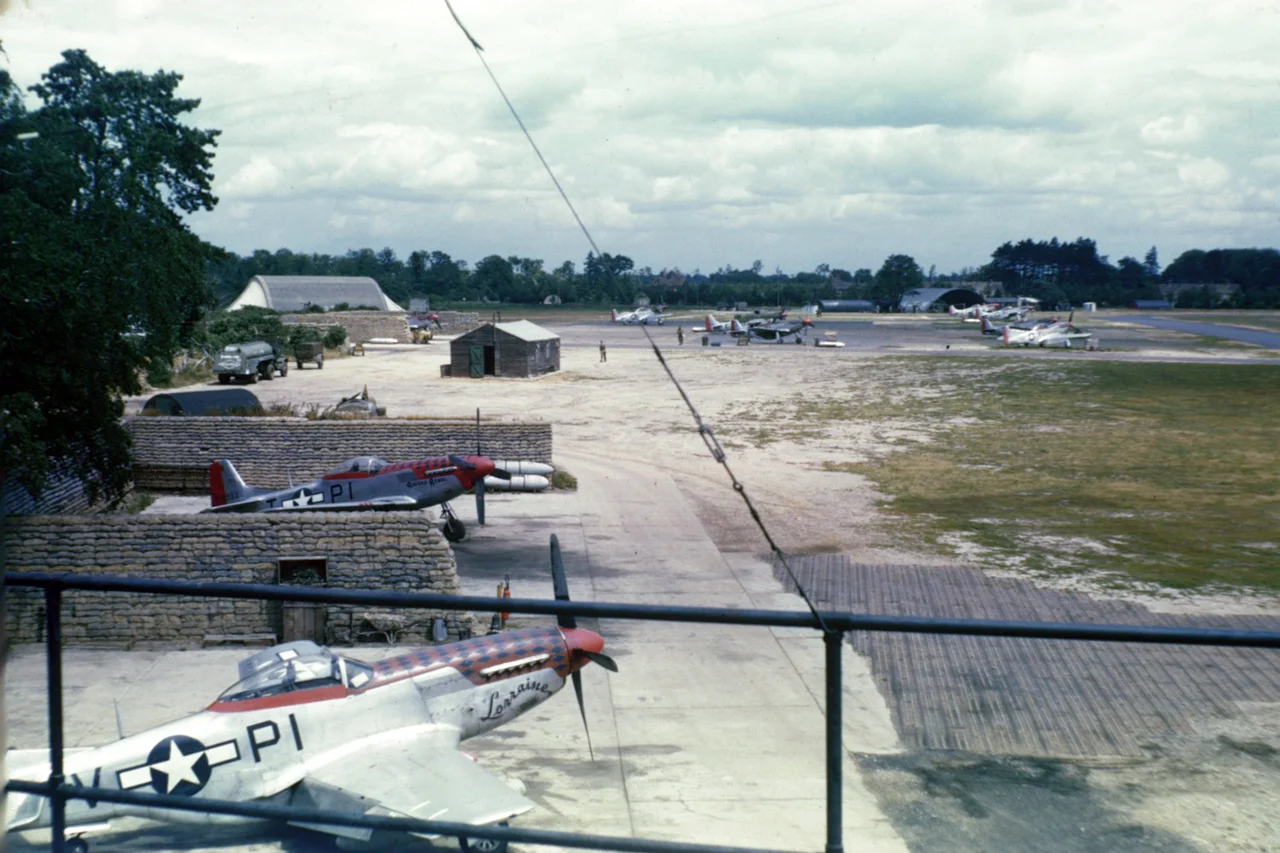
From 1943, Martlesham became a USAAF fighter base, home to the 356th Fighter Group flying P-47 Thunderbolts and later P-51 Mustangs. The 356th's job was bomber escort - flying out from Suffolk to meet the heavy bombers returning from raids deep into Germany, and protecting them through the most dangerous part of the route home. The group flew its first mission in October 1943 and its last on the day Germany surrendered. Across that period, the men who served with the 356th lost friends on a scale that is hard to grasp in retrospect: fighter losses on the East Anglian bomber escorts were heavy, and many of the missing were never recovered. On what was once the RAF parade ground, near the surviving prewar hangars, a memorial stands today to the members of the 356th Fighter Group who did not come home. The control tower is now a museum, restored and maintained by the Martlesham Heath Aviation Society.
Cold War, Tropo-Scatter, and Now
After the war Martlesham reverted to the RAF, but the proximity of Ipswich limited the runway extensions that jet operations needed. Various specialist units came and went - a Bomb Ballistics and Blind Landing Unit, an Air-Sea Rescue helicopter detachment, the Battle of Britain Memorial Flight for three years between 1958 and 1961. The Air Ministry finally closed the facility on 25 April 1963. The story did not end there. In 1961 the US 3rd Air Force set up a radio relay station at the south-west corner of the airfield, with six steel masts that linked British, American, Belgian and Dutch military communications via UHF tropo-scatter dishes. From 1966, one of only two AUTOVON automatic exchanges in the United Kingdom was housed in its main building. The station shut down progressively between 1988 and 1990. Today Martlesham Heath is an industrial estate and dormitory suburb of Ipswich; the prewar hangars house light industry; the police constabulary headquarters occupies part of the airfield. In July 2017 a commemorative stone was unveiled on the village green outside the Douglas Bader public house, with a Hurricane and a Spitfire flying overhead to music by Vera Lynn.
From the Air
RAF Martlesham Heath lies at 52.06 degrees north, 1.27 degrees east, 1.5 miles south-west of Woodbridge on the western side of the River Deben estuary. The prewar hangars - all four of them - and the restored control tower are still visible from the air, though housing now covers much of the former airfield. Recommended viewing altitude is 1,500-2,500 feet. The Deben estuary makes the obvious navigation reference; the A12 dual carriageway runs north-east-south-west through the immediate area. Nearest active airfields are RAF Wattisham (EGUW) and Norwich (EGSH). RAF Bentwaters lies just to the east. Watch for coastal sea breezes in summer - they push afternoon visibility down quickly.
Nearby Stories
- Walton-on-the-Naze 2.7 km away
- Clare, Suffolk 9.5 km away
- RAF Lakenheath 10 km away
- RAF Hardwick 11 km away
- Beeleigh Abbey 13 km away
- Four Days' Battle 45 km away
- Southern Bight 75 km away
- Battle of Lowestoft 79 km away