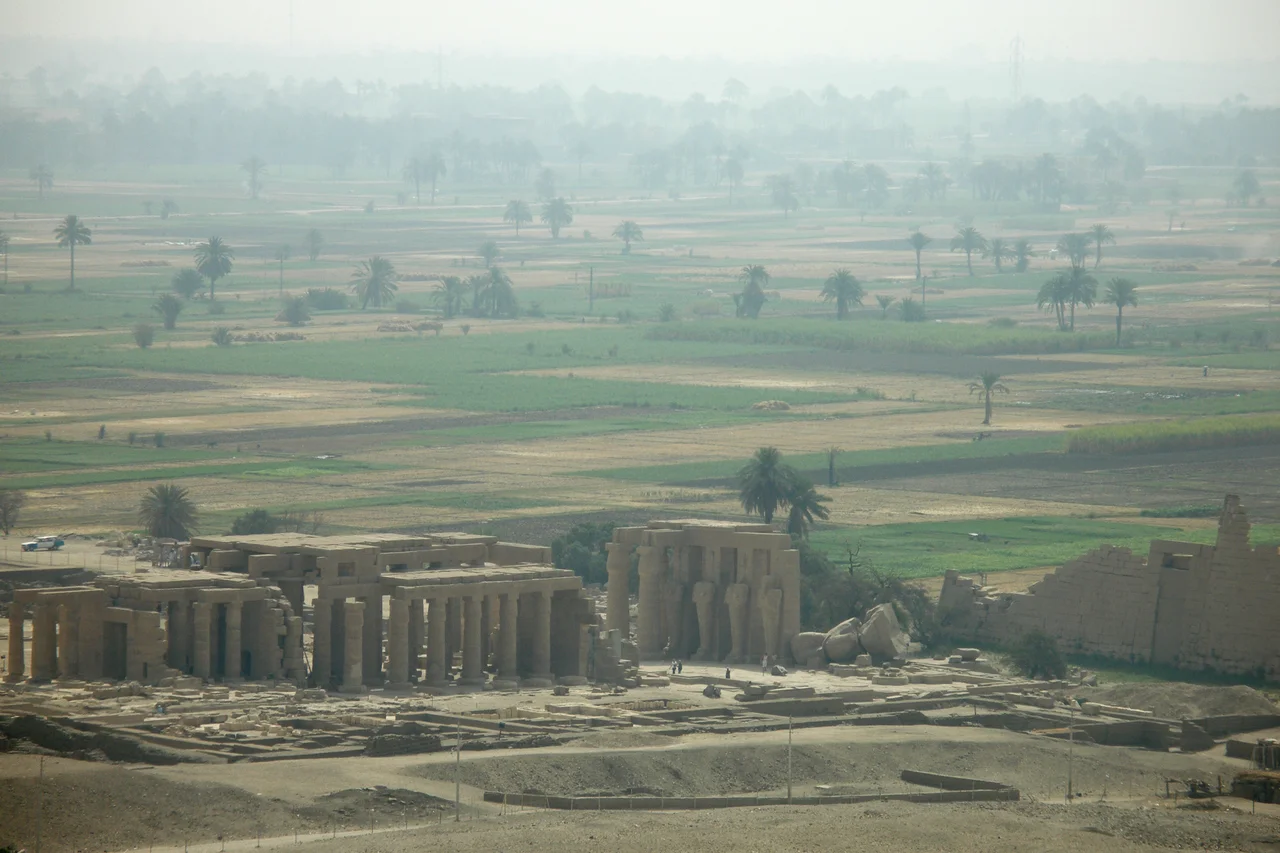

Ramesseum
"My name is Ozymandias, king of kings: Look on my works, ye Mighty, and despair!" Percy Bysshe Shelley wrote those lines in 1817, and the ruin that inspired them lies here, on the west bank of the Nile across from Luxor. The poet never saw it. He was reacting to news that a seven-ton granite head of Ramesses II was being hauled toward the British Museum, and to ancient accounts of a fallen colossus in the desert. The temple itself is the Ramesseum, the memorial temple of Ramesses the Great, and near its second courtyard lies exactly what Shelley imagined: a vast statue toppled and broken, a shattered face half sunk in sand, the works of a king who ruled for sixty-six years scattered across the ground. The irony is almost too perfect. The pharaoh built this place precisely so he would never be forgotten, and it became the world's most famous monument to the impermanence of power.
House of Millions of Years
Ramesses II began this temple soon after taking the throne around 1279 BC, and work continued for some twenty years. He called it the "House of millions of years" that unites with Thebes in the domain of Amun, a place where his memory would be sustained by ritual long after his death. It is among the largest temples in Egypt, roughly ten hectares of pylons, courtyards, and a forty-eight-column hypostyle hall, thirty-nine of whose columns still stand. The outer walls celebrated his reign in the usual way, with carved scenes of military triumph, above all the Battle of Kadesh against the Hittites around 1274 BC, fought to a bloody draw that Ramesses nonetheless commemorated as a great victory. One block even records his sacking of a city called Shalem, which may or may not have been Jerusalem.
The Fallen Colossus
The statue that became Ozymandias was carved from a single block of granite. Had it still stood, it would have towered roughly nineteen meters, taller than a six-story building, one of the largest free-standing statues Egypt ever made. Instead it lies broken across the temple floor, the head and torso separated from the legs, the hands and feet nearby. On its shoulder is a cartouche bearing the king's throne name, User-maat-re Setep-en-re, which the Greek historian Diodorus of Sicily transcribed in the first century BC as "Ozymandias." Shelley's "vast and trunkless legs of stone" owe more to poetic license than to the actual ruin, but his "shattered visage" lying in the sand is an accurate description of the wreck. No one knows for certain what felled it. Time, earthquakes, and the slow erosion of the river's flood plain all played their part.
How the King Reached London
The Ramesseum's modern fame began with a circus strongman. In 1816, Henry Salt, the British consul, hired Giovanni Belzoni, an Italian showman turned engineer, to remove a colossal granite head and torso of Ramesses II, the so-called Younger Memnon, and ship it to England. Napoleon's men had tried and failed a decade earlier. Belzoni succeeded with wooden sledges, palm-fiber ropes, hand-cut rollers, and a crew of local laborers, dragging the 7.25-ton stone to the Nile. It reached London in 1818 and became a star of the British Museum. The excitement around its arrival is what set Shelley writing. A friendly rivalry with a fellow poet produced two sonnets on the same theme; only Shelley's is still remembered, which is its own small lesson in whose works endure.
Stars on the Ceiling, Bricks in the Vaults
For all the grandeur, the most quietly remarkable things at the Ramesseum are small. Part of the hypostyle hall ceiling survives, painted with gold stars on a deep blue ground, a fragment of the night sky preserved for three thousand years. Behind and beside the temple stand the mudbrick storerooms and granaries, and among them is the oldest true arch still standing in Egypt. These vaults were built without proper wedge-shaped stones, held together by mortar alone, which is why so few survive. The temple was also home to a school for scribes; a potsherd found here, now in London, is doodled with a monkey mischievously scratching a girl's nose, the kind of human detail that outlasts every boast about kings.
The Lesson in the Sand
Ramesses II was not a modest man, and the Ramesseum was meant to broadcast his glory across the centuries. In a sense it succeeded. We do remember him, more vividly than almost any other pharaoh. But we remember him through a poem about ruin, standing among broken stones where the desert has reclaimed his "colossal wreck." Diodorus claimed the original inscription read, in part, that no one who wished to know how great the king was should try to surpass his works. Shelley turned that boast inside out. Round the decay of the wreck, he wrote, "the lone and level sands stretch far away." Stand here at the right hour, with the toppled face staring blankly at the sky, and the poem needs no explaining at all.
From the Air
The Ramesseum lies at 25.728N, 32.611E, on the Theban west bank about 4 km west of the Nile and roughly 5 km southwest of the Mortuary Temple of Hatshepsut. From the air it reads as a rectangular complex of standing columns and mudbrick storerooms at the edge of the cultivated floodplain, where green fields meet the desert and the Theban Hills rise to the west. The Colossi of Memnon stand about a kilometer to the southeast. Best viewed from 1,000 to 2,500 feet AGL; late-afternoon light throws long shadows across the fallen colossus and the columned hall. Luxor International Airport (HELX / LXR) is about 9 km to the east across the river. Skies over Upper Egypt are usually clear, with occasional spring dust haze from khamsin winds.
Nearby Stories
- Temple of Seti I (Abydos) 20 km away
- Dendera Temple complex 21 km away
- Esna 22 km away
- Abydos, Egypt 49 km away
- Mersa Gawasis 116 km away
- Kharga Oasis 147 km away
- Hurghada 184 km away
- Wadi El Gemal National Park 238 km away