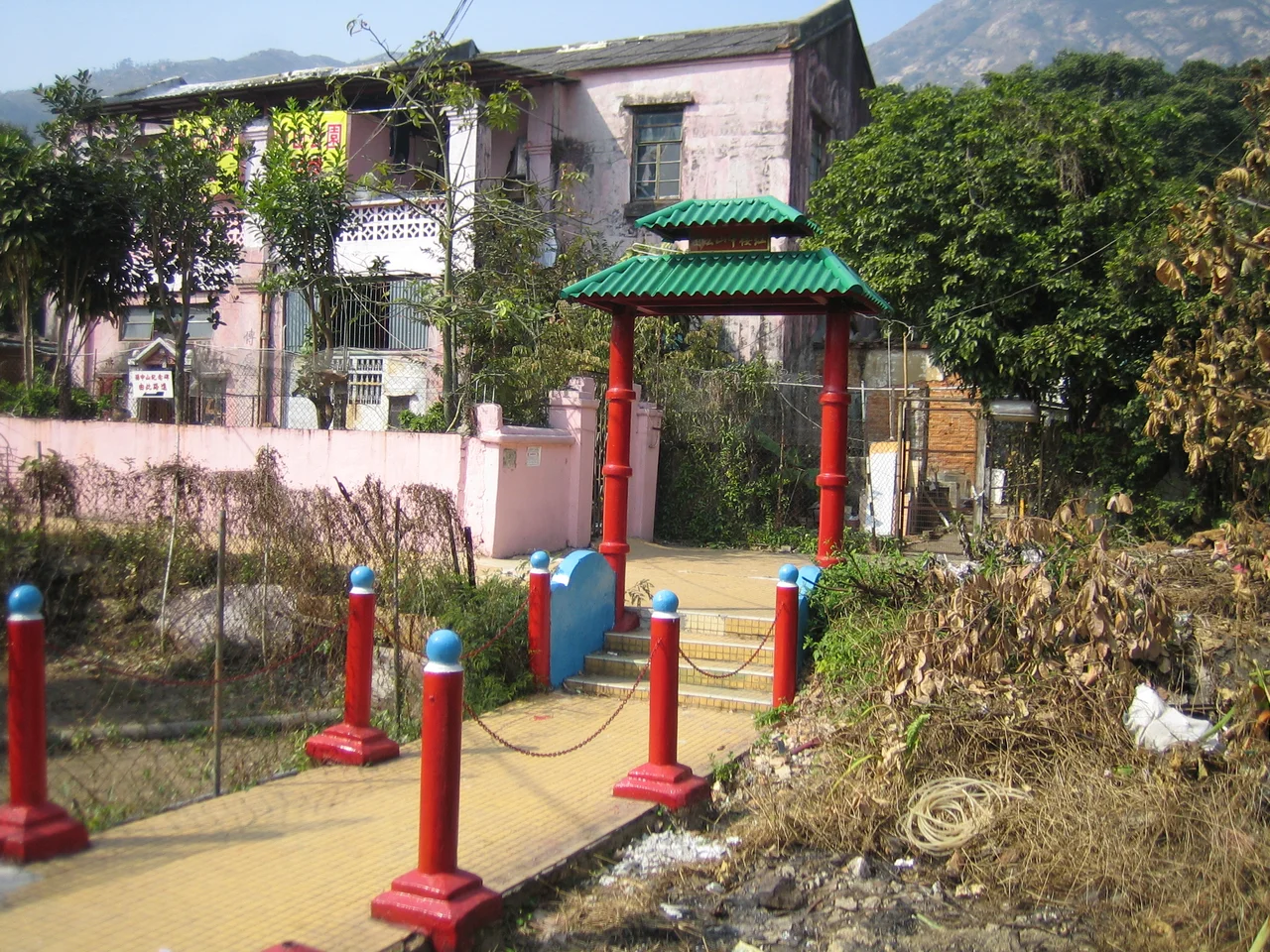

Red House (Hong Kong)
In 1901, a Hong Kong merchant named Li Ki-tong made his farm available to a group of revolutionaries. This was not a casual act of generosity. The Revive China Society — *Xingzhonghui* (興中會) — was planning the overthrow of the Qing dynasty, the imperial government that had ruled China for more than two and a half centuries. Li had met Sun Yat-sen in 1895 and joined the Society in 1900. The farm in Pak Kok, Tuen Mun, provided what the conspirators needed most: cover, distance from the colonial authorities who were watching the city, and enough food to sustain the group while they planned coup attempts in Guangzhou and Wuhan. The two-storey house that stands there now — the Red House, Hung Lau, named for its distinctive red-pigmented external render — was built slightly later, between 1905 and 1910, on the same farmland.
A Farmhouse Built for Revolution
The Red House is a Grade I historic building in Hong Kong, classified since 2009. The designation acknowledges its significance without mandating its preservation — a legal distinction that has mattered greatly in the decades since. The building is two storeys, mixing Chinese and Western architectural influences in a way common to the prosperous merchant class of early twentieth-century South China. It stands near the Tuen Mun Public Riding School, Butterfly Estate, and Castle Peak, in a part of Tuen Mun that has been swallowed by suburban development on three sides but has not entirely lost its older character. The red-pigmented render that gives it its name is still visible on the exterior walls.
Li Ki-tong and the Secret Base
Li Ki-tong was not a romantic rebel. He was a businessman — a Hong Kong merchant and financier connected to the original *China Daily* newspaper — who concluded, after meeting Sun Yat-sen in 1895, that the Qing dynasty was beyond reform. When he joined the Revive China Society in 1900 and provided his farm as a base the following year, he was making a political and financial commitment with potentially fatal consequences. The farm's rural setting in Tuen Mun, away from the commercial districts of Hong Kong Island and Kowloon, made it a plausible hiding place. Revolutionary planning sessions could be conducted under the cover of ordinary farm operations. The group that gathered there was working toward the 1911 Xinhai Revolution, which ended imperial China and established the Republic of China. Whether the specific house that stands today was the exact building used in 1901 has been disputed; the government declined in December 2017 to promote it as a declared monument, citing a lack of concrete evidence linking the current structure to the 1911 revolution.
Decades of Neglect and Bureaucratic Caution
The long gap between the revolution and any serious attempt to preserve the site reflects competing political sensitivities that neither colonial nor post-colonial Hong Kong found easy to navigate. A 1968 proposal by lawmaker Ellen Li to establish a memorial garden and museum was rejected because British colonial officials were unwilling to collaborate with the pro-ROC Sun Yat-sen Memorial Association of Hong Kong. In the 1990s and early 2000s, the Tuen Mun District Council proposed spending HKD $86 million on restoration, but the project did not move forward. A Sun Yat-sen Commemorative Garden was built on the same plot of land in 1983, containing an obelisk and statue; it became one of the few places in Hong Kong where the flag of the Republic of China flies continuously. The garden has been vandalized multiple times — in 2002 the statue was damaged and three Arenga trees were cut down; in December 2020, commemorative plates were spray-painted and flag poles removed.
Sale, Protest, and Political Pressure
In November 2016, the Red House was controversially sold to a mainland buyer for HKD $5 million. Within months, the Antiquities Advisory Board declared it a proposed monument on 9 March 2017, a temporary protective measure against further damage or modification. Three hundred people protested in February 2017 when the new owner began demolishing a wall. By October 2017, a government subsidy arrangement was proposed, conditioned on the building not being demolished or sold for ten years after restoration. The government ultimately declined to pursue full declared monument status in December 2017. Since then, the site's political charge has only intensified. From 2018 onward, the new owner blocked celebrations of the Republic of China National Day on Double Tenth (October 10); during the 2018 observance, approximately 350 people were turned away from the grounds.
The Present Standoff
On 10 October 2020, police vans arrived outside the Red House. A dozen plainclothes officers checked identification cards at the entrance. Private security guards in dark suits, hired by the owner, barred visitors from the grounds. Johnny Mak, chairman of the Highwise Yuen Long Service Centre — the group that manages the adjacent commemorative garden — said he had never seen such a police presence there before. He attributed it to the 2020 National Security Law, which had transformed the legal landscape of assembly and political expression in Hong Kong. On 10 October 2021, the same scene repeated: police and private security again blocked access. A farmhouse built for a revolution is now a contested zone in a different kind of political struggle — between a building's history and the authorities who decide what that history is allowed to mean.
From the Air
Hung Lau (the Red House) is located in Pak Kok, Tuen Mun, at approximately 22.38°N, 113.96°E in the western New Territories of Hong Kong. From the air, Tuen Mun appears as a large new town on the eastern shore of the Urmston Road waterway, with Castle Peak (583 m) as the dominant landmark to the northeast. The River Trade Terminal at Tuen Mun and Pillar Point are visible to the south along the shoreline. The nearest airport is Hong Kong International Airport (VHHH) on Lantau Island, approximately 15 km to the south-southeast. For general aviation, the western New Territories approach corridor passes south of Tuen Mun along the Urmston Road. The Castle Peak power station stacks to the south serve as navigation references.
Nearby Stories
- Chapel of St. Francis Xavier 3.5 km away
- Cuiheng 4.1 km away
- 2015 Shenzhen Landslide 16 km away
- Shunde 31 km away
- Wanshan Archipelago 37 km away
- Nanxiong Formation 96 km away
- Heyuan 149 km away
- Checheng Fu'an Temple 629 km away