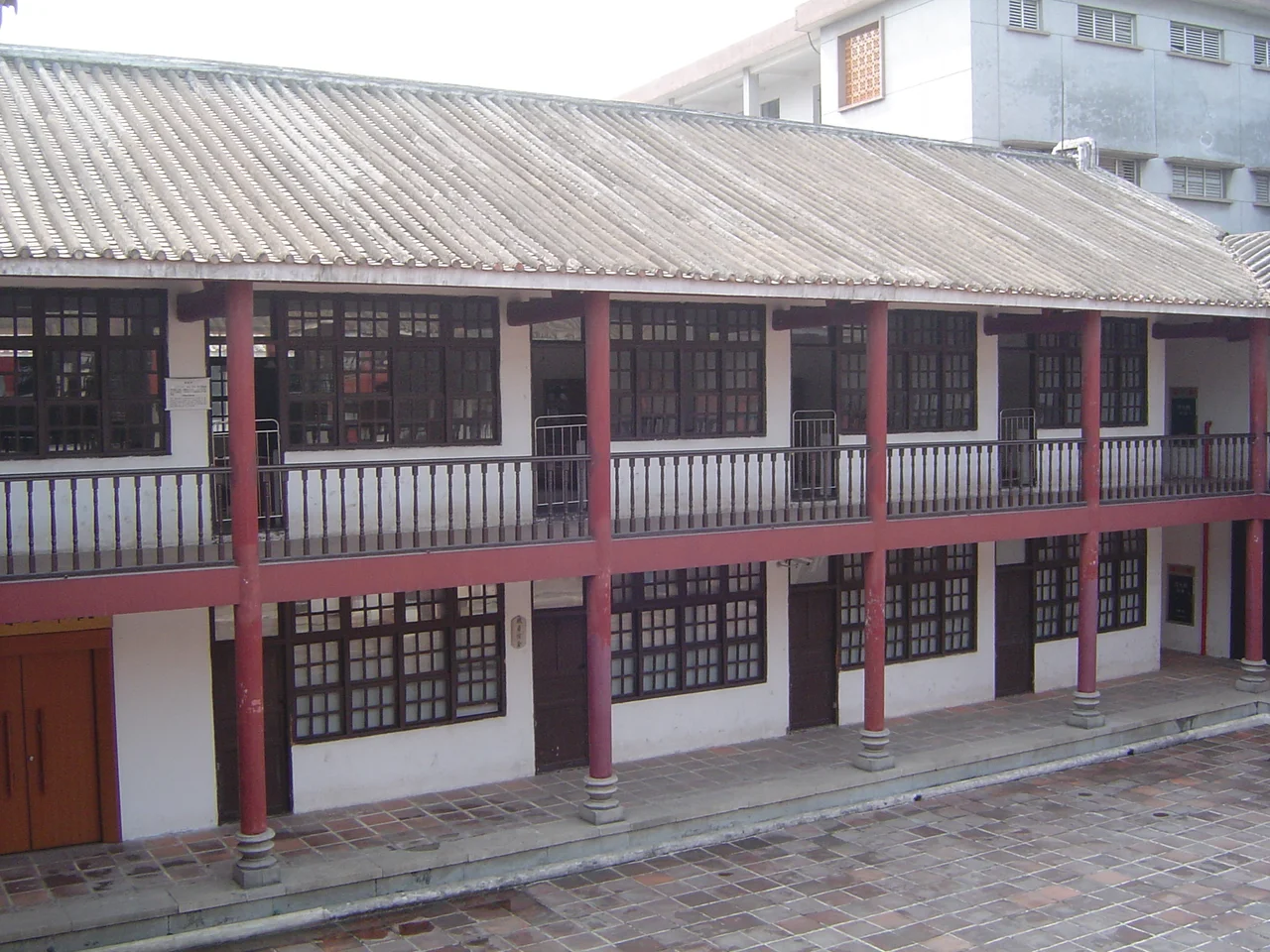

Republic of China Military Academy
Zhou Enlai taught the political classes. Chiang Kai-shek ran the school. Their students would spend the next quarter century trying to kill each other. The Whampoa Military Academy, founded in May 1924 on a small island in the Pearl River near Guangzhou, was designed to create a modern officer corps for Sun Yat-sen's revolutionary movement. It succeeded beyond anyone's expectations -- producing graduates who led armies on both sides of the Chinese Civil War. When the war ended in 1949, the academy evacuated to Kaohsiung, Taiwan, where it continues to operate as the Republic of China Military Academy. The original campus in Guangzhou is now a museum. The Kaohsiung campus, tucked into Fengshan District, still trains officers for the Republic of China Army, carrying forward a tradition that has outlived the revolution that created it.
Unlikely Allies on Dane's Island
The academy's founding in 1924 was a product of the First United Front, that brief and uneasy alliance between Sun Yat-sen's Kuomintang and the Chinese Communist Party. Soviet money, materiel, and military advisors flowed in to help the KMT build a modern armed force. Political commissars were introduced alongside military instructors. The KMT's 1st National Congress approved the creation of the academy to train junior officers for what would become the National Revolutionary Army. Sun Yat-sen took the ceremonial title of premier. Chiang Kai-shek, then an ambitious military officer, was named superintendent. The faculty was drawn from graduates of the Baoding Military Academy, the Yunnan Military Academy, and the Imperial Japanese Army Academy, supplemented by Soviet instructors from the Frunze Military Academy. Communist Party members were admitted as both faculty and students. The political department was led by Zhou Enlai, the future premier of the People's Republic of China.
Training an Army in Twelve Months
Cadets received a compressed 6-to-12-month program that blended Western military pedagogy with political education. Military training focused primarily on infantry tactics but included artillery, engineering, logistics, and heavy weapons. Political instruction was grounded in Sun Yat-sen's Three Principles of the People, KMT party history, and Western political and economic theory. The program was less rigorous than those offered by established professional armies, but it gave the National Revolutionary Army a decisive edge over the less organized Chinese forces of the Warlord Era. The first class of 490 cadets graduated in November 1924. That same October, the academy had already formed its first "model" regiment, which put down an insurrection by angry merchants and their private militia in Guangzhou. Whampoa forces went on to fight successfully in the Guangdong-Guangxi War and the Yunnan-Guangxi War before becoming the backbone of the Northern Expedition.
A School Divided Against Itself
By the start of the Second Sino-Japanese War in 1937, the majority of Chinese divisions were commanded by Whampoa graduates. But those graduates served on both sides of an increasingly bitter divide. When the United Front collapsed and the Chinese Civil War consumed the country, Whampoa alumni found themselves commanding opposing armies. The People's Liberation Army recruited heavily from Whampoa's ranks, just as the Nationalists did. Lin Biao, who would become a Marshal of the People's Republic, graduated from Whampoa. So did countless Nationalist generals who followed Chiang Kai-shek to Taiwan. The academy itself migrated with the conflict: from Guangzhou to Nanjing in 1928 (renamed the Central Military Academy after the Northern Expedition), then to Chengdu in 1938 as Japan's armies advanced, and finally to Kaohsiung when the civil war was lost.
A Century in Kaohsiung
The academy has been in Kaohsiung since 1949, longer than it existed on the mainland. In June 2024, President Lai Ching-te visited the campus to celebrate the institution's 100th anniversary -- a century that spans the founding of modern China, a world war, a civil war, and Taiwan's transformation from authoritarian state to vibrant democracy. The campus today offers departments in civil engineering, physics, foreign languages, political science, chemistry, electrical engineering, mechanical engineering, and information management. It is accessible from Dadong Station on the Kaohsiung MRT. From the air, the military academy's orderly grounds stand in contrast to the dense residential neighborhoods of Fengshan District that surround it -- a rectangle of discipline amid the organic sprawl of a city that has grown up around an institution older than the country it serves.
From the Air
Located at 22.619N, 120.366E in Fengshan District, eastern Kaohsiung. The academy campus is visible as an orderly compound amid dense urban development. Nearby airports: RCKH (Kaohsiung International Airport, 12 km southwest). Best viewed at 3,000-5,000 ft AGL. Weiwuying Metropolitan Park is visible approximately 2 km to the southwest.
Nearby Stories
- Taimali 7.2 km away
- Meinong East Gate Tower 15 km away
- Kunci Temple 20 km away
- Checheng Fu'an Temple 42 km away
- Dongji Island 49 km away
- Orchid Island 69 km away
- South Penghu Marine National Park 77 km away
- Hong Kong 12 549 km away