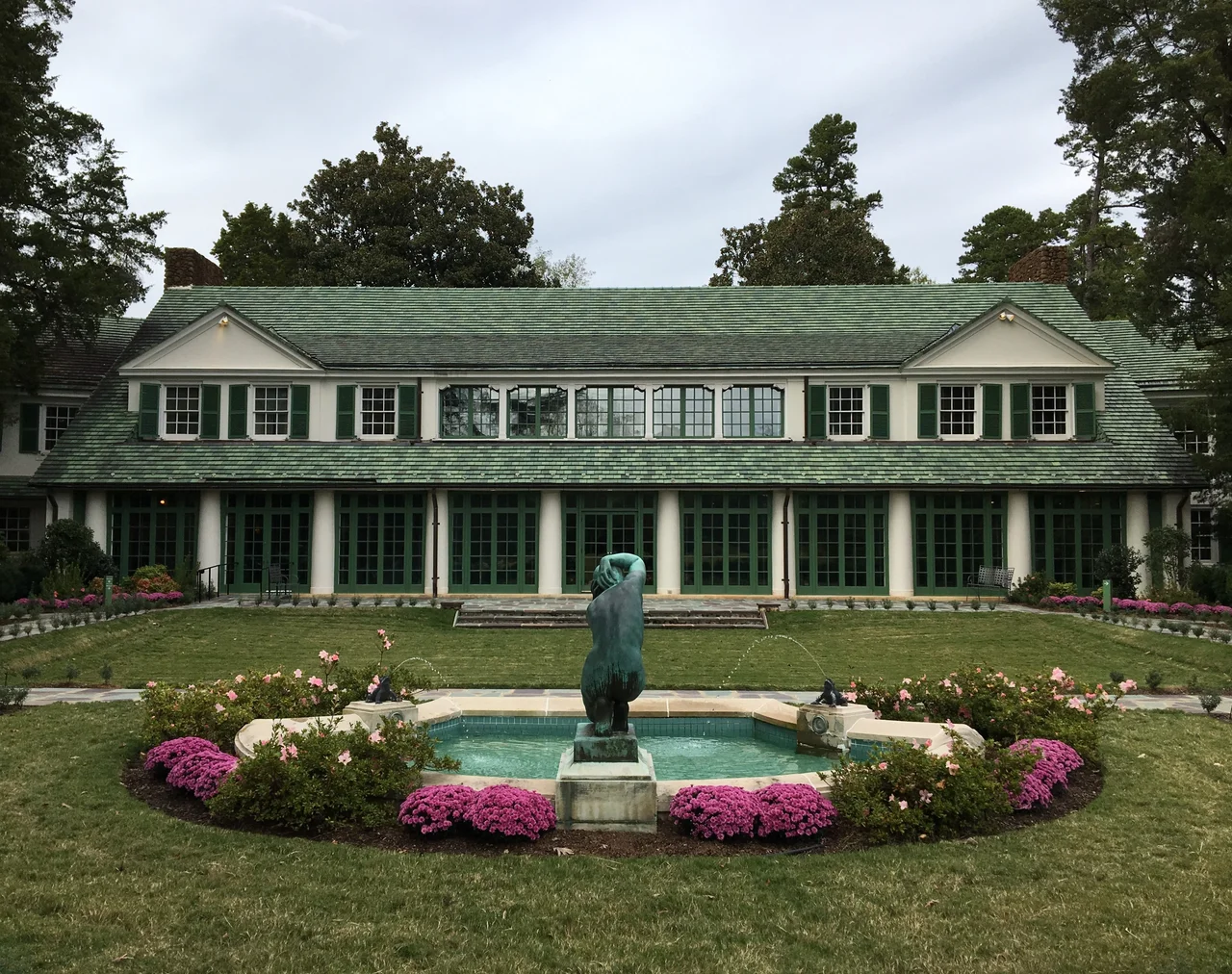

Reynolda House Museum of American Art
R. J. Reynolds was already dying of pancreatic cancer when his family moved into Reynolda in December 1917. He had been waiting five years for the house. He lived in it for less than a year. He died at the bungalow-style mansion on July 29, 1918, and the wealth that had built it, the wealth of the R. J. Reynolds Tobacco Company, kept building Reynolda after him: a model village, a working dairy, a 16-acre lake stocked with bass, a 1,067-acre estate run as a self-contained world on the western edge of Winston-Salem.
Katharine's Project
Reynolda was, more than anything, Katharine Smith Reynolds's project. Design and construction ran from 1912 through 1917. She hired Charles Barton Keen, a Philadelphia-trained architect already known for country houses in Pennsylvania and New York, to design not just the main house but an entire village around it: a church, stables, a school, dairy buildings, cottages for farm workers, and the boulevards that connected them. Her correspondence with Keen survives, and it is detailed. She debated tile colors, door hardware, the placement of windows. The famous green Ludowici terra-cotta roof tiles, which became a Winston-Salem signature visible in dozens of later buildings, were her choice. She was deeply involved with the gardens too, planted with Japanese cryptomeria, weeping cherries, and formal beds laid west of the house.
How the Money Was Made
The fortune that paid for Reynolda came from cigarettes. The R. J. Reynolds Tobacco Company introduced Camel cigarettes in 1913 and turned them into one of the most successful consumer products of the twentieth century. The Winston-Salem factories that produced them ran on tobacco grown across the North Carolina Piedmont, much of it by Black tenant farmers and sharecroppers working land they did not own. The processing floors at the factory were largely segregated, with Black workers concentrated in the dustier and lower-paid jobs of stemming and sorting leaf. The Reynolda estate is, in its silence about all of this, also a record of it: the columns, the cryptomeria, the green tile, the lake bass were paid for by a labor system whose participants would never set foot in the house as guests. Telling the story of Reynolda honestly means holding the beauty and the bookkeeping in the same view.
From Vacation House to Museum
In 1934, R. J. and Katharine's elder daughter Mary Reynolds Babcock acquired the estate. She and her husband Charles Babcock used Reynolda as a vacation home until 1948, when they moved in permanently. The house remained the family's for nearly fifty years. After Mary Babcock's death, the family transitioned Reynolda toward public use. It opened in 1965 as an institution dedicated to the arts and education, and in 1967 as an art museum. The interior rooms were restored to reflect the periods when the family had lived in them, the wallpaper and furnishings researched from photographs and inventories. Walking the second-floor bedrooms today is a peculiar experience: you are inside an art museum and inside someone's preserved house at the same time.
The Collection
Reynolda's permanent collection covers three centuries of American art and sculpture, hung throughout the historic rooms rather than corralled in dedicated galleries. The roster reads like an American survey: Gilbert Stuart's 1809 portrait of Mrs. Harrison Gray Otis. Edward Hicks's Peaceable Kingdom of the Branch from around 1826 to 1830. Thomas Cole's Home in the Woods from 1847. Frederic Church's spectacular The Andes of Ecuador from 1855. Mary Cassatt, Jacob Lawrence, Georgia O'Keeffe. In 2005 the Mary and Charlie Babcock Wing opened with a dedicated traveling exhibition gallery, hosting two major shows a year. The collection is intimate by museum standards but unusually deep in nineteenth-century landscape and twentieth-century modernism, the two strands the family bought heavily in.
The Village That Remains
Twenty-eight of the original thirty buildings on the estate still stand. Reynolda Village, once the working heart of the farm operation, is now occupied by boutiques, restaurants, and shops along Reynolda Road. Lake Katharine, behind the house, has reverted from a stocked recreational pond to wetlands, and the wildlife has returned with it. Reynolda became affiliated with Wake Forest University in 2002, anchoring the western end of the university's Reynolda Campus. The walk from the formal gardens past the dairy buildings to the old post office takes about twenty minutes if you do not stop, but the point of Reynolda has always been to slow you down. The green tile roof catches afternoon light. The cryptomeria and weeping cherries lean over the path. The house at the center holds a fortune's worth of paintings and the rooms of the people who made it.
From the Air
Located at 36.13 degrees north, 80.28 degrees west, on the western side of Winston-Salem, North Carolina, between Reynolda Road and the Wake Forest University campus. The estate is identifiable from the air by its green Ludowici tile roof, the formal gardens west of the main house, and the wetland that was once Lake Katharine to the east. Best viewed below 3,000 feet AGL. Nearest tower-served airport is Smith Reynolds (KINT) at Winston-Salem, about 4 miles east; Class D applies. Piedmont Triad International (KGSO) at Greensboro lies about 23 miles east-northeast. Contact KINT tower before low overflight.
Nearby Stories
- Battle of Wetzell's Mill 5 km away
- Hanging Rock State Park 5.9 km away
- Mebane's Bridge 11 km away
- 2025 North Carolina Cessna Citation II Crash 13 km away
- Wil-Cox Bridge 16 km away
- North Wilkesboro Speedway 19 km away
- Galax, Virginia 31 km away
- Deep River Camelback Truss Bridge 60 km away