
Richard Coeur de Lion Statue
On the day after Carlo Marochetti first unveiled his giant clay statue at the Great Exhibition in 1851, the horse's tail fell off. It would not be the last indignity. Forty years on, when someone bothered to investigate properly, the bronze that had eventually replaced the clay turned out to be riddled with holes - and never properly bolted to its pedestal. Then in the Blitz, a Luftwaffe bomb landed a few metres away and bent the king's raised sword. Yet Richard the Lionheart still sits his horse in Old Palace Yard, sword in the air, looking permanently as though he is about to charge at the entrance to the House of Lords. He is the most travelled, most damaged, and most argued-over statue on the parliamentary estate.
The Italian Outsider
Carlo Marochetti was born in Turin, ennobled by the Kingdom of Sardinia, and built his career in Paris during the July Monarchy of the 1830s. By the time he met Queen Victoria in 1849, he had a reputation for grand equestrian statues - including a much-praised Duke of Wellington in Glasgow - and a courtly manner that Victoria immediately liked. She and Prince Albert became his patrons. The Victorian artistic establishment was less impressed; Punch magazine took to calling him 'Count Marrowfatty.' But royal favour bought him a place in the design of the Great Exhibition, and Marochetti chose for his contribution a figure who suited the moment: Richard I, the crusader king who reigned from 1189 to 1199. He may also have had a competitive eye on the Belgian sculptor Eugene Simonis, whose statue of Godfrey de Bouillon - leader of the First Crusade - was due to appear at the same exhibition. The two sculptors even shared the same Paris bronze founder.
From Clay to Bronze
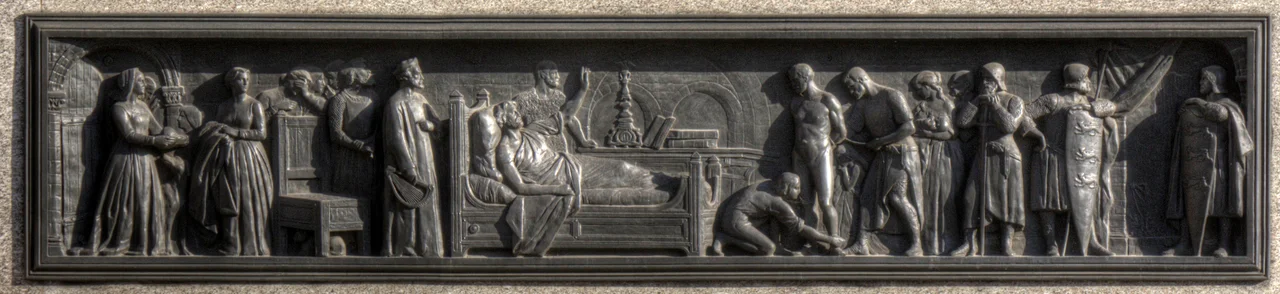
The original 1851 statue was clay, placed outside the west entrance to the Crystal Palace, and it was popular enough that Queen Victoria and Prince Albert headed the subscription list to have it cast in bronze. The cast was completed in 1856. Then the arguments started. A memorial to the Great Exhibition? Some objected. A spot outside Charles Barry's newly completed Palace of Westminster? Barry himself objected, calling Old Palace Yard 'too limited in area, and too irregular and unsymmetrical in its form and approaches.' Various locations were proposed and rejected. In the end, Marochetti got his way - Old Palace Yard, where the cabbies could tether their horses against the plinth. The statue was finally installed in October 1860. Marochetti had wanted four bronze reliefs on the pedestal in the manner of Ghiberti's doors on the Florence Baptistery - the coronation of Richard at Westminster, the taking of Ascalon, Richard as a Saracen prisoner, and Richard on his deathbed. Parliament voted him funds for only two: Ascalon and the death scene. They were not added until March 1867.
The Bent Sword
A few months after installation, in 1861, the statue was reported to be swaying in strong winds. Marochetti pronounced it sound. He promised to strengthen the legs if necessary. Then in the Second World War, a German bomb dropped during the Blitz exploded close enough to pepper the statue with shrapnel. The pedestal cracked. The horse's tail took several holes. And Richard's high-held sword bent back at the tip. Vincent Massey, the Canadian High Commissioner, argued the sword should be left exactly as the bomb had left it - because the bent blade symbolised 'the strength of democracy which will bend but not break under attack.' For a few years it stayed that way, the king brandishing his crumpled weapon at the House of Lords. The sword was finally replaced in 1947. Other repairs followed.
Ghiberti at the Plinth
The two bas-reliefs on the pedestal are the better part of the work. On one side, the army of crusaders taking the coastal city of Ascalon - figures pressed forward in stone, ladders against walls, the kind of compressed Renaissance crowd Marochetti had studied in Florence. On the other, Richard on his deathbed: the king dies at Chalus in 1199 from a crossbow wound that turned gangrenous, attended by men in armour and cloaks. The reliefs are smaller than the looming horseman above them, and most tourists walk past without realising they are there. They sit at eye level - quiet, detailed, slightly mournful - while above, Richard charges nothing in particular.
What He Stands For Now
Marochetti always insisted that his figure was inspired by Richard I rather than accurate to the twelfth century. The crowned helmet, the chainmail and surcoat, the rearing horse - these are nineteenth-century romance, not medieval reality. Richard the Lionheart was a king who barely lived in England, who spoke French, who spent his reign mostly on crusade and at war with Philip II. Yet by 1851, in the high noon of the British Empire, he had become a useful symbol: the warrior monarch, sword raised toward the Holy Land. That the statue still presides over the entrance to the House of Lords - the chamber descended from the medieval Curia Regis that Richard's father, Henry II, knew - is not an accident. In the summer of 2009 the bronze was cleaned, the old black wax stripped, the surface re-patinated to its original colour, and protected with new clear wax against the London air. The Italian outsider's most argued-over commission, twice nearly lost, is now Grade II listed and quietly cared for.
From the Air
The statue stands at 51.499 N, 0.126 W in Old Palace Yard, outside the south end of the Palace of Westminster, opposite Westminster Abbey. Look for the rearing equestrian bronze just south of Westminster Hall, facing the House of Lords entrance. Nearest major airports: London City (EGLC) eight miles east; London Heathrow (EGLL) fifteen miles west. From cruise, the Westminster complex reads as the bend of the Thames where Parliament's gothic spires sit on the north bank.
Nearby Stories
- Battle of Britain, Northfleet 1.1 km away
- Bayham Old Abbey 5.4 km away
- Catharine Macaulay 6.4 km away
- Hatfield rail crash 8.8 km away
- Chequers 8.9 km away
- Chelmsford Cathedral 10 km away
- Queen Victoria Hospital 13 km away
- Fishbourne Roman Palace 36 km away