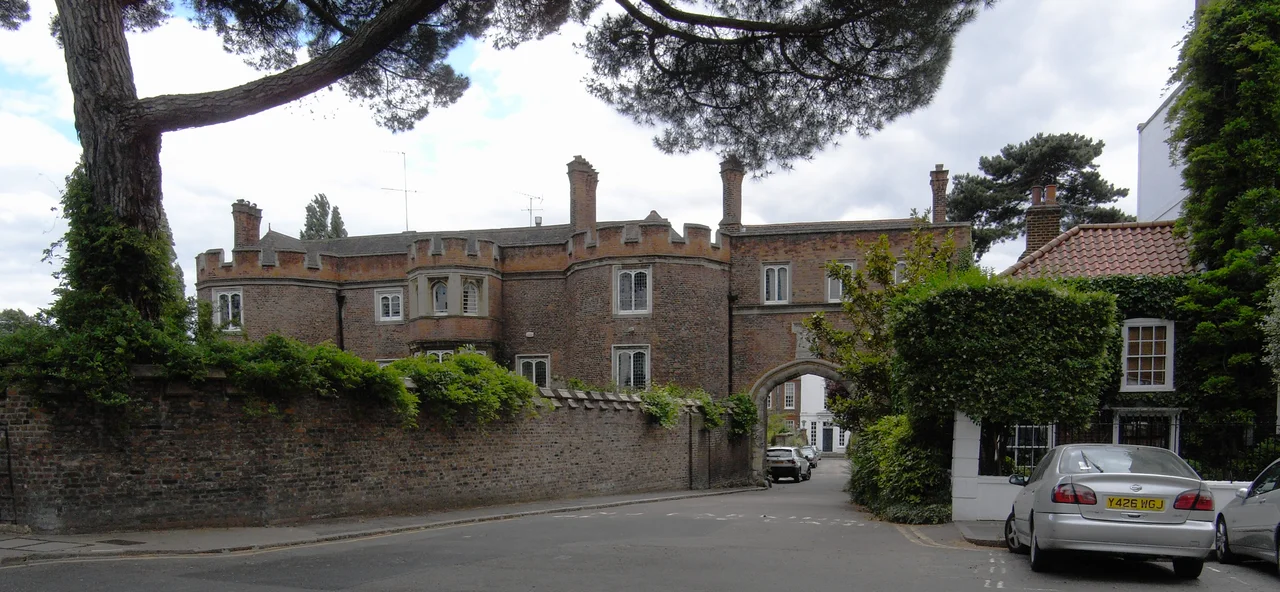

Richmond Palace
Sometime around Christmas 1497, the corridors at Sheen Palace caught fire. The king, Henry VII, barely made it out alive; one passage nearly collapsed onto him. His mother Margaret Beaufort and his wife Elizabeth of York were carried free. All but one of the royal children - including a six-year-old prince who would later become Henry VIII - were rushed out of the burning halls in the arms of nursemaids. Tapestries burned to cinders. Crown jewels were lost. The bedding, much of it cloth of gold, was destroyed. The Italian diplomat Soncino, sending the news back to Milan, reported that the king did not seem much bothered. 'He purposes,' Soncino wrote, 'to build the chapel all in stone, and much finer than before.' That offhand sentence is, in a way, the founding charter of Richmond Palace.
A Name Changed by Royal Command
Before he became king, Henry Tudor had been Earl of Richmond. In 1500, with construction underway on the new palace at Sheen, he ordered that the town surrounding the royal manor change its name to Richmond, in honour of the earldom that had been his. The locals kept calling it Sheen anyway, often, and both names continued to be used for centuries. The new palace went up between 1498 and roughly 1501, on the south bank of the Thames about nine miles upstream from the Palace of Westminster. Building in brick and white stone, with geometric octagonal towers, pepper-pot chimney caps, and ornate brass weather vanes, Richmond was one of the first English buildings to break with the heavy slit-windowed castle tradition. Henry installed long galleries to display sculpture and portraiture - Renaissance imports from Venice that he was buying through Italian bankers. He set up a library. He built a chapel rich enough to make the courtiers stare. The grounds covered orchards and walled gardens. From the river, Richmond looked nothing like an English fortress and everything like a new kind of court.
Elizabeth's Favourite Room
For five generations, Richmond was where the royal family went when they wanted to be away from London without being far from it. Henry VIII celebrated Christmas at Richmond with Catherine of Aragon at the start of 1510, twelfth night brought into the hall by an artificial mountain studded with gold and gems, dancers descending from a golden tree hung with roses and pomegranates. On another night, a lion and an antelope drew an embroidered forest into the hall, each carrying a costumed damsel. Henry's first son with Catherine, Henry Duke of Cornwall, was born at Richmond on New Year's Day 1511. He died fifty-two days later. Mary I spent her honeymoon here with Philip of Spain in 1554. Anne of Cleves received the palace as part of her annulment settlement from Henry VIII in 1540. But it was Elizabeth I who loved Richmond most. She hunted stags in the surrounding deer park - the Newe Parke of Richmonde, now called the Old Deer Park. She kept court here in her old age. On 24 March 1603, after a long final illness, Elizabeth died at Richmond. Her body was taken by barge down the river to Whitehall to lie in state. The Tudor century ended on this water.
Cromwell's Yard Sale
Charles I owned Richmond before he became king and began to build his famous art collection there. Like Elizabeth before him, he loved hunting, and in 1637 he carved out a new royal park - now simply called Richmond Park - which still holds descendants of his deer, free from hunting and surprisingly tame around the joggers. When the Civil War ended with the king's execution in January 1649, Parliament moved quickly on the royal estates. Within months Richmond Palace was surveyed for its sale value. It went for 13,000 pounds. Over the next ten years it was largely pulled apart, the stone and timber re-used as building materials elsewhere across Surrey and London. The 1649 survey is the most detailed description we have: the great hall lit by tall windows with a clock-turret at one end; the prince's lodgings 'a freestone building, three stories high, with fourteen turrets covered with lead'; the Canted Tower with its staircase of 124 steps; the chapel with cathedral seating; three pipes bringing water in from the conduit, the town fields, and the almshouses. All of it gone, item by item, into other people's houses.
Sir John Harington's Innovation
Tucked into Richmond's strange legacy is one of the more unexpected English contributions to domestic comfort: a flushing lavatory. Sir John Harington, godson of Elizabeth I, designed the device - he called it the 'Ajax,' a pun on 'jakes,' the period word for a privy. He installed one for the queen at Richmond Palace. Henry VIII had earlier put flushing latrines into Hampton Court. The technology then quietly disappeared for two centuries before being reinvented in the late eighteenth century. Picture Elizabeth, in the last years of her reign, using a working flush toilet at a riverside palace - and then picture the next king, James I, deciding he preferred Whitehall.
What the Thames Kept
Three pieces of Richmond Palace survived the great dismantling. The Wardrobe building, which once housed the royal robes, is now a Grade I listed private house. The Trumpeters' House, where the heralds had their quarters, is Grade I as well. The Gate House, built in 1501 with Henry VII's coat of arms still visible above the arch, is the most photographed survivor. The Crown Estate let it on a 65-year lease in 1986; it has five bedrooms and the surreal honour of being a five-bedroom rental property that was also a Tudor royal palace. In 1997 Channel 4's Time Team investigated the site for an episode broadcast in January 1998, finding outlines of foundations beneath the lawn. Eighteenth-century plans by William Chambers for a new Richmond Palace exist but were never built. The dun cow of the Earldom of Richmond still appears in the heraldry. Walking the Thames path here, with the green of Richmond Park rising behind, it is possible to feel - faintly - the shape of a building that was once the most modern court in England.
From the Air
Richmond Palace stood at 51.460 N, 0.310 W on the south bank of the Thames in Richmond, about ten miles south-west of central London. The Gate House and Trumpeters' House survive along Old Palace Yard, just east of Richmond Green. Nearest major airport: London Heathrow (EGLL) six miles west; London City (EGLC) sixteen miles east. From cruise, look for the broad curve of the Thames as it loops around Richmond Park and the Old Deer Park - the palace footprint sits between the river bend and the green.
Nearby Stories
- Battle of Britain, Northfleet 1.1 km away
- Bayham Old Abbey 5.4 km away
- Catharine Macaulay 6.4 km away
- Hatfield rail crash 8.8 km away
- Chequers 8.9 km away
- Chelmsford Cathedral 10 km away
- Queen Victoria Hospital 13 km away
- Fishbourne Roman Palace 36 km away