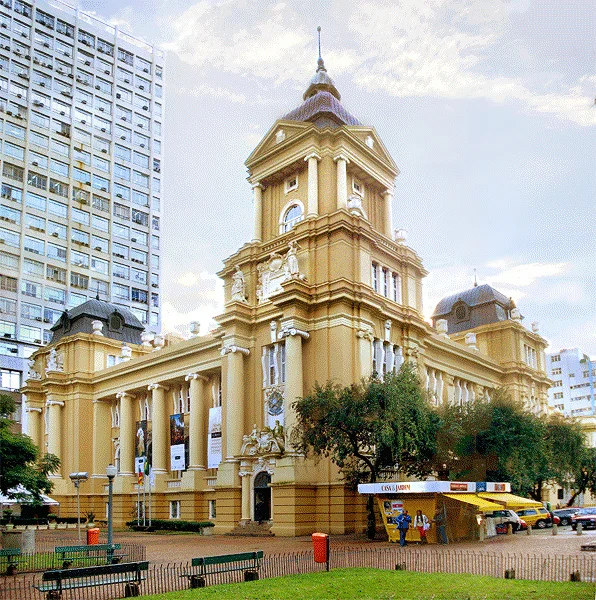

Rio Grande do Sul Museum of Art
When the state of Rio Grande do Sul created its art museum by decree in 1954, it gave the institution something strange: no home and not a single work of art. It existed only on paper, a name in search of a collection. The man asked to make it real was Ado Malagoli, a Sao Paulo-born painter newly arrived in Porto Alegre to teach, and he did it the hard way - gathering scattered paintings from state offices, traveling to buy more, accepting donation after donation. The museum that grew from that improbable start now holds the largest public art collection in the state. Seventy years later, in May 2024, it nearly lost everything, as two meters of river water rose through its historic halls.
A Museum from Nothing
Malagoli began with almost empty hands. He collected paintings dispersed among state institutions, then used the funds he was given to buy works in Sao Paulo - stars of Brazilian painting alongside some European masters - and to acquire pieces from Rio Grande do Sul's own contemporary artists. The museum opened to the public in 1955 in the foyer of the Sao Pedro Theatre, showing roughly 120 first acquisitions. It was modest, even makeshift, but it was alive. When Malagoli resigned in 1959 the state funding stopped, and from then on the collection grew chiefly through generosity - over a thousand works by the time the museum settled, in 1978, into the building it occupies today. The institution carries his name still: the Museu de Arte do Rio Grande do Sul Ado Malagoli, MARGS for short.
The Building on the Square
MARGS occupies one of Porto Alegre's most admired historic buildings, an eclectic pile on the Praca da Alfandega built in 1913 as the headquarters of the federal revenue office. Its design is usually credited to the German-Brazilian architect Theodor Wiederspahn, whose facade sculpture defined an era of the city's architecture, though the local historian and artist Fernando Corona attributed it instead to Germano Gundlach. Either way it is a national heritage building, all carved stone and stately proportion, the kind of structure that lends an institution instant gravity. In the 1990s a major restoration modernized its equipment and made it capable of hosting international shows - tapestries from the Musee d'Orsay, paintings from the Uffizi, decorative art from the Petit Palais.
What Hangs on the Walls
The collection has grown to more than 2,600 works spanning nearly every form of visual art, and its heart is the art of Rio Grande do Sul. Here are the gaucho masters: Ibere Camargo, the prodigious printmaker Pedro Weingartner, the sculptor Vasco Prado, Joao Fahrion, Carlos Scliar, Glenio Bianchetti. Among them hangs Weingartner's Tempora mutantur of 1898 and Malagoli's own work. Beyond the local, a smaller but choice selection reaches into the broader story of Brazilian art - Candido Portinari, Emiliano di Cavalcanti, Lasar Segall - and into nineteenth-century Europe. Strongest of all are the paintings and the works on paper, the drawings and engravings that record how artists of the south saw their world. It is, in sum, the visual memory of a state, assembled piece by donated piece over seven decades.
Memory Under Water
Then came the flood. In May 2024 the Guaiba rose to a height the city had never recorded, and water poured into the ground floor of MARGS until it stood two meters deep inside the historic building. Around four thousand items by more than seven hundred artists were touched by the water or by the long, creeping damage of humidity - hundreds of photographs, a thousand drawings, some 2,400 engravings, roughly a hundred paintings, seventy sculptures. Conservators raced to pull the collection from beneath the surface, rescuing what one Brazilian outlet called the memory under the water. Recovery took 5.6 million reais and seven months. The museum reopened in December 2024 with an exhibition built from the disaster itself - a show about the flood, the loss, and the painstaking work of saving a collection that had begun, after all, with nothing, and had survived to be worth saving twice.
From the Air
MARGS stands at 30.0291 S, 51.2317 W on the Praca da Alfandega in Porto Alegre's historic center, a block from the Guaiba waterfront whose 2024 flooding reached its ground floor. The nearest field is Salgado Filho International Airport (ICAO: SBPA), about 5 to 6 km north-northeast; Canoas Air Force Base (ICAO: SBCO), roughly 21 km north, handled civilian flights while Salgado Filho was closed in 2024. The riverfront museum quarter is best seen on an approach from over the lake to the west. A viewing altitude of 1,500 to 2,500 feet AGL frames the centro and the waterfront; winter radiation fog off the Guaiba is frequent and can delay early flights.
Nearby Stories
- Itapuã State Park 22 km away
- Nova Petrópolis 37 km away
- Aparados da Serra National Park 77 km away
- Santa Cruz do Sul 77 km away
- Serra Geral National Park 111 km away
- 2009 Brasil de Pelotas Bus Disaster 161 km away
- Passo Fundo 176 km away
- Battle of the River Plate 446 km away