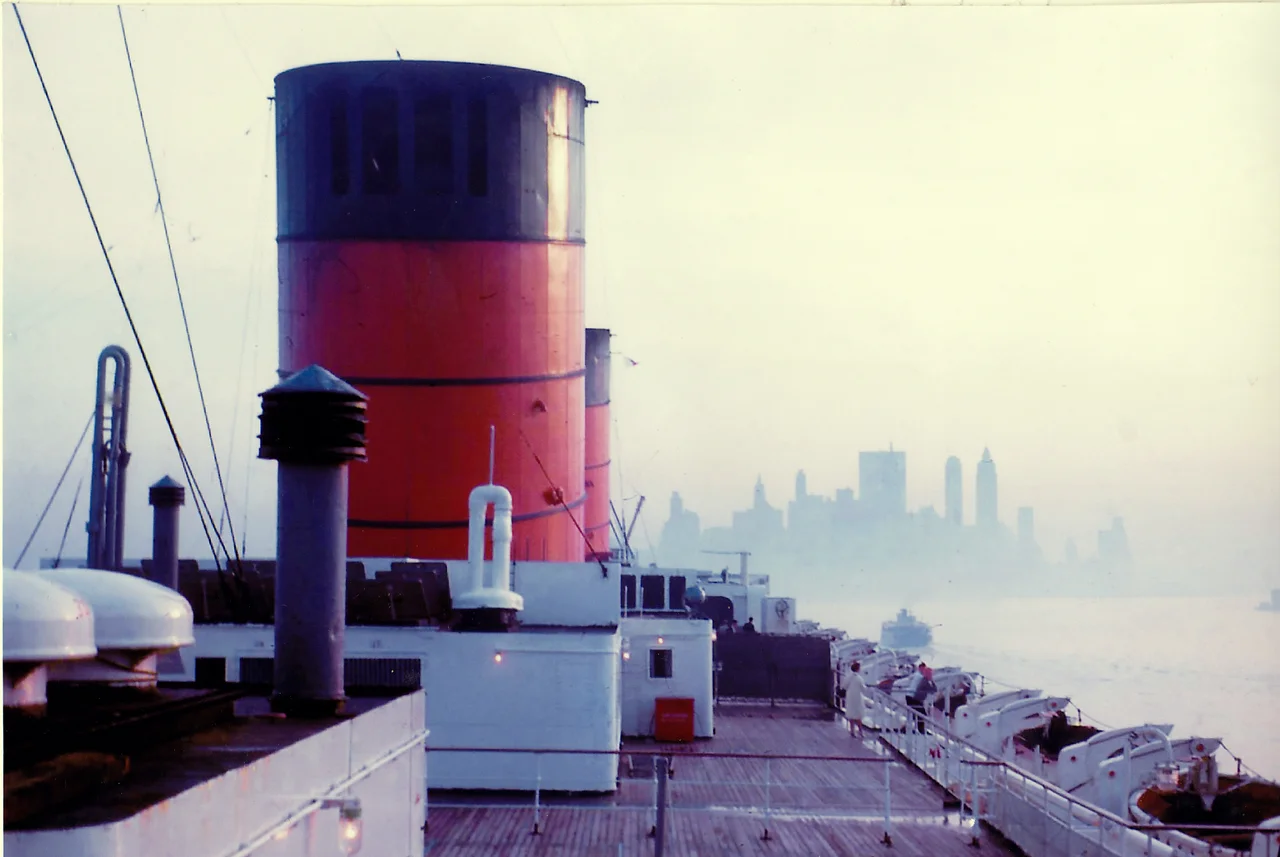

RMS Queen Elizabeth
She was insured for $8 million. Her owner had paid $3.5 million. In January 1972, as workers clambered through the scaffolding of the half-converted RMS Queen Elizabeth in Victoria Harbour, fires broke out simultaneously at multiple points across the hull. Whether it was arson, accident, or something in between has never been settled — but within hours, the largest passenger liner ever built was listing at 45 degrees, then rolling onto her side, then sinking into the shallow mud of Hong Kong harbour. The ship that had carried more than 750,000 troops across the world's oceans, that had outrun German U-boats and survived the Second World War untouched, was finally undone in peacetime — and nobody knows exactly why.
Born on the Clyde
The Queen Elizabeth's keel was laid down at John Brown and Company's shipyard in Clydebank, Scotland, on 4 December 1936 — the same year her sister ship, Queen Mary, made her maiden voyage across the Atlantic. Cunard's chairman Sir Percy Bates had been planning the second great liner for years, designing her as an improvement on the Mary: twelve boilers instead of twenty-four, one fewer funnel, a cleaner hull profile with a raked bow. The interior was the work of architect George Grey Wornum and a team of artists who fitted her with sweeping staircases, panelled lounges, and the restrained glamour of late-1930s British taste. When she was launched on 27 September 1938 — named for Queen Elizabeth, wife of King George VI — she was the largest passenger liner in the world, a record she would hold for an extraordinary 56 years. She was also, immediately, a ship whose first voyage would be nothing like the one anyone had planned.
A Secret Wartime Crossing
She never made a peacetime maiden voyage. When the Second World War began, the partly-fitted Queen Elizabeth was ordered out of Clydebank immediately — an elaborate deception made it appear she was sailing to Southampton for finishing work, while in fact she slipped away to New York in March 1940. For years afterward, her wartime movements were kept classified. Painted grey and stripped of her finery, she carried troops across oceans she had never crossed as a luxury liner. In mid-1942, she and the Queen Mary were capable of over 30 knots — fast enough to outrun any submarine — and they ferried tens of thousands of American soldiers to Britain in single crossings. A German U-boat commander, Horst Wilhelm Kessler, heard a detonation and believed he had hit her; one of his torpedoes had detonated prematurely, and the ship was unharmed. By the war's end, Queen Elizabeth alone had carried more than 750,000 troops and sailed some 500,000 miles.
The Golden Decade, Then the Decline
After her first commercial voyage in October 1946, Queen Elizabeth settled into the life she had been built for: a weekly shuttle between Southampton, Cherbourg, and New York, sailing in tandem with the Queen Mary to guarantee a departure every few days. Together the two ships dominated transatlantic passenger traffic through the late 1940s and 1950s. Yet Sir Percy Bates had asked that they not race each other, and so Queen Elizabeth never held the Blue Riband for speed — a deliberate choice, not a failure. What undid both ships was not competition but technology. The jet airliner arrived at the end of the 1950s and crossed the Atlantic in hours rather than days. Passenger numbers fell sharply. Cunard retired Queen Mary in 1967 and Queen Elizabeth after her final crossing to New York on 5 November 1968. She went first to Port Everglades, Florida, as a floating tourist attraction; that failed within eighteen months. Then she was sold to Hong Kong tycoon Tung Chao Yung.
Fire in the Harbour
Tung's plan was ambitious: convert the old liner into a floating university, rename her Seawise University, and sail her on educational cruises. The work began in Victoria Harbour in late 1971. Then, on the morning of 9 January 1972, fires ignited across the ship at multiple locations almost simultaneously. Fireboats pumped water onto the blazing decks; the weight of that water, combined with the instability caused by the fire itself, caused the massive hull to roll slowly onto its side. She settled on the shallow harbour bottom, a gutted carcass lying at a grotesque angle — a sight photographed by dozens of journalists and visible for miles. The wreck was eventually cut apart between 1974 and 1975, though 40 to 50 percent of the hull, along with the keel, boilers, and engines, was simply left on the seabed. In the late 1990s, the last remains were buried beneath reclaimed land during the construction of Container Terminal 9. The spot is still marked 'Foul' on local sea charts.
What Remained
Tung retrieved one of the liner's anchors and the large metal letters 'Q' and 'E' from the bow and placed them outside the building in Torrance, California, that had been intended as Seawise University's headquarters. They later moved to the lobby of Wall Street Plaza in New York. Two brass fire warning plaques recovered by a dredger went on display at the Aberdeen Boat Club in Hong Kong. The charred remnants of the ship's final ensign were cut from the flagpole and framed; they still hang in the officers' mess of the Marine Police headquarters in Hong Kong. Parker Pen produced a limited edition of 5,000 pens made from material salvaged from the wreck. And in the 1974 James Bond film The Man with the Golden Gun, the tilting, half-submerged wreck served as a secret MI6 base — Hollywood's tribute to a ship that had always been larger than life.
From the Air
The wreck site of RMS Queen Elizabeth lies beneath what is now Container Terminal 9 in Victoria Harbour at approximately 22.33°N, 114.11°E. Approaching from the east at 3,000 to 5,000 feet, the entire western harbour opens up — Kowloon to the north, Hong Kong Island to the south, and the vast container terminal complex occupying the reclaimed land where the ship burned. Hong Kong International Airport (VHHH) is on Lantau Island, roughly 25 nautical miles to the west-southwest. The harbour itself is a tight operating environment; the approach to VHHH runs almost directly over the former wreck site when coming in from the east.
Nearby Stories
- Chapel of St. Francis Xavier 3.5 km away
- Cuiheng 4.1 km away
- 2015 Shenzhen Landslide 16 km away
- Shunde 31 km away
- Wanshan Archipelago 37 km away
- Nanxiong Formation 96 km away
- Heyuan 149 km away
- Checheng Fu'an Temple 629 km away