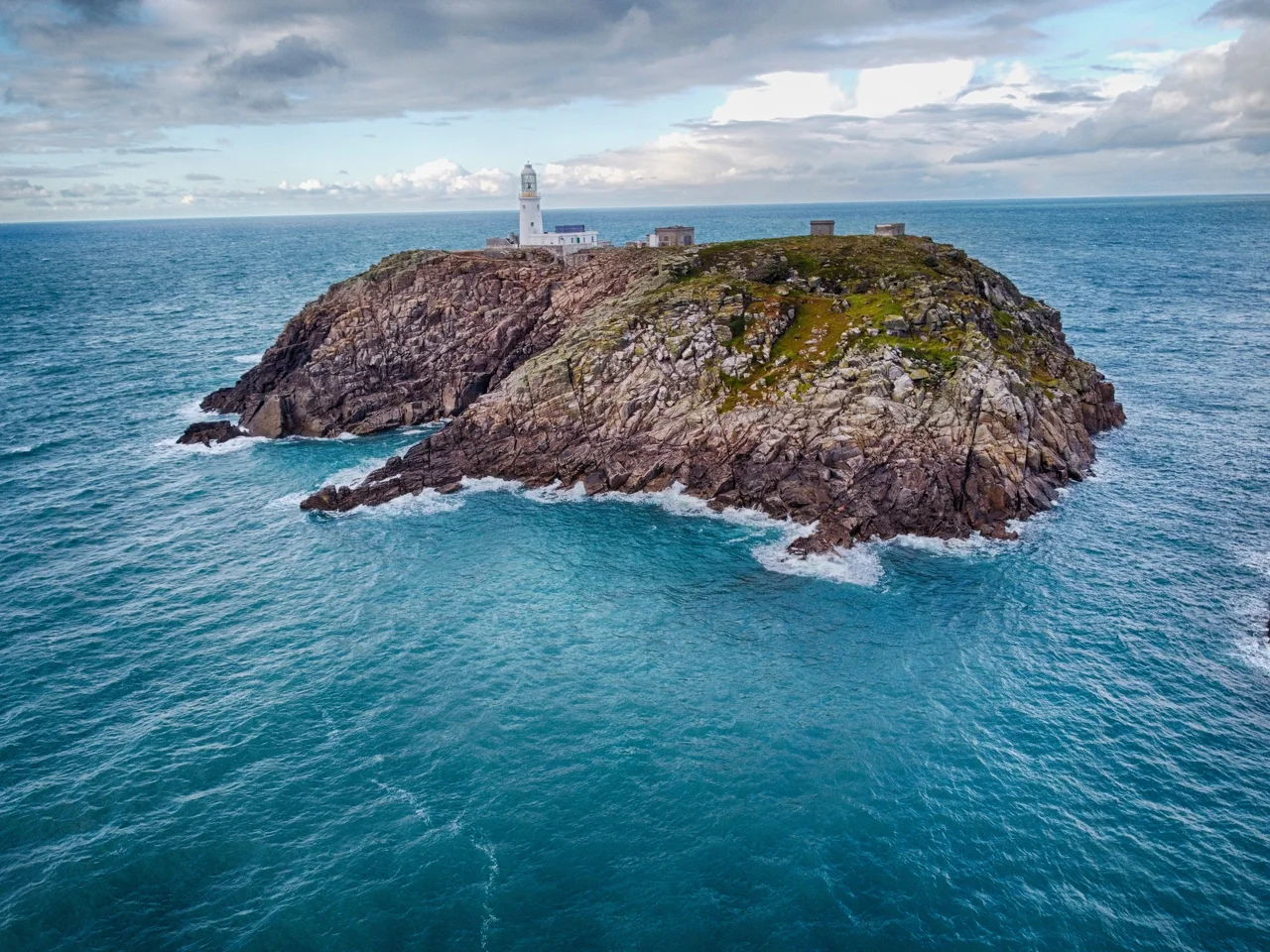

Round Island Light, Isles of Scilly
A lighthouse keeper on Round Island in the 1880s could not work out where the small black feathers were coming from. He kept finding them in the living quarters at night. Eventually he saved a few, identified the bird, and the cat was banished. The feathers belonged to European storm-petrels, the smallest seabird in the northern hemisphere, breeding silently in the crevices of the granite tower they shared with him. Today, a century and a half later, Round Island holds the second-largest storm-petrel colony in the Isles of Scilly, and the keepers and their cats are long gone. The light still flashes white every ten seconds.
The Hump Lighthouse
Round Island is a 35-metre hump of Hercynian granite rising at the northern edge of the Scilly archipelago, three miles from St Mary's and just north of St Helen's. The Cornish name for it translates as the hump lighthouse, and that is exactly what was built on top in 1887. William Tregarthen Douglass - chief engineer for the Commissioners of Irish Lights and a member of a famous family of British lighthouse engineers - designed the 19-metre ashlar granite tower for Trinity House. At the time of its building, it was one of only three lights in Scilly, alongside Bishop Rock to the west and St Agnes to the south, each marking a different approach through the rocks. Round Island guarded the northern threshold. Its first flash crossed the Atlantic on 12 November 1887.
Building on a Crag
Getting men and stone onto Round Island was its own engineering problem. There is no harbour, no beach, nothing but vertical granite walls dropping into deep water. Workers cut a flight of steps up the south face of the rock, and supplies were hauled up the cliff by an aerial cableway from a small landing. Inside the lighthouse walls the keepers tended a tiny vegetable garden, every spoonful of soil shipped in from somewhere else. The first optic was extraordinary: a biform hyperradial lens 4.6 metres tall, weighing over eight tons, built by Chance Brothers of Birmingham. To distinguish it from a similar lens at nearby Bishop Rock, Round Island's lamp showed a single red flash every thirty seconds - tinted glass dimmed the light, so engineers fitted oversized ten-wick burners to push it back through the colour. In 1912 a pair of huge red Rayleigh trumpets were mounted on a fog horn house alongside, blasting four notes every two minutes through the Atlantic murk.
The Keepers Leave, the Birds Stay
The light was electrified in 1966 and a helicopter pad was built on the rock in 1969, ending the cliff climb forever. Trinity House automated the lighthouse in 1987, and the last keeper turned off the kettle for good. Most of what they had brought with them - cats, rats, vegetable patches, oil-soaked rags - either left or had to be removed. The island was designated a Site of Special Scientific Interest in 1995 and is now managed by the Isles of Scilly Wildlife Trust. The European storm-petrels the old keepers once mistook for a draft of feathers are back in force: the Seabird 2000 survey counted 183 occupied nests, and a 2006 follow-up found 251, the second-highest total in Scilly. Manx shearwaters breed in the cliffs too. A long campaign to eradicate the brown rats that had reached the rock - probably via the cableway baskets a century before - was completed in the early 2020s, and the seabirds have responded.
Still Flashing
The original red flash was replaced long ago. The current lamp is a 360-millimetre revolving drum optic, upgraded to LED in 2025, throwing one white flash every ten seconds with an intensity of 42,945 candela and a range of 18 nautical miles. The tower itself is Grade II listed, and landing is forbidden except for maintenance. Approach Scilly from the north on a clear evening, by ferry or by air, and Round Island is the first thing that resolves out of the haze - a granite stub topped with a white drum, a horizontal flicker at the edge of the world. The puffins that workmen reported walking into their kitchens in 1887 are gone, lost to egg-collecting long before. The storm-petrels, smaller and more careful, are still here.
From the Air
Coordinates 49.9789°N, 6.3230°W, at the northern edge of the Isles of Scilly archipelago, just north of St Helen's. Best viewed at 1,500 to 2,500 feet AGL - the lighthouse is a 19-metre white tower on a 35-metre granite hump, visible in almost any weather as a distinct feature against open water. Nearest airport is St Mary's (EGHE), about three nautical miles south. Land's End Airport (EGHC) is roughly 30 nm east-northeast. The light flashes white every ten seconds, visible 18 nm in clear conditions. No landing on the island; it is a designated SSSI.
Nearby Stories
- Penlee lifeboat disaster 5.8 km away
- SS Georgia (1890) 18 km away
- Great Wheal Charlotte 28 km away
- 1979 Fastnet Race 37 km away
- Wheal Coates 66 km away
- SM U-27 93 km away
- HMS Affray 151 km away
- Tower of Hercules 719 km away