
Rovos Rail
It began with a misunderstanding about a hobby. In the mid-1980s a Pretoria businessman named Rohan Vos bought a few old passenger coaches, intending to hitch them to scheduled trains and take his family on holidays around South Africa. The national railway told him that was not how things worked. If he wanted to run his own carriages, he would have to run his own train. So he did. By 1989 the hobby had become Rovos Rail, and the family coaches had multiplied into a rolling hotel that now glides out of Capital Park Station and across the high veld toward Cape Town, Victoria Falls, and the Indian Ocean.
A Train That Refuses to Hurry
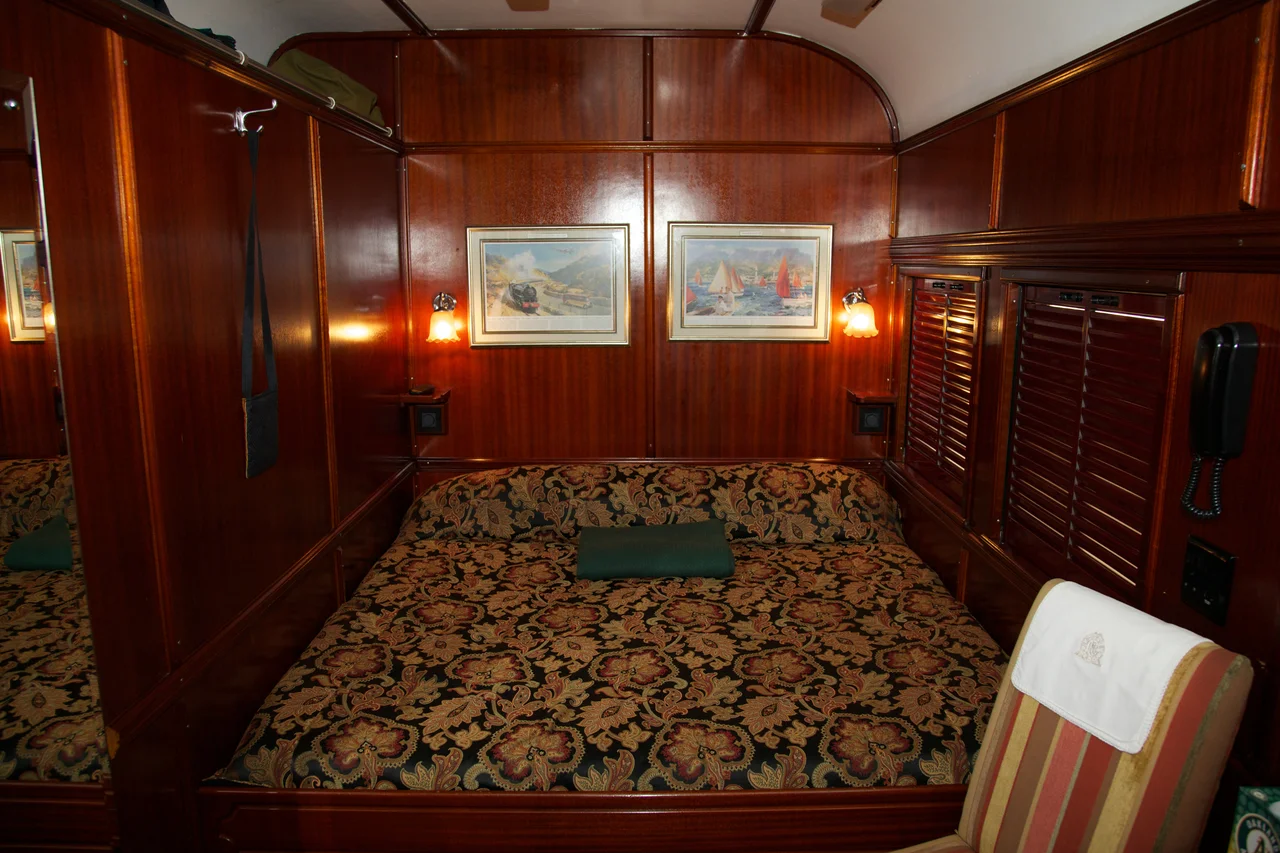
Rovos calls itself the "Pride of Africa," and the boast is built into the timetable. Where a modern express would sprint, the Rovos train ambles, because the point is the looking. Restored wood-panelled coaches, originally built for the National Railways of Zimbabwe, carry no more than a few dozen guests behind two lounges and two dining cars. There are no televisions in the compartments and, by long-standing house rule, mobile phones stay out of the public spaces. Passengers dress for dinner. Through the windows, the landscape unspools: Karoo scrubland, the lion-coloured grass of the highveld, escarpments dropping toward distant rivers. The experience is less transport than a moving country house, where the scenery does the entertaining.
Suites on Rails
The accommodation comes in three sizes, and even the smallest is generous by the standards of any railway. A Pullman suite folds out to roughly seven square metres; a Deluxe suite occupies more. The Royal Suite is the showpiece, taking up fully half a carriage at about sixteen square metres, with its own lounge and a Victorian-style bathtub set beside a picture window. Every compartment, from the modest to the palatial, has a private bathroom with shower, basin, and toilet. Hot water and crisp linen reach the most remote corners of the route, hundreds of kilometres from the nearest town. It is the contrast that lands hardest: a deep soak in a claw-foot tub while the wilderness of Southern Africa slides past the glass.
Saved From the Scrapyard
Behind the polished brass sits a quieter rescue operation. Rovos owns seven steam locomotives, and several were pulled back from the brink of the cutting torch. Three Class 19D engines, built in Germany in the 1930s and named Brenda, Bianca, and Shaun after Vos's children, were bought from scrap-metal dealers, painstakingly rebuilt, and returned to steam in 1989. The oldest locomotive in the fleet, a Class 6 christened 439 Tiffany after his youngest daughter, was constructed by Dübs & Company of Glasgow in 1893. The naming runs deep into the family: one engine honours Vos's mother, another his wife, and one carries the name King Zog, after a beloved Dalmatian. In the company's Capital Park depot, a workforce that has grown to more than four hundred keeps these machines, and the carriages they haul, alive.
The Day It Went Wrong
Luxury and risk share the same rails, and on 21 April 2010 the railway suffered its darkest hour. During a locomotive changeover at Centurion station, south of Pretoria, nineteen uncoupled carriages began to roll free, gathering speed with no engine to hold them. They ran back toward Pretoria station and crashed. Three people were killed and several passengers injured; roughly half of the train's fifty-five guests were aboard, along with members of the crew. The accident remains a sober counterpoint to the romance of the journey, a reminder that even the gentlest-seeming travel moves real weight at real speed. Rovos resumed operations, and the train continues to draw travellers from around the world, but the day is not forgotten.
Lines Across a Continent
From its Pretoria base, the Rovos network reaches astonishingly far. The classic three-night run descends to Cape Town; another climbs north to Victoria Falls, crossing the Zimbabwean border to one of the great waterfalls of the world. The most ambitious itineraries stretch over two weeks and thousands of kilometres, threading through Namibia to the Atlantic coast at Walvis Bay, or running clear across the continent to Dar es Salaam on the Tanzanian shore of the Indian Ocean. On some of these journeys the train rolls onto the storied TAZARA line, picking its way over river gorges in the African bush. Few forms of travel cover so much ground while asking the traveller to slow down so completely.
From the Air
Rovos Rail's home base, Capital Park Station, lies in northern Pretoria at roughly 25.72 degrees south, 28.19 degrees east, on the Highveld plateau at about 1,300 metres elevation. The depot's rail yards and the city's gridded streets are the navigational landmarks from the air. The nearest field is Wonderboom Airport (ICAO FAWB, elevation about 4,095 feet) on Pretoria's northern edge; Lanseria (ICAO FALA, about 4,517 feet) lies to the southwest, and OR Tambo International (ICAO FAOR, about 5,558 feet) serves greater Johannesburg some 50 km to the south. The Highveld offers reliably clear, dry skies through the winter months of June to August, with afternoon thunderstorms common in the summer.
Nearby Stories
- Little Foot 3.9 km away
- Hartebeesthoek Radio Astronomy Observatory 18 km away
- Boksburg explosion 23 km away
- Tswaing crater 24 km away
- Secunda CTL 69 km away
- Sun City 71 km away
- Bushveld Igneous Complex 87 km away
- Battle of Bergendal 127 km away