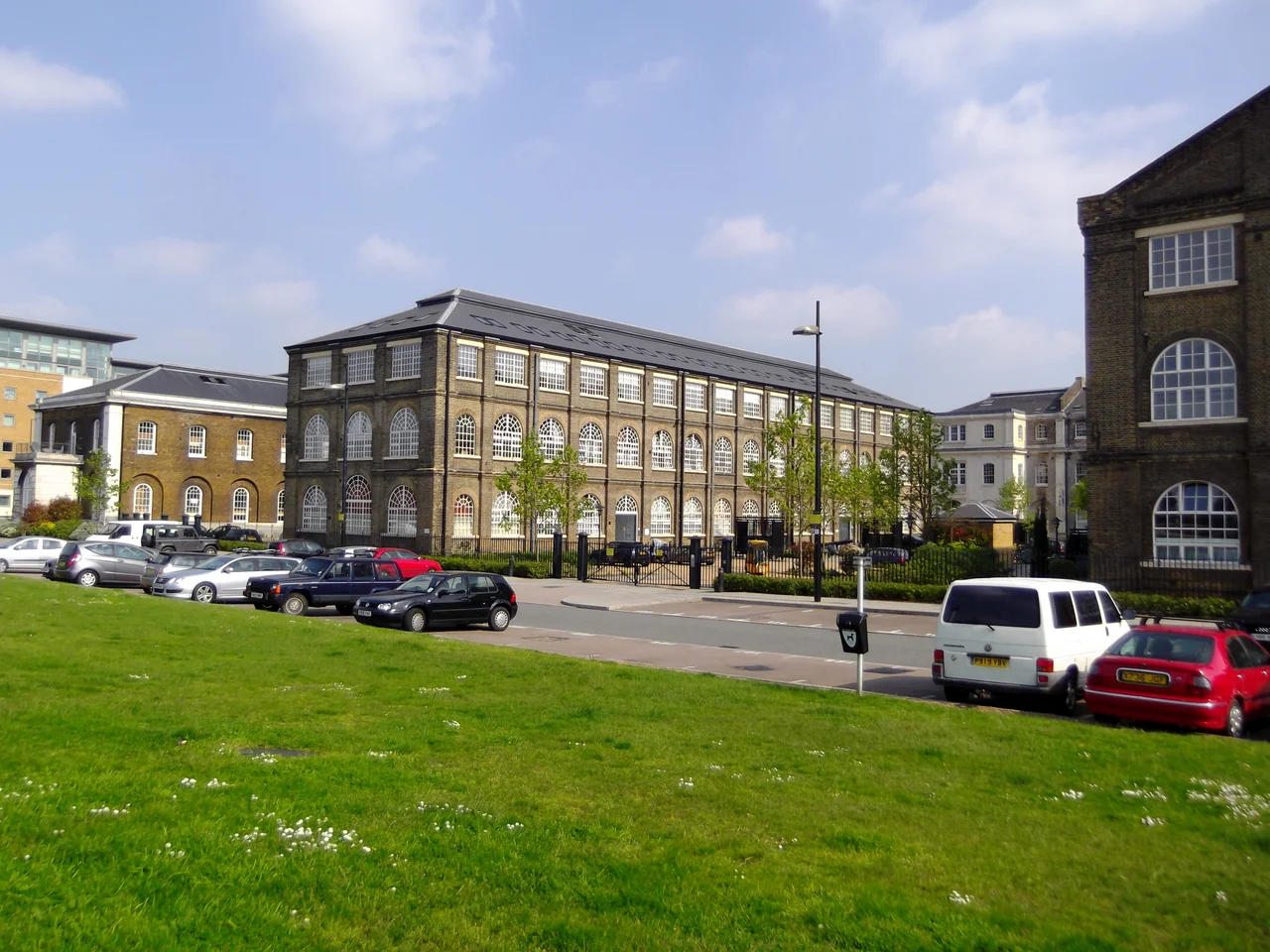

Royal Arsenal
It started as a Tudor mansion's rabbit warren. In 1651 the owners of Tower Place, a house with an octagonal tower built in the 1540s by goldsmith and Lord Mayor Martin Bowes, let the Board of Ordnance use the warren land to prove its cannons. Three hundred years later the Royal Arsenal at Woolwich covered 1,285 acres of the Thames south bank, employed close to 80,000 people during the First World War, and made shells, cartridges, fuses, gun carriages, torpedoes, rockets, and (after 1947) components for Britain's first atomic bomb. Today, you can buy a flat in the old Royal Carriage Works, see a play in the old Paper Cartridge Factory, and catch the Elizabeth Line at Woolwich station, which Berkeley Homes part-funded as it converted the place from secret enclave to neighbourhood.
The Warren
In 1667, in response to the Dutch raid on the Medway, the Crown built a gun battery here named after Prince Rupert. The following year the Board of Ordnance bought Tower Place outright, exchanging the old Gun Wharf at Woolwich Dockyard for the 31-acre estate. In 1682 the Board moved its main proving ground from the Tower of London to the Warren, sending a thousand cannon and ten thousand cannonballs downriver in one consignment. By 1716, two permanent companies of artillery were stationed here, marking the foundation of the Royal Artillery. A separate corps of twenty-six military engineers, founded the same year, became the Royal Engineers. Both regiments had their headquarters at the Warren for a time. In 1695 the Royal Laboratory was established here, manufacturing gunpowder, shell cases, fuses, and paper cartridges. By 1717, the Royal Brass Foundry opened, casting cannons in a high-ceilinged hall designed for boring vertical barrels. Its building still stands. In 1805, at George III's suggestion, the whole complex became known as the Royal Arsenal.
Convict Labour and the Boundary Wall
Expansion in the late 18th and early 19th centuries was achieved largely with convict labour. Between 1777 and 1778, convicts built a brick boundary wall around the site, eight feet high and two and a half miles long. The wall was raised to twenty feet near the Plumstead road in 1804. The same labour dug the Ordnance Canal in 1814 to 1816, forming the eastern boundary, and constructed the huge new wharf finished in 1813. The site was, by design, sealed off from the surrounding town. Inside the wall, the Arsenal pursued every innovation in artillery. Frederick Abel, the chemist, brought guncotton into safe use here and, with James Dewar, jointly invented cordite, winning a patent dispute with Alfred Nobel over the rights. The Arsenal proof butts, where every cannon and gun made in Britain was test-fired, were moved progressively eastwards across the site as the testing demands grew and the noise complaints from Woolwich grew louder.
The First World War and Eighty Thousand Workers
By 1914 the Arsenal was enormous and during the First World War it became colossal. At its peak the site covered 1,285 acres, stretching from Woolwich east across the Plumstead and Erith marshes to roughly where Thamesmead now stands. Close to 80,000 people worked here, many of them women drafted in by the shell shortage of 1915. They filled cartridges and fuses with explosive, an enormously dangerous job: yellow TNT residue stained their hands and faces, earning them the nickname canaries. Between the wars the workforce shrank. During the Second World War the Arsenal was bombed: one of the Frog Island buildings was destroyed in September 1940. From 1947 to 1951 it was a site of the British atomic weapons programme, called High Explosive Research, before the work moved to RAF Aldermaston. The factory finally closed in 1967. The Ministry of Defence moved out completely in 1994.
From Football to Football Boots
Some Arsenal stories have unexpected reach. In 1886, workers at the Royal Arsenal formed a football club called Dial Square, named after the sundial above their workshop entrance. They played their first match on 11 December, a 6 to 0 victory over Eastern Wanderers on the Isle of Dogs. Two weeks later they renamed themselves Royal Arsenal. In 1893 they entered the professional Football League as Woolwich Arsenal, and in 1913 they moved to north London and dropped the Woolwich. Arsenal Football Club is still here, still bearing the cannon on its crest, an industrial heritage that thirty thousand fans now sing about at the Emirates Stadium without always knowing why.
The Modern Quarter
Today's Royal Arsenal is one of the largest concentrations of Grade I and Grade II listed buildings converted to residential use in Britain. Berkeley Homes has built more than 3,000 flats on the western section: in The Armouries, The Warehouse, the Royal Artillery Quays towers. The Dial Arch pub opened in 2010 in the old Dial Arch building. Wellington Park provides green space between the apartment blocks. The Thames Clipper riverboat stops here. The Elizabeth Line station opened in 2022, part-funded by Berkeley. The eastern section, formerly Royal Arsenal East, sits separately at Plumstead. The old Paper Cartridge Factory (Building 17), Royal Laboratory Offices (Building 18), and surrounding buildings have become Woolwich Works, a 31 million pound cultural district housing rehearsal studios for resident companies including Chickenshed Theatre and the Greenwich Plus Docklands International Festival. The same brick walls that once sealed the place off now host theatre and dance. The Dial Arch, the Royal Brass Foundry, the riverside guardhouses of 1815 are all still there. So is the cannon on the Arsenal crest, pointing wherever the wind takes it.
From the Air
Located at 51.491 degrees north, 0.070 degrees east, in Woolwich. The Arsenal stretches along the south bank of the Thames between Woolwich proper and Thamesmead, with the old brick boundary wall still partly visible from the air. The Royal Brass Foundry and Dial Arch buildings are landmark survivors. London City Airport (EGLC) is about 2 nautical miles north across the river. Best viewed from low altitude on clear days, when the riverside guardhouses, the long apartment terraces, and the cultural district around No 1 Street can all be picked out.
Nearby Stories
- Hampton, London 1.1 km away
- Queenborough Castle 3.2 km away
- Groombridge Place 4 km away
- North Weald Airfield 4.9 km away
- Kings Langley Palace 8.3 km away
- White House Farm murders 11 km away
- Port Lympne Mansion 22 km away
- Amberley Museum & Heritage Centre 31 km away