.jpg)
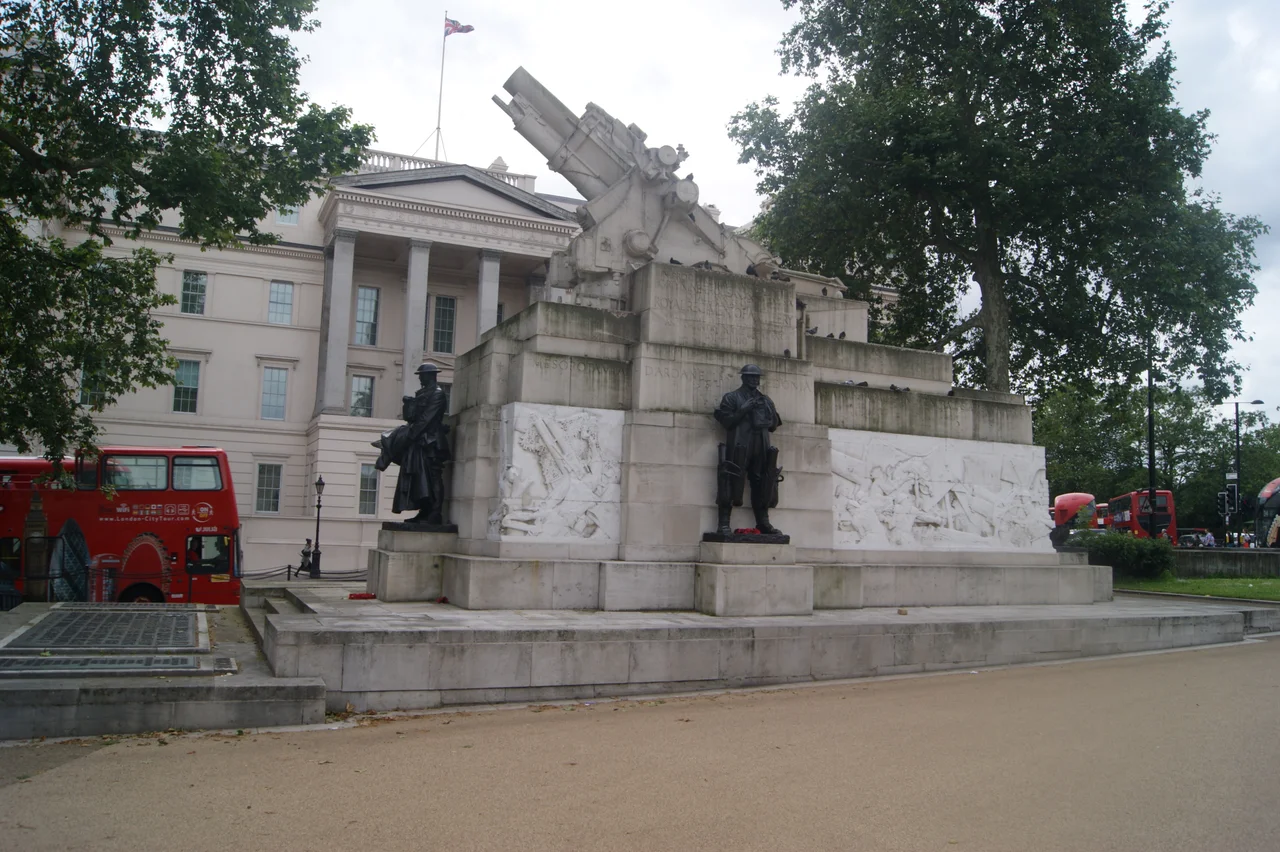
Royal Artillery Memorial
Most war memorials show soldiers as they would have wanted to be remembered: upright, healthy, immaculate. Charles Sargeant Jagger looked at the First World War and decided to do the opposite. On the north side of his memorial at Hyde Park Corner, he placed a fourth figure - a dead soldier, life-size, his greatcoat thrown over the body, his helmet resting on his chest. The committee that commissioned him was nervous about the idea. Some members worried it would shock the public, 'especially women.' Jagger offered to pay for the bronze casting himself. He got his way. When the Royal Artillery Memorial was unveiled by Prince Arthur on 18 October 1925, a corpse was lying at eye level on a major London war memorial - and that, more than anything else, is why we still talk about it.
49,076 Names
Trench warfare changed what artillery did and what it cost. Over half the casualties of the First World War were caused by guns like the BL 9.2-inch howitzer that Jagger placed, one-third over-life-size and carved in Portland stone, on top of his memorial. The Royal Artillery alone lost 49,076 men between 1914 and 1918 - the number now carved on the memorial's main inscription. The Royal Artillery War Commemoration Fund was set up in 1918 to figure out how to honour them. Members considered various options: a house for wounded soldiers, a network of small shrines, a contribution to some national monument. They were unimpressed with the regiment's existing Boer War memorial on the Mall, which they considered unimaginative. Sir Edward Poynter argued that future memorials needed more care, time, and funding. The committee took the advice. They eventually decided on a single, ambitious monument at Hyde Park Corner.
The Architects Who Said No
Three of the great Edwardian architects were approached first. Sir Edwin Lutyens sent in three designs, each under 15,000 pounds. The committee felt they looked too much like his Cenotaph and did not give artillery enough prominence. When the Office of Works said his designs would be too tall for the site, Lutyens withdrew. Sir Herbert Baker disagreed with the very idea of single-service monuments and walked away. Sir Aston Webb, who had designed the regiment's Boer War piece, declined to submit. Only then did the committee turn to Charles Sargeant Jagger - a sculptor, not an architect, and a former infantry officer who had been wounded at Gallipoli and Neuve-Eglise, awarded the Military Cross. The American painter John Singer Sargent, one of Jagger's patrons, may have nudged the committee. General Sir John Du Cane argued that this commission would make Jagger's reputation, and that the sculptor would therefore do his very best work. He was right.
Models with Names
Jagger took advice from the committee on technical matters - the howitzer's appearance, the gunners' uniforms - but he was fierce about the design itself. He engaged the architect Lionel Pearson to build the stone structure, a squat Roman cross of Portland stone supporting the oversized howitzer. The four bronze figures at the ends of the cross are based on real men. The driver, leaning back against the parapet with his cape draped over his outstretched arms, was modelled on William Fosten, an ex-gunner. The shell carrier was an ex-gunner named Metcalfe. The officer at the front, holding a greatcoat, was Lieutenant Eugene Paul Bennett, VC - who had fought in the same regiment as Jagger. We do not know who modelled for the dead soldier. Beneath that figure, Jagger had carved a line from Shakespeare's Henry V: 'Here was a royal fellowship of death.' He chose the quotation himself.
The Argument
When the memorial was unveiled, the argument that followed was as loud as the howitzer was big. The Times compared it unfavourably to the Cenotaph. The Daily Mail argued the money could have gone toward injured veterans instead. Modernists, including the critic Roger Fry, dismissed the memorial as conventional. The Cenotaph's whole approach - clean abstract architecture, allegorical figures of Peace and Victory, soldiers depicted as Homeric warriors if at all - had set the template. Jagger broke it. His gunners stand at ease rather than at attention. The driver looks contemplative or exhausted. The dead soldier is faceless and heavily laden, pulled down as if by a great weight. The howitzer is unmistakably a weapon, not a symbol. Some critics found this dehumanising. But ex-servicemen quoted in the press said the bronze figures had captured the reality of their time in the artillery. Two days after the official ceremony, a crowd gathered in the rain before dawn to hold an unofficial commemoration. The Illustrated London News thought that said more than the critics did.
The Greatest Sculpture
Jagger paid for the memorial in another way too. After delivering it - already running four months late, his best assistant having resigned earlier in 1925 - he suspended work on all his other commissions for six months to recover. He was awarded the Royal British Society of Sculptors' gold medal in 1926. The Royal Artillery Memorial slowly became understood as his masterpiece. In 1949 a set of bronze tablets was added at its base, commemorating the 29,924 Royal Artillerymen killed in the Second World War, unveiled by the future Queen Elizabeth II. The memorial was Grade II* listed in 1970, then upgraded to Grade I in July 2014 to mark the centenary of the First World War - reserved for structures of 'the greatest historic interest,' about 2.5 percent of listed buildings. In 2004 the critic Brian Sewell called it 'the greatest sculpture of the twentieth century.' Historic England, in its citation, calls it 'internationally recognised as one of the finest memorials to have been erected anywhere after the First World War.' The dead soldier still lies there, on a traffic island at Hyde Park Corner, refusing to look like a hero.
From the Air
The Royal Artillery Memorial sits at 51.503 N, 0.152 W on the central island at Hyde Park Corner in the City of Westminster, central London. Look for the cruciform stone monument with the carved howitzer on top, immediately south-east of the Wellington Arch and surrounded by other war memorials. Nearest major airports: London City (EGLC) seven miles east; London Heathrow (EGLL) thirteen miles west. From cruise, find the rounded south-east corner of Hyde Park where it meets Green Park - the memorial island is the busy junction with the arched gateway.
Nearby Stories
- Battle of Britain, Northfleet 1.1 km away
- Bayham Old Abbey 5.4 km away
- Catharine Macaulay 6.4 km away
- Hatfield rail crash 8.8 km away
- Chequers 8.9 km away
- Chelmsford Cathedral 10 km away
- Queen Victoria Hospital 13 km away
- Fishbourne Roman Palace 36 km away