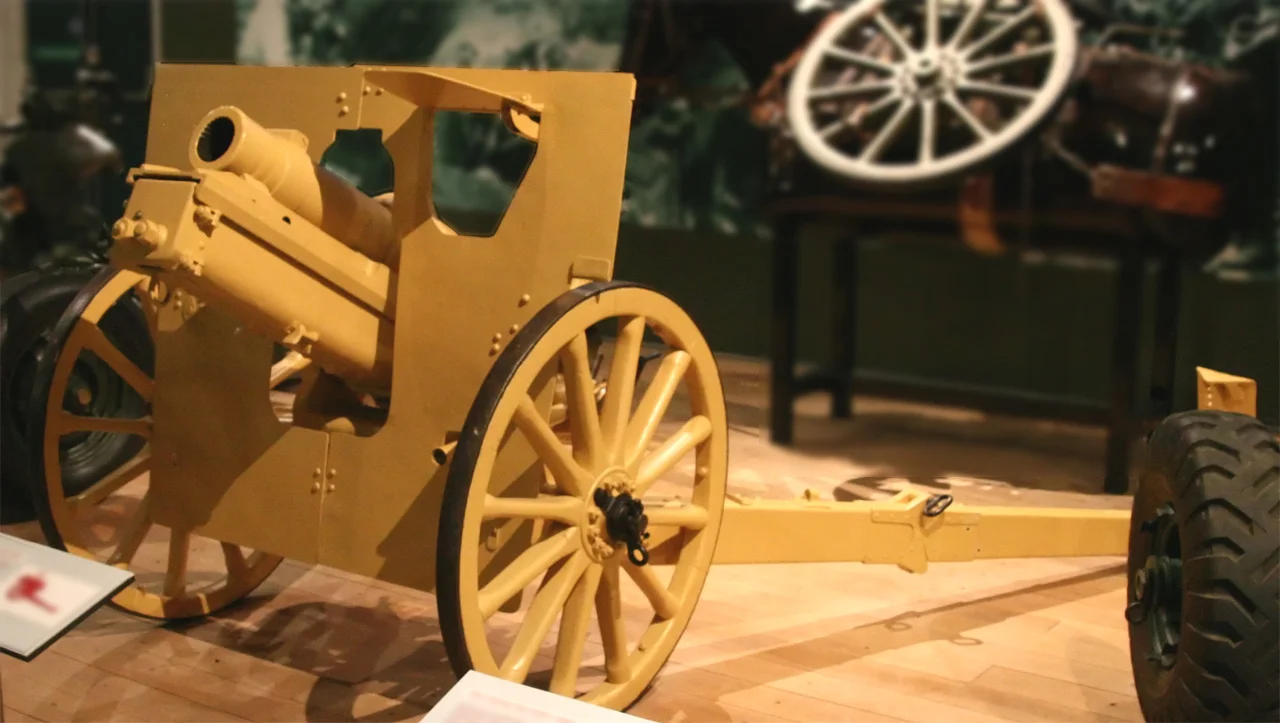

Royal Artillery Museum
In 1814, while the Duke of Wellington was finishing the job of defeating Napoleon, the Prince Regent threw him a celebration ball in the gardens of Carlton House in London. The architect John Nash designed the venue: a circular marquee dressed up to look like an elaborate military bell tent, named the Rotunda. When the parties were over, the building had no obvious next use. In 1818 the Prince Regent gave it to Woolwich, where it was disassembled, transported, and rebuilt on a Repository Grounds hilltop. On 4 May 1820 it opened as one of the world's first free permanent public museums. For 179 years it housed the Royal Artillery Museum.
Captain Congreve's Repository
The story really starts in 1778 with Captain William Congreve of the Royal Artillery, a veteran who had served as a lieutenant firework in Canada during the Seven Years' War. He had come back convinced that artillerymen needed proper training in manoeuvring heavy ordnance through difficult terrain. So inside the Royal Arsenal at Woolwich, he set up the Royal Military Repository: a two-storey building beside the Carriage Works where cannons were stored on the ground floor for field training and smaller items and instructional models were displayed upstairs. It was a teaching collection. But it became a museum almost by accident, as cadets and visitors discovered the upstairs rooms full of small arms, model engines, and trophies brought back from successive wars.
Fire and Rotunda
In 1802, the Repository building was seriously damaged by fire, probably arson. The salvaged collection moved into the vacated premises of the Royal Military Academy when that institution moved up to Woolwich Common in 1806. After Congreve senior died in 1814, his son William Congreve (better known as the inventor of the Congreve rocket) succeeded him as Commandant of the Repository. The younger Congreve secured the disused Rotunda, originally erected for the Duke of Wellington celebrations of 1814, as a new permanent home. On 7 December 1818 he wrote requesting it be erected on the brow of the hill at the eastern boundary of the Repository Grounds, that spot being the most convenient as well as the most picturesque situation for it. The Rotunda was rebuilt there during 1819, and the Museum of Artillery in the Rotunda opened to the public on 4 May 1820, free of charge: an early, accessible public museum nearly a decade before the British Museum even installed coat-check facilities for visitors. Congreve added his own celebrated rocket inventions to the collection, alongside models, cannon, and trophies. Larger artillery pieces were displayed outside on the grass.
A Second Museum on the Common
Quite separately, the Royal Artillery Institution founded in 1838 began collecting its own material: uniforms, medals, regimental archives. Its headquarters lay within the Royal Artillery Barracks on Woolwich Common, where the Royal Artillery had been quartered since moving up from the Arsenal in 1777. During the Blitz the Institution headquarters was severely damaged. Everything salvageable from the museum, library, and archives was moved in 1941 to the central block of the recently vacated Royal Military Academy building on the Common; the academy had transferred to Sandhurst in 1939. The Institution's regimental collection stayed in that building until 1999, when it was combined with the Rotunda collection to create a new merged museum on the Royal Arsenal site, branded Firepower.
Firepower, and Then Silence
Firepower: The Royal Artillery Museum opened in 2001 in former Royal Laboratory Department buildings on the Arsenal site, mostly Grade II listed. The Gunnery Hall in old Building 17 (the Paper Cartridge Factory of 1855 and 1856) displayed 20th-century pieces below and older artillery above. Building 18, the former Royal Laboratory Offices, housed the museum offices and the James Clavell Library archive. Building 41, across the way, contained large Cold War-era pieces, including a section of the 1990 to 1991 Iraqi supergun that intelligence agencies had intercepted en route to Saddam Hussein. There was a Gatling gun, a 3.7-inch mountain howitzer, an Abbot self-propelled gun. The Royal Artillery Museum collection is designated by Arts Council England as being of national and international significance. But Firepower struggled to attract visitors to its riverside location, and it closed in July 2016. A board member called the closure a missed opportunity. The buildings were acquired by Greenwich Council as part of plans for a new cultural quarter.
Waiting on Salisbury Plain
The plan was to relocate the entire Royal Artillery Museum collection to a new building on Salisbury Plain at Avon Camp West, south of Netheravon, much closer to where the Royal Regiment of Artillery is now based. But in 2020 the Army withdrew its support for the proposed lease, and the project went into what was politely called strategic re-appraisal. The exhibits sit in storage with limited public access. Building 17 became part of Woolwich Works, the 31 million pound cultural district that opened in the same buildings Firepower once occupied, where 450-seat theatres and rehearsal studios now host Chickenshed Theatre, Protein Dance, and the Greenwich Plus Docklands International Festival. The Rotunda itself is still standing on Repository Road, empty now, its conical roof and Nash-designed bell-tent profile distinctive against the sky. The oldest public museum in this corner of London is no longer open. The artillery, for now, has gone quiet.
From the Air
The original Rotunda building stands at approximately 51.483 degrees north, 0.063 degrees east on the southern edge of Woolwich Common, recognisable by its conical roof in bell-tent profile. The Firepower buildings (now Woolwich Works) lie within the Royal Arsenal at 51.494 degrees north, 0.071 degrees east. London City Airport (EGLC) is about 2 nautical miles north across the Thames. The Rotunda's distinctive shape is the easier of the two locations to spot from low altitude.
Nearby Stories
- Hampton, London 1.1 km away
- Queenborough Castle 3.2 km away
- Groombridge Place 4 km away
- North Weald Airfield 4.9 km away
- Kings Langley Palace 8.3 km away
- White House Farm murders 11 km away
- Port Lympne Mansion 22 km away
- Amberley Museum & Heritage Centre 31 km away