.JPG)
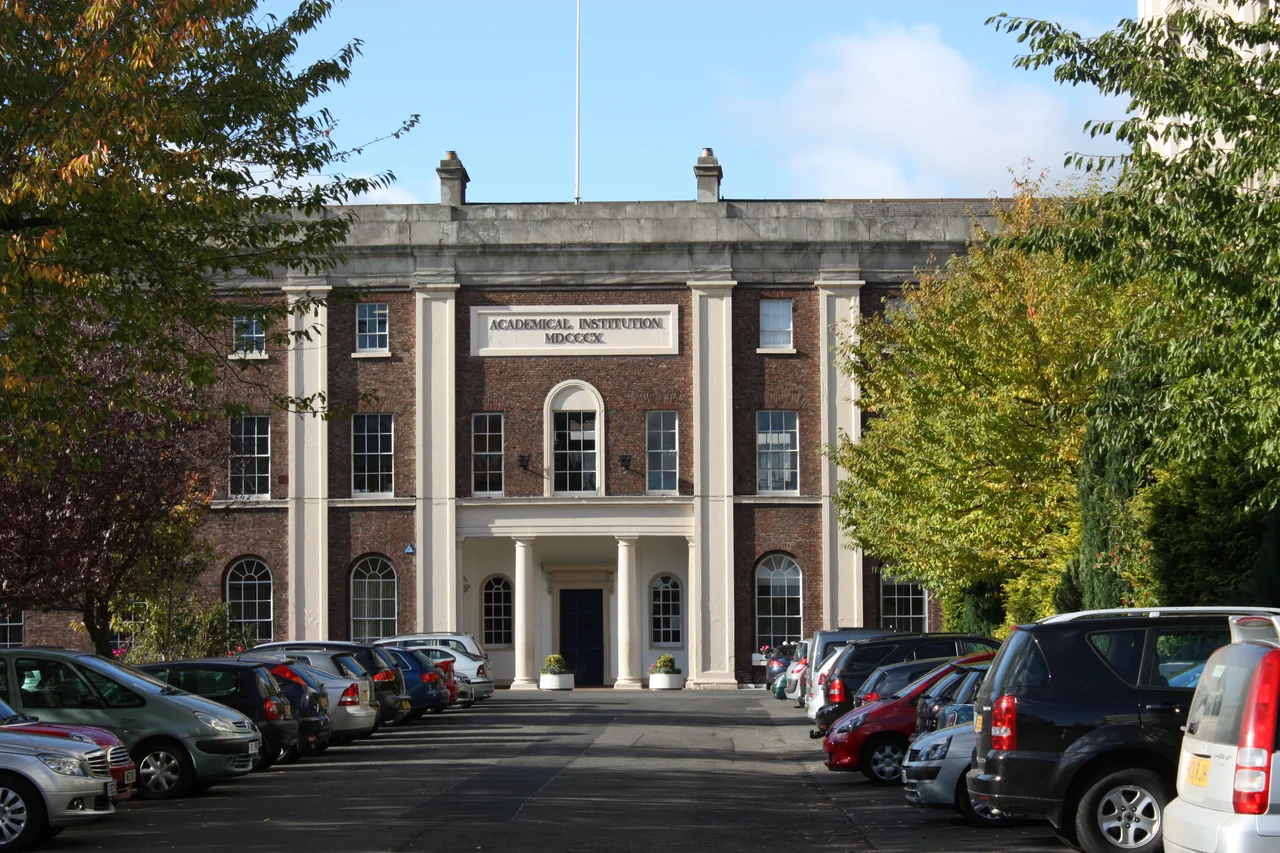
Royal Belfast Academical Institution
The architect of the Bank of England designed it for free. The first principal had been a United Irishman. The foundation stone was laid by the local Marquess in 1810; the doors opened in 1814 with a speech in which William Drennan - the man who first called Ireland 'the Emerald Isle' - promised that admission would be 'perfectly unbiased by religious distinctions' and that discipline would rely on 'example' rather than 'manual correction or corporal punishment.' Two centuries later the Royal Belfast Academical Institution, known to every Belfast schoolboy simply as Inst, still occupies the same 18-acre site in the city centre. The Doric columns Soane drew were never built - the budget ran out. But the school survived its founders, its founders' politics, and an awful lot of subsequent attempts to close it.
The Dissident Founders
Inst was born out of defeat. In 1798 the United Irishmen rebellion had failed, and many of its leaders - the Belfast Presbyterian reformers, doctors and merchants who had backed Wolfe Tone - were either dead, exiled, or imprisoned. William Drennan, who had drafted the United Irish constitution, was now a chastened middle-aged poet and physician who believed that Irish reform would only come through education. With his fellow former United Irishmen Robert Simms and the Tennent brothers, and the botanist John Templeton, he persuaded a town meeting in 1807 to back a new academical institution with a school department for boys and a collegiate department teaching both sexes. They raised £25,000 from Belfast merchants and from £5,000 collected in India under the patronage of the Earl of Moira. Sir John Soane, architect of the Bank of England, drew the plans gratis. The Marquess of Donegall laid the foundation stone in 1810. The institution opened on 1 February 1814.
Toasts to the French Revolution
The first generation of staff and board members did not hide their politics. At a St Patrick's Day dinner in 1816 chaired by Robert Tennent, board members and staff drank a series of toasts that would have horrified any London official: to the French and South American Revolutions, to Catholic Emancipation, to 'a Radical Reform of the Representation of the People in Parliament,' and to 'the exiles of Erin' under 'the wing of the republican eagle' in the United States. The government, which had reluctantly granted £1,500 a year to the college's Presbyterian seminary, attached conditions to the grant. Board members resigned. The school's library that same year included books by William Godwin, Joseph Priestley, and the radical John Horne Tooke. Despite this, by 1831 the government had not only restored the grant but King William IV bestowed the title 'Royal' on the school. Inst had become respectable enough to be tolerated - though never trusted.
Henry Cooke's War
Inst's next enemy was internal to Ulster Presbyterianism itself. The conservative preacher Henry Cooke believed Inst's teaching staff combined theological laxity with political subversion. Two professors in particular - Henry Montgomery of the English department and the younger William Bruce in classics - refused to subscribe to the Westminster Confession of Faith, which described the Pope as the Antichrist and required affirmation of the Holy Trinity. Cooke accused them of Arian and Socinian heresy. The board refused to hold a religious inquisition into staff beliefs. Cooke lost his battle to remove them but won a longer war: in 1853 the Presbyterian Synod established the separate Assembly College specifically to train ministers outside Inst's influence. More damagingly, the dispute meant that when the government created Queen's College Belfast in 1845-49, Inst was passed over for the role. The collegiate department closed in 1849. The school continued. The dream of being a university quietly died.
Three Boys and the Titanic
In the 1860s two Inst boys left the school at fifteen, having decided that an apprenticeship at Harland and Wolff was a better prospect than the Indian Civil Service exam. William Pirrie eventually became chairman of the shipyard. Alexander Carlisle became its yard manager. In 1889 they were joined by a third Inst alumnus, Thomas Andrews, who rose to head the draughting department. Between them, these three Old Instonians designed and built nearly every great White Star liner of the early 20th century: the Oceanic II in 1899, the Olympic in 1911, and the Titanic, completed in 1912. Andrews sailed with the Titanic on her maiden voyage and went down with the ship. Carlisle had retired before the design was finalised but had been responsible for the original lifeboat-davit specifications. Pirrie survived both his school friends and was created Viscount Pirrie. A photograph of the three of them, all wearing the same Inst tie, has become one of the school's prized possessions.
Through the Bombs
Inst sits in central Belfast immediately next to the Europa Hotel, which during the Troubles became 'the most bombed hotel in the world' - hit 36 times. The school had regular bomb alerts. Pupils evacuated to the front lawn. Yet across the entire thirty-year Troubles, the school is proud to record, not a single school day was lost. The 700 old boys who served in the First World War and the 106 who died in the Second are commemorated on bronze plaques in the entrance hall. The school still operates as a voluntary grammar school with around 1,200 boys aged 11-18 on the main site, plus a preparatory department, Inchmarlo, in south Belfast. Rugby is the sport - Inst has won the Ulster Schools Cup outright 34 times, second only to Methody. The Royal Academical Debating Society, founded with the school in 1814, is the oldest continuously extant debating society in Ireland. The Soane-designed central block is now a Grade A listed building. The school's first principal was appointed in 1898 - 84 years after it opened. Some institutions are in no hurry.
From the Air
The Royal Belfast Academical Institution sits at 54.597°N, 5.936°W in central Belfast, immediately south-west of the City Hall and immediately east of the Europa Hotel. From the air, look for an 18-acre walled campus inside the city-centre grid - a long brown-brick central building (the Soane block) facing College Square East, with playing fields to the rear and sports halls and a sixth-form centre clustered around. The Europa Hotel and the Grand Opera House are the immediate neighbours. Belfast City Airport (EGAC) is 2 nautical miles east-north-east; Belfast International (EGAA) is 13 nautical miles west-north-west. Recommended viewing altitude: 1,500-3,000 feet for the school's central plaza and the surrounding civic-centre rooftops.
Nearby Stories
- Larne 1.2 km away
- Ahoghill 3.5 km away
- Castleskreen 4.9 km away
- Lough Neagh 6.1 km away
- Kingsmill Massacre 14 km away
- Pasages (steam trawler) 23 km away
- Ballantrae Lifeboat Station 34 km away
- St Patrick's Isle 39 km away