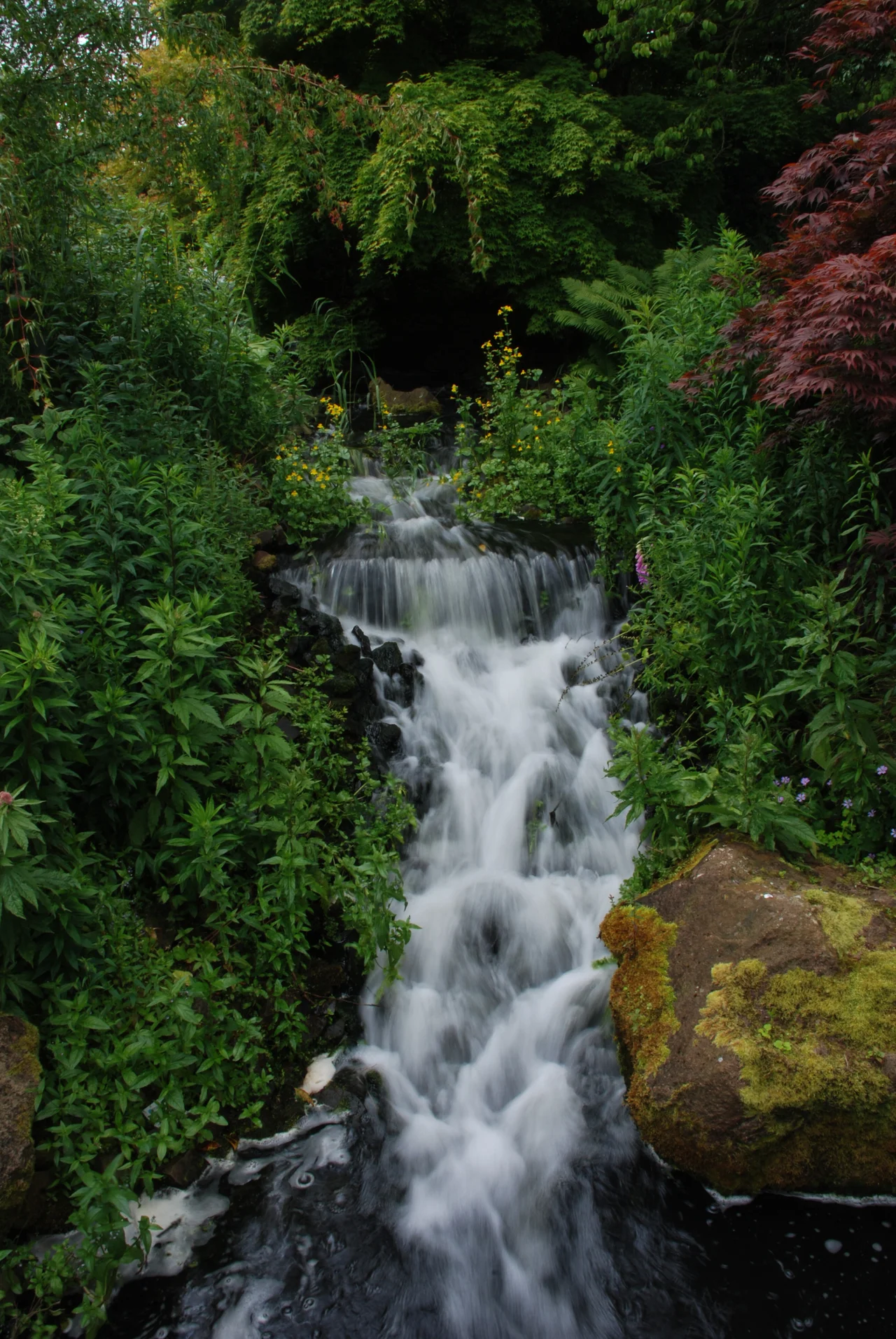

Royal Botanic Garden Edinburgh
In 1670, two Edinburgh physicians enclosed forty square feet of ground next to Holyrood Palace and planted somewhere between eight and nine hundred medicinal herbs. They needed the plants to teach apothecaries and treat patients - botany was still mostly a medical discipline - and they could not get reliable supplies any other way. From that small physic garden grew the Royal Botanic Garden Edinburgh, which today spreads across seventy acres a mile north of the city centre and holds more than 13,000 species. It is the second-oldest botanic garden in Britain, beaten only by Oxford, and its three million herbarium specimens travel the world by digital scan to researchers in 157 countries.
Four Sites, Four Climates
The Edinburgh garden could not grow everything Scotland might want to grow. So over the twentieth century, the Royal Botanic Garden acquired three regional gardens, each with a climate the main site lacks. Benmore, on the wet west coast, became a regional garden in 1929 - its avenue of giant redwoods and its refurbished fernery thrive in oceanic rainfall. Logan, in the southwest at the tip of the Galloway peninsula, has an almost subtropical climate warmed by the Gulf Stream; it grows southern hemisphere plants that would die in Edinburgh. Dawyck, in the Borders south of Peebles, is colder and drier, suited to hardy alpines and cryptogams. Together the four sites let RBGE conserve plants from nearly every climate band, all within Scotland.
Moved by a Drained Loch
The garden has occupied four different sites in Edinburgh during its 355 years. The first, at St Anne's Yard near Holyrood, proved too small. In 1676 the operation moved to a second site east of the Nor Loch - the long marshy lake that filled what is now Princes Street Gardens. Then in 1689, for military reasons, the Nor Loch was drained. The water and mud poured into the garden, ruining most of the plants. By 1695 the survivors had been moved to a third site. In 1763, Professor John Hope shifted the entire collection out of the polluted city centre to a five-acre Physick Garden on Leith Walk, where he raised the first rhubarb plants grown in Britain from seeds brought to him by the African explorer Bruce of Kinnaird. In the 1820s, under curator William McNab, the collection moved one last time, to its present home beside Inverleith Row.
The Glasshouses and Inverleith
The Temperate Palm House, built in 1858, remains the tallest in Scotland - a soaring iron-and-glass structure designed to give palms the headroom they refuse to forgive. The Edinburgh garden is locally just "the Botanics," and locals walk it the way other cities walk waterfronts. Entry is free; only the glasshouses cost a few pounds. Inverleith House, an eighteenth-century mansion bought by the city in 1877 and added to the garden, sits at the centre of the grounds. From 1960 to 1984 it was the Scottish National Gallery of Modern Art before that gallery outgrew it; today Inverleith House shows contemporary art and exhibits drawn from the garden's historical collections. The view from the lawn south of the house frames the Old Town skyline - castle, crowns of Old College and St Giles, all rising on their volcanic ridge a mile away.
Three Million Specimens, Digitised
The herbarium - the scientific archive of pressed and preserved plants - holds more than three million specimens collected over centuries from 157 countries. For most of that time, accessing a specimen meant travelling to Edinburgh. Now RBGE is photographing them all at high resolution and putting them online. The one-millionth digitised specimen was Stereocaulon vesuvianum, a lichen collected by Dr Rebecca Yahr on the slopes of Ben Nevis in 2021. Researchers from anywhere can now compare type specimens, trace historical distributions, and work on conservation problems without leaving home. The original physic garden of 1670 served the city's apothecaries. The same institution, three and a half centuries later, serves botany worldwide - and still lets Edinburgh families wander its lawns on a Sunday afternoon.
From the Air
Located at 55.9651 N, 3.2085 W, about one mile north of Edinburgh city centre, on the north side of the Water of Leith. Nearest airport is Edinburgh (EGPH), 10 km southwest. From the air, look for the band of green between the New Town's Georgian grid and the suburb of Inverleith - the Botanics covers 70 acres with a distinctive crescent of glasshouses near its southern edge. Best appreciated from low altitude on a sunny day, with the castle rock visible beyond to the south.
Nearby Stories
- Ardoch Roman Fort 2.2 km away
- Craignethan Castle 3.1 km away
- Haddington 3.8 km away
- Balvaird Castle 4.3 km away
- Battle of Kilsyth 9.4 km away
- Siege of St Andrews Castle 9.9 km away
- Neidpath Castle 11 km away
- Melrose Abbey 15 km away