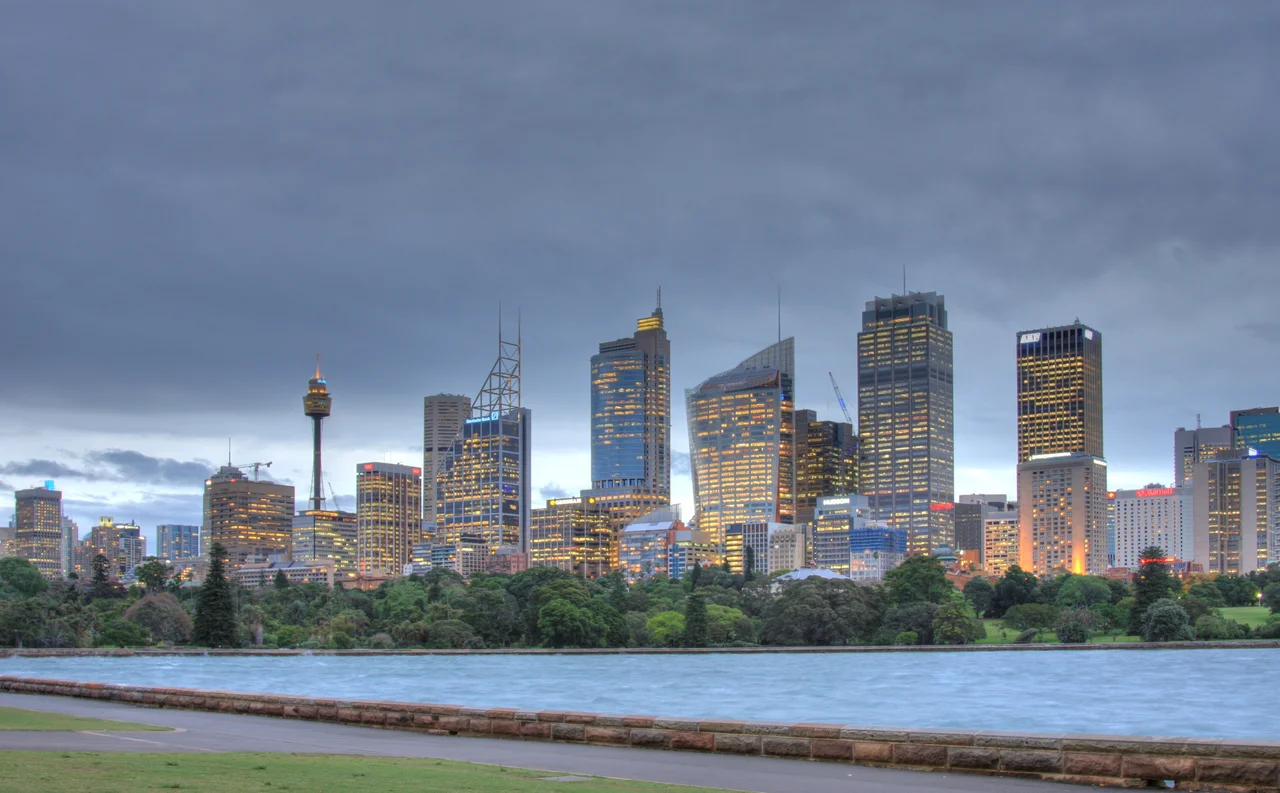

Royal Botanic Garden, Sydney
The ground slopes gently down toward the water, a green amphitheatre wrapped around the curve of Farm Cove, with the white sails of the Opera House at one edge and the city towers rising behind. It looks effortless now, thirty hectares of lawns and palm groves on some of the most valuable harbour frontage on Earth. But this soil has been worked harder, and for longer, than almost any other in Australia. This is Gadigal country, land the Cadigal people knew as Cadi, where they had lived and gathered for thousands of years. It was also where the newcomers, in 1788, drove their first ploughs into the earth and very nearly starved.
The Farm That Failed
The story of the garden begins with hunger. When Governor Arthur Phillip stepped ashore in 1788, the survival of the entire colony depended on coaxing food from unfamiliar ground, and he chose this curve of harbour shore, Farm Cove, for the settlement's first farm. It was a poor choice in some ways: the sandy soil was thin and stubborn, and the crops struggled. The farm effectively failed. Yet the land was never abandoned. Generation after generation found ways to make the difficult soil yield, and it has been under continuous cultivation ever since, an unbroken thread of more than two centuries. The squared garden beds you can still see in the Middle Garden are said to trace the lines of those very first furrows, the ghost of a desperate experiment that became the seed of something enduring.
The Oldest Science in the Country
In 1816, Governor Lachlan Macquarie formally founded a botanic garden on the old farm site, and in doing so created the oldest scientific institution in Australia. The following year the colony appointed its first Colonial Botanist, Charles Fraser, and the garden's true work began: collecting, studying, and trading plants with the wider world. It became a node in a vast colonial exchange network, sending Australian natives off to Europe and receiving species from every temperate corner of the globe to be acclimatised in Sydney soil. Crops that would build whole industries passed through here, including the early stock of Australia's wine and olive trades. Today the National Herbarium on the grounds holds more than 1.4 million plant specimens, among them samples gathered by Joseph Banks and Daniel Solander on James Cook's first Pacific voyage in 1770.
Moore's Long Labour
If one person shaped the garden as we see it, it was Charles Moore. A Scotsman trained at Trinity College Dublin, Moore took over as Director in 1848 and held the post for forty-eight years, an astonishing tenure that let him think in decades. He inherited Phillip's old problems, poor soil, scarce water, thin funding, and attacked them with patience and nerve. He laid out the Palm Grove at the garden's heart, a collection of temperate and subtropical palms now counted among the finest in the world. Most dramatically, between the 1840s and 1870s he had a great seawall built around Farm Cove and reclaimed its tidal flats to enlarge the lower garden, raising the wall partly from stone salvaged from a demolished government building. That hand-hewn sandstone seawall, curving from Mrs Macquarie's Point to the Opera House, remains the garden's signature feature.
The Tarpeian Rock
Not every corner of the garden is gentle. At its northwestern edge, facing Bennelong Point and the Opera House, stands a sheer quarried cliff of sandstone known as the Tarpeian Rock. The name is a grim borrowing: the original Tarpeian Rock was a cliff on Rome's Capitoline Hill from which condemned prisoners were hurled to their deaths. Sydney's version got the name in the 1880s, when the headland was cut away to extend Macquarie Street, leaving a dramatic vertical face with stone steps and an early carving that reads "The Tarpeian Way." The cliff now does quiet duty as a kind of backstage wall to the Opera House forecourt, an enclosing edge to one of the most famous public spaces in the world. It is the only visible trace of what stood on the Opera House site before the Opera House itself.
The Battle of the Bats
For decades the garden hosted unwanted tenants: a colony of grey-headed flying foxes, fruit bats sometimes numbering more than 20,000, that roosted in the historic trees and slowly destroyed them. By the time the trust acted, the bats had killed or badly damaged dozens of mature trees and palms around the Palm Grove. The eviction, announced in 2010, was strange and contentious. The plan was to drive the bats off with blasts of loud recorded noise, which an animal welfare group fought in court for years before approval came in 2012. By June 2013 the colony had abandoned the garden, and the wounded trees began to recover. The episode had an ironic afterlife: many of the displaced bats relocated to a forest on the New South Wales north coast that was itself slated for destruction to widen a highway, turning one conservation fight straight into another. The garden, meanwhile, keeps growing on its two-hundred-year-old ground, free at last to be visited every day of the year.
From the Air
The Royal Botanic Garden wraps around Farm Cove on the eastern edge of the Sydney CBD, at 33.86°S, 151.22°E, immediately east of the Sydney Opera House on Bennelong Point. From the air it is a broad green crescent against the harbour, its curved sandstone seawall tracing the shoreline from the Opera House to Mrs Macquarie's Point, with the city skyline behind and the Harbour Bridge just to the northwest. The garden's lawns and the darker mass of the Palm Grove stand out clearly amid the dense city. Best viewed from 1,500–2,500 feet on a clear day. The nearest major airport is Sydney Kingsford Smith (YSSY / SYD), about 8 km south; Bankstown (YSBK) lies to the southwest. This is congested controlled airspace beneath approaches to YSSY, with frequent harbour seaplane and helicopter traffic nearby.
Nearby Stories
- Royal National Park 28 km away
- Jervis Bay 107 km away
- Hive shipwreck 149 km away
- Apsley Falls 283 km away
- Smoky Cape Lighthouse 316 km away
- South West Rocks Pilot Station Complex 346 km away
- Roxy Theatre and Peters Greek Cafe Complex 413 km away
- 2003 Fiordland Earthquake 1774 km away