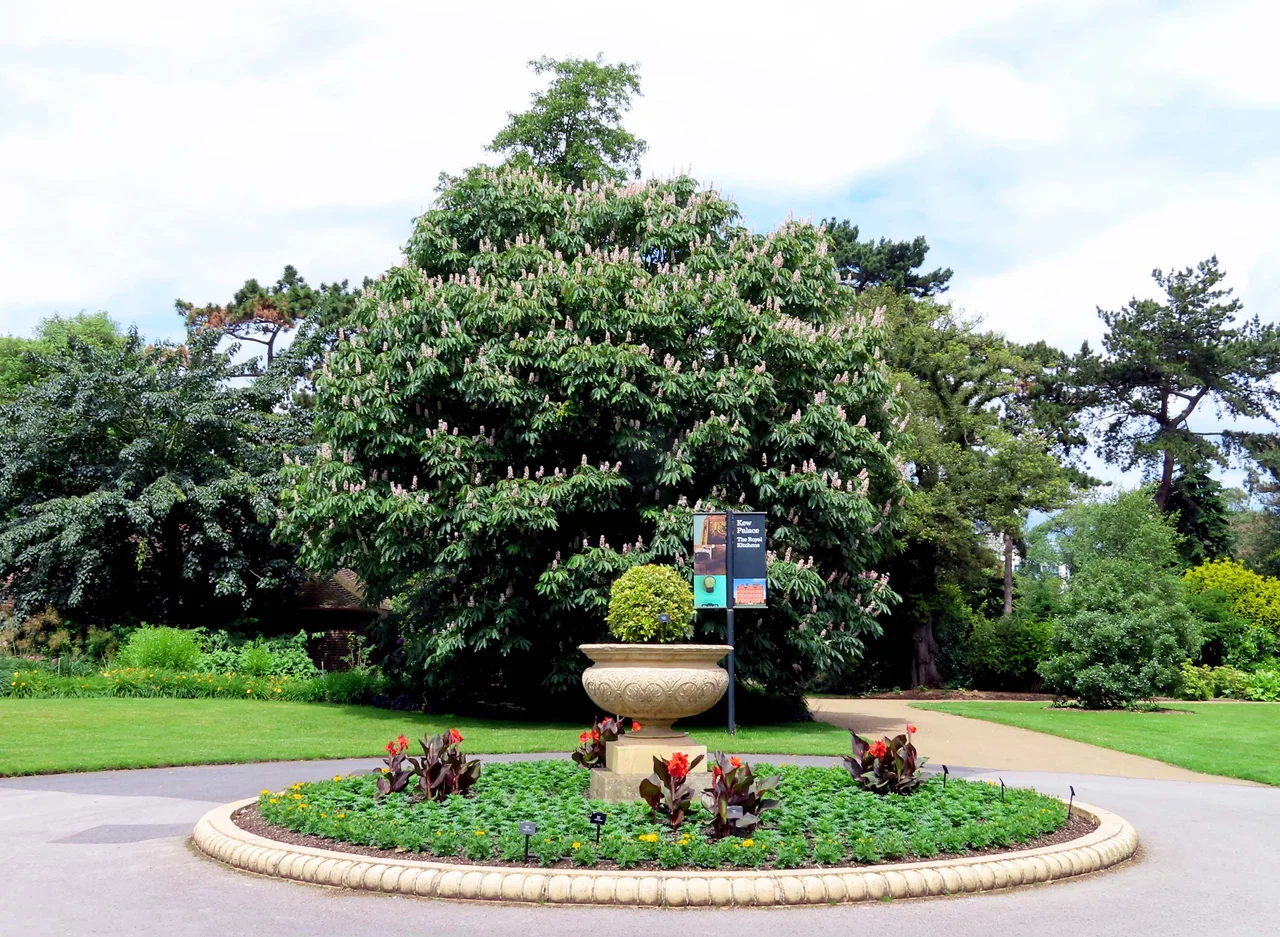

Royal Botanic Gardens, Kew
Somewhere in a basement at Wakehurst Place, in deep Sussex countryside, sit more than 2.4 billion seeds. They are held in airtight glass vials at minus twenty degrees Celsius, sorted by species, gathered from nearly 40,000 different plants by scientists working with partners in more than 95 countries. If a forest burns somewhere in central Africa, if a meadow vanishes under a Bolivian highway, if the last patch of an island endemic dies in a hurricane, there is a reasonable chance that the species itself is still alive here, asleep in the dark, waiting. That is what the Millennium Seed Bank does. It is one half of the operation called the Royal Botanic Gardens, Kew - and the other half, the famous Victorian glasshouses in south-west London, gets all the postcards.
326 Acres and 40 Listed Buildings
Kew Gardens sits on the south bank of the Thames in the London Borough of Richmond upon Thames, about ten miles south-west of central London. The site covers 326 acres and contains 40 historically important buildings - the Palm House, the Temperate House, the Pagoda, the Princess of Wales Conservatory, the Hive, the treetop walkway, and so on. In 2003 the whole thing became a UNESCO World Heritage Site. In 2019 it received 2,316,699 visitors. Wakehurst, the sister site eighty kilometres south in West Sussex, is a National Trust property managed by Kew that pulled in another 312,813. Together the two sites hold over 27,000 different taxa of living plants. The herbarium - Kew's collection of pressed and dried plant specimens - contains 8.3 million sheets, each one a flattened, labelled record of a species at a moment and place in the world. Some of the sheets date back centuries. They are still used, every week, by botanists trying to tell one species from another.
How Kew Names the World
When a botanist wants to know whether a plant has been described before, and what to legally call it, Kew is often the answer. The International Plant Names Index - run jointly with the Harvard University Herbaria and the Australian National Herbarium since 1999 - is the global registry of every published name for seed plants, ferns, and lycophytes. It builds on Index Kewensis, a project Kew started in the nineteenth century to list 'the Names and Authorities of all known flowering plants and their countries.' The World Checklist of Selected Plant Families catalogues accepted scientific names for 200 chosen seed-plant families. Plants of the World Online, launched in 2017, aims to be a single open access point for everything Kew knows about a species - identification, distribution, uses, conservation status, molecular phylogeny. The World Checklist of Useful Plant Species lists 40,292 species that humans actually do something with. The Plant List, a collaboration with the Missouri Botanical Garden, was succeeded by World Flora Online in 2012. None of this is glamorous work. It is, however, the foundation on which most of modern plant science is built.
Hooker's Inheritance
Kew's modern shape is largely the work of Sir William Jackson Hooker, who became director in 1841, and his son Joseph Dalton Hooker, who succeeded him in 1865. They turned what had been a royal pleasure garden into a serious scientific institution. Joseph - a friend and collaborator of Charles Darwin - led plant-collecting expeditions from the Himalayas to Antarctica and brought specimens, drawings, and ideas back to Kew. Curtis's Botanical Magazine, published since 1787 and now produced by Wiley-Blackwell on Kew's behalf, is the world's longest-running plant illustrated journal. The Kew Bulletin, peer-reviewed and indexed, is one of the leading taxonomic journals. Today more than 470 scientists work for Kew under Director of Science Alexandre Antonelli. They study everything from Madagascan endemics - through the Kew Madagascar Conservation Centre - to the conifers planted at Bedgebury National Pinetum in Kent, founded jointly with the Forestry Commission in 1923, and the trees at the Yorkshire Arboretum at Castle Howard.
Why a Seed Bank Matters
Storing seeds is not as straightforward as it sounds. Some species, like coconuts and oaks, do not survive freezing - their seeds are 'recalcitrant' and must be kept alive in cultivation. But the seeds of most flowering plants can be dried down to low moisture and held for decades, sometimes centuries. The Millennium Seed Bank Partnership, headquartered at Wakehurst, focuses on plants from drylands and from regions most under threat from agriculture, urbanisation, and climate change. In partnership with botanical institutions in more than 95 countries, it has banked seeds from roughly 40,000 species - around 16 percent of the world's known wild plants. The 1976 Kew conference on threatened plants helped establish the coordinating principle of plant conservation: knowing what is in cultivation, where it is held, and what is missing. Each accession is a small, dry insurance policy against the loss of something irreplaceable.
Public Body, Private Charm
Technically, the Royal Botanic Gardens, Kew is a non-departmental public body sponsored by the UK Department for Environment, Food and Rural Affairs. The chair of trustees is Dame Amelia Fawcett. Eleven members serve, including Sir Paul Nurse, Krishnan Guru-Murthy, and Judith Batchelar; the monarch appoints one trustee on the recommendation of the Secretary of State. None of that comes through when you walk in. What comes through is the smell of Victorian wrought iron and warm wet leaves in the Palm House, the dry rustle of grass seed heads outside the Temperate House, the children laughing on the treetop walkway. The Great Plant Hunt, an initiative for primary schools funded by the Wellcome Trust, sends education materials about plants to classrooms across the country. The Kew Gardens (Leases) Act 2019, of all things, is an Act of Parliament. Plants do not care about Acts of Parliament. They grow anyway, as they have at this stretch of Thames since 1759 - which is the year the Princess of Wales's nine-acre exotic garden first became something more than a private royal whim.
From the Air
Kew Gardens sits at 51.479 N, 0.296 W on the south bank of the Thames in the London Borough of Richmond upon Thames, about ten miles south-west of central London. Look for the distinctive curve of the Palm House and Temperate House glasshouses, and the broad green of the gardens against the river. Nearest major airport: London Heathrow (EGLL) six miles west; London City (EGLC) sixteen miles east. From cruise, find the southerly loop of the Thames between Brentford and Richmond - Kew is the large green block on the south side.
Nearby Stories
- Battle of Britain, Northfleet 1.1 km away
- Bayham Old Abbey 5.4 km away
- Catharine Macaulay 6.4 km away
- Hatfield rail crash 8.8 km away
- Chequers 8.9 km away
- Chelmsford Cathedral 10 km away
- Queen Victoria Hospital 13 km away
- Fishbourne Roman Palace 36 km away