
The Royal Cache
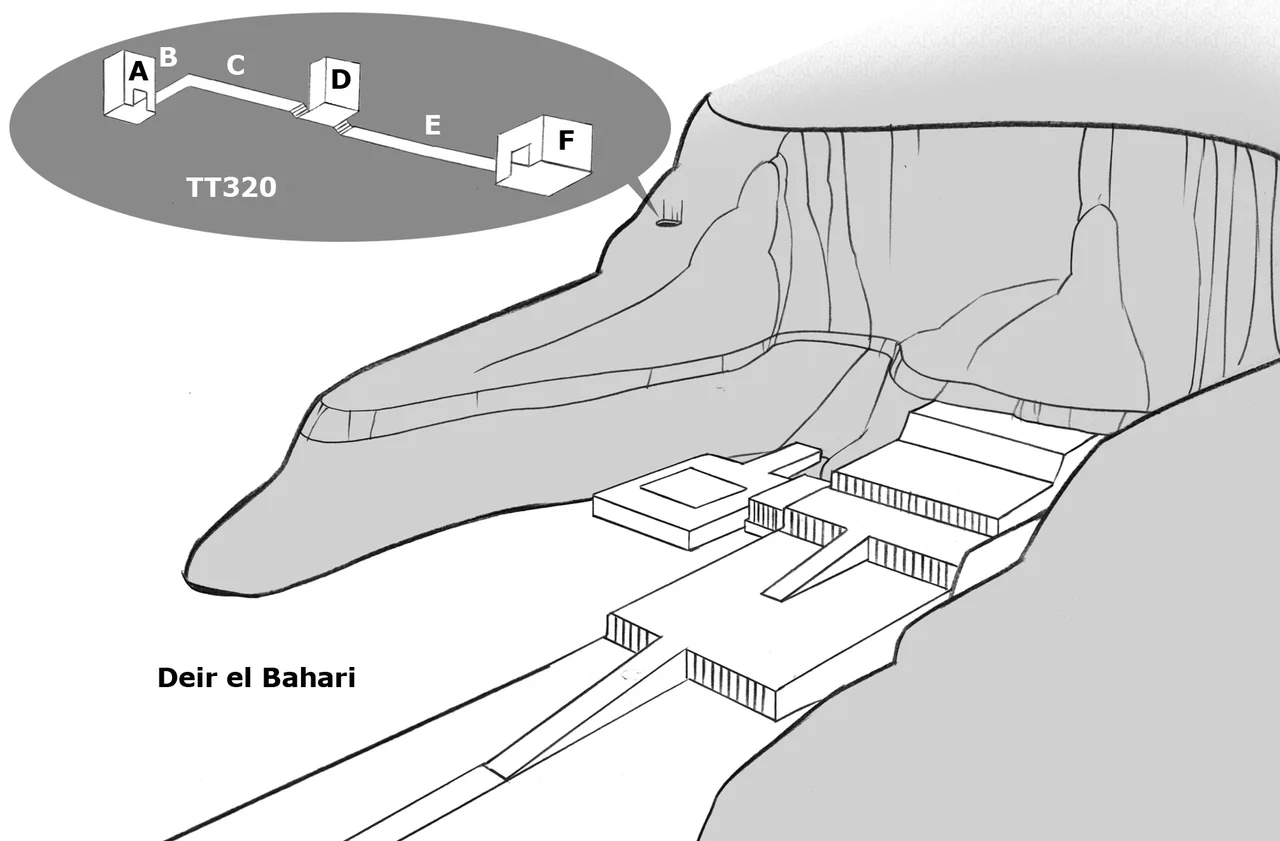
The antiquities dealers of Luxor had a problem in the 1870s. Genuinely royal objects were appearing on the market, papyri and canopic jars inscribed with the names of pharaohs who should have been three thousand years dead and accounted for. One Book of the Dead sold in 1876 for four hundred pounds, a fortune. Egyptologists realized something extraordinary was being quietly looted, and that someone knew where the kings were hidden. The answer lay in a vertical shaft in the cliffs above Deir el-Bahari, a tomb now catalogued as TT320 but long known as DB320, the Royal Cache. Inside, packed into a single rough corridor, lay more than fifty mummies, including some of the greatest rulers Egypt ever produced. They had not died here. They had been moved, in secret, by people trying to save them.
Who Was in the Tomb
The names recovered from the cache read like a roll call of the New Kingdom. Ahmose I, who expelled the foreign Hyksos and founded the Eighteenth Dynasty. Amenhotep I. Thutmose I, II, and III, the warrior kings who pushed Egypt's empire to its greatest extent. Seti I and his son Ramesses II, Ramesses the Great himself, whose toppled colossus inspired Shelley's "Ozymandias." Ramesses III, the last great pharaoh. Alongside the kings lay queens, princes, princesses, royal nurses, and the Twenty-first Dynasty high priests of Amun who had organized the whole rescue. More than fifty bodies in all, with thousands of funerary objects. It was, and remains, one of the richest single finds in the history of archaeology, a concentration of royalty unmatched until Tutankhamun's tomb came to light four decades later.
A Rescue, Not a Burial
These kings were never meant to share a tomb. Each had been laid to rest in his own grand sepulchre in the Valley of the Kings, surrounded by treasure. But by the end of the New Kingdom, around 1100 BC, Egypt's grip on its own necropolis was failing. Tomb robbery had become epidemic, and official investigations uncovered corruption reaching into the highest offices. The priests of Amun made a hard decision. Rather than leave the royal dead to the looters, they gathered the violated mummies, rewrapped those that needed it, and labeled each coffin with a docket recording who lay inside and where the body had been moved from. Some kings were shuffled between hiding places more than once before they came to rest in this obscure shaft, chosen precisely because it was remote, hard to reach, and easy to lose beneath the windblown sand.
The Family Who Kept the Secret
The hiding place worked for nearly three thousand years, and then it worked for one family in particular. By most accounts the Abd el-Rassul family of the nearby village of Qurna found the shaft around 1871, possibly earlier. The story passed down was that a man went down after a goat that had fallen in, and emerged having found a tomb full of royal coffins. For roughly a decade they kept their discovery to themselves, descending into the cliffs to remove a papyrus here, an amulet there, feeding objects slowly into the antiquities trade so as not to flood the market or attract attention. It was a careful, patient operation, and for a long time it held.
Cracking the Case
As the inscribed objects accumulated, the antiquities service traced them back to Qurna and to the el-Rassul brothers. The men were interrogated and, by the accounts of the period, harshly treated, yet they gave nothing away. What finally broke the secret was not the authorities but a quarrel within the family over the division of the spoils. In the summer of 1881, one of the brothers led officials to the shaft. Gaston Maspero, head of the antiquities service, was away in France, so his assistant Emile Brugsch made the descent. What he found astonished him: a corridor crammed with the kings of Egypt. Fearing renewed looting, his team cleared the entire tomb in roughly forty-eight hours, hauling more than fifty mummies and nearly six thousand objects up the shaft and downriver to Cairo by steamer.
The Kings Come Home
Local lore holds that as the steamer carried the royal dead north, villagers lined the banks of the Nile, the women wailing and the men firing guns in the air, mourning their ancient kings as they passed. The mummies eventually reached the museum in Cairo, where many were studied, X-rayed, and in time put on respectful display. The story so captured Egypt's imagination that it inspired a celebrated 1969 film, The Night of Counting the Years. Modern teams are still at work in the wadi, asking new questions about whether the shaft was only ever a hiding place or had some older meaning. Whatever they conclude, the central fact endures: when their world was collapsing, a few priests refused to abandon their kings, and a few villagers, much later, kept a secret that preserved them all over again.
From the Air
The Royal Cache (TT320 / DB320) lies at 25.737N, 32.605E, in the Theban cliffs immediately south of and above the Mortuary Temple of Hatshepsut at Deir el-Bahari. There is little to see from the air, just a concealed shaft in a fold of the desert hills, which is exactly why it stayed hidden for three millennia. Use the dramatic terraces of Hatshepsut's temple and the high peak of El Qurn (about 489 m) as visual anchors; the cache lies in the rocky ground between them. Best appreciated from 1,500 to 3,000 feet AGL over the Theban Necropolis. Luxor International Airport (HELX / LXR) is roughly 10 km east across the Nile. Visibility over Upper Egypt is generally excellent outside of spring khamsin dust events.
Nearby Stories
- Temple of Seti I (Abydos) 20 km away
- Dendera Temple complex 21 km away
- Esna 22 km away
- Abydos, Egypt 49 km away
- Mersa Gawasis 116 km away
- Kharga Oasis 147 km away
- Hurghada 184 km away
- Wadi El Gemal National Park 238 km away