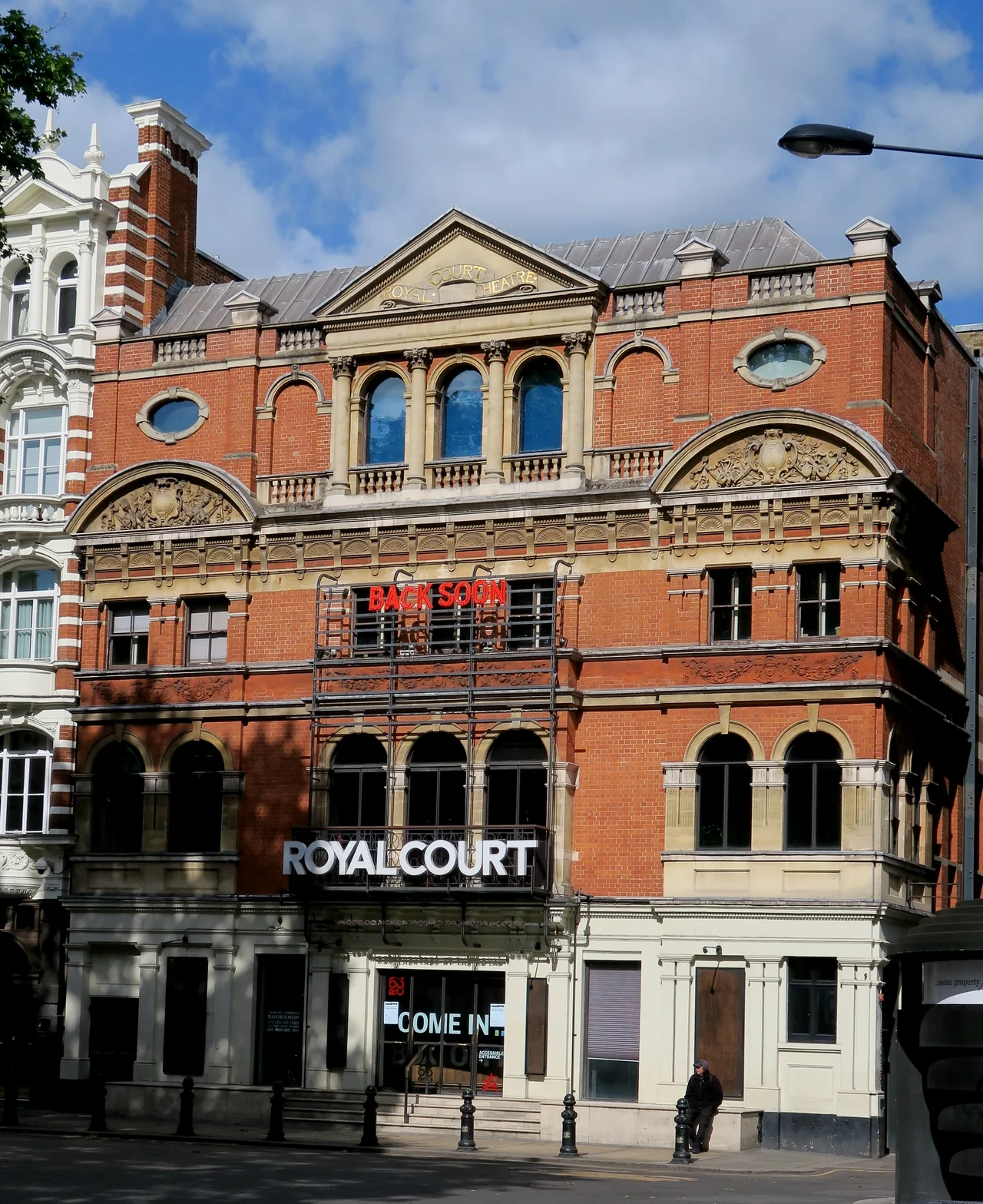

Royal Court Theatre
In May 1956 an unknown twenty-six-year-old playwright named John Osborne saw his third full-length play go up at a small theatre on Sloane Square. The reviews were mixed. Some critics dismissed it. Then Kenneth Tynan wrote that he could not love anyone who did not want to see Look Back in Anger, and the cultural weather changed overnight. The Royal Court Theatre - red brick and Italianate stone, capacity 380 in its current configuration - had been a converted Nonconformist chapel, a Victorian vehicle for W. S. Gilbert's comedies, a cinema during wartime, and then, in 1956, suddenly the most important new-writing theatre in Britain. It has held the title, with some interruptions, for nearly seventy years.
Chapel to Theatre
The first theatre on Lower George Street, off Sloane Square, was the Ranelagh Chapel - a Nonconformist meeting house repurposed in 1870 as The New Chelsea Theatre. The actress Marie Litton took over as manager in 1871 and brought in the architect Walter Emden to remodel the interior. It was renamed the Court Theatre. Several of W. S. Gilbert's early plays were staged there, including the comic political satire The Happy Land in 1873 - Gilbert's most controversial play, censored for its impersonations of Prime Minister William Ewart Gladstone and his cabinet. Arthur Wing Pinero's farces followed: The Magistrate in 1885, The Schoolmistress in 1886, Dandy Dick in 1887. The theatre closed and was demolished in July 1887. A new building, designed by Walter Emden and Bertie Crewe in fine red brick with a stone Italianate facade, opened on the east side of Sloane Square on 24 September 1888 - originally as the New Court Theatre, with an 841-seat capacity. By the end of the century it was again the Royal Court.
The Angry Young Men
Harley Granville-Barker managed it briefly in the early twentieth century, with George Bernard Shaw's plays in the repertory. It went dark as a theatre in 1932. From 1935 to 1940 it was a cinema. Then World War II bomb damage closed it altogether. In 1954, three theatre people - the Communist-turned-impresario Oscar Lewenstein, the actor and director George Devine, the poet-playwright Ronald Duncan, joined by Honorary Secretary Greville Poke - founded the English Stage Company with a mission to stage 'plays by young and experimental dramatists' and 'the best contemporary plays from abroad.' The ESC bought the Royal Court in 1956. The company's third production that year was Look Back in Anger, directed by Tony Richardson, with Kenneth Haigh as Jimmy Porter. Osborne became, with Kingsley Amis and others, the writer the press would soon call the Angry Young Men. In 1957 The Entertainer followed, with Laurence Olivier in the title role of Archie Rice - a play the actor essentially commissioned for himself.
What the Court Did Next
Edward Bond's Saved opened in 1965, directed by William Gaskill - a play featuring the stoning of a baby in a pram that helped end stage censorship in Britain. Eugene Ionesco's Exit the King brought Alec Guinness to Sloane Square in 1963. Samuel Beckett's Not I premiered in 1973 - a single illuminated mouth, talking. The Rocky Horror Show premiered the same year, before transferring up the road and around the world. Caryl Churchill's first play at the Court was Owners in 1972; she would become one of the playwrights most associated with the building. The Theatre Upstairs - a small studio space - opened in 1969 to develop riskier work, including Mark Ravenhill's Shopping and Fucking, Sarah Kane's Blasted and Cleansed, Jez Butterworth's Mojo. The theatre was Grade II listed in June 1972. The Europe Prize Theatrical Realities, awarded to the Royal Court in 1999, cited 'the moral anger, urban despair and political disillusion' that had sent its writers' work across the continent.
Floods and Lottery Money
Through all that, the building was falling apart. The stalls and understage flooded repeatedly through the twentieth century. Facilities for both audience and performers were poor. By 1995 closure looked likely. Then the National Lottery and Arts Council England came together with a 16.2 million pound grant for redevelopment. Under artistic director Stephen Daldry, the architects Haworth Tompkins rebuilt almost the whole building from 1996, preserving only the facade and the intimate Victorian auditorium itself. The theatre reopened in February 2000 with the 380-seat Jerwood Theatre Downstairs and the 85-seat Jerwood Theatre Upstairs. A new generation of playwrights debuting in the years that followed included Joe Penhall, Sarah Kane, Mark Ravenhill, Roy Williams, and others - many of whom went on to define the so-called 'in-yer-face' theatre wave of the 1990s. Since 1989 the Court has also run an International Residency programme that brings writers from around the world to develop new work.
Difficult Conversations
Not every chapter has been clean. In 1987 Ken Loach's production of Perdition was withdrawn after protests and commissioned historical reviews. In 2009 Caryl Churchill's Seven Jewish Children drew sharp accusations of antisemitism from Jewish leaders and journalists, accusations the theatre disputed. In November 2021 the lead character in Al Smith's Rare Earth Mettle was renamed from Hershel Fink to Henry Finn after criticism that the original name perpetuated anti-Semitic stereotypes; the theatre apologised. In 2018, alongside the Royal Exchange Theatre in Manchester, the Court co-commissioned an independent safeguarding inquiry following allegations of abuse involving the playwright and director Chris Goode, whose work had been staged at both venues. The artistic directors form a roll call of postwar British theatre - Devine, Gaskill, Anderson and Page, Lewenstein, Wright and Kidd, Burge, Stafford-Clark, Daldry, Rickson, Cooke, Vicky Featherstone (the first woman, 2013 to 2024), and now David Byrne from early 2024. The mission has not changed since 1954. The plays keep coming.
From the Air
The Royal Court Theatre stands at 51.493 N, 0.157 W on the east side of Sloane Square in the Royal Borough of Kensington and Chelsea, central London. Look for the red-brick facade with its Italianate stone front, directly across from the Sloane Square Underground station. Nearest major airports: London City (EGLC) seven miles east; London Heathrow (EGLL) twelve miles west. From cruise, find the green of Hyde Park to the north; Sloane Square sits in the prosperous block south of Knightsbridge.
Nearby Stories
- Battle of Britain, Northfleet 1.1 km away
- Bayham Old Abbey 5.4 km away
- Catharine Macaulay 6.4 km away
- Hatfield rail crash 8.8 km away
- Chequers 8.9 km away
- Chelmsford Cathedral 10 km away
- Queen Victoria Hospital 13 km away
- Fishbourne Roman Palace 36 km away