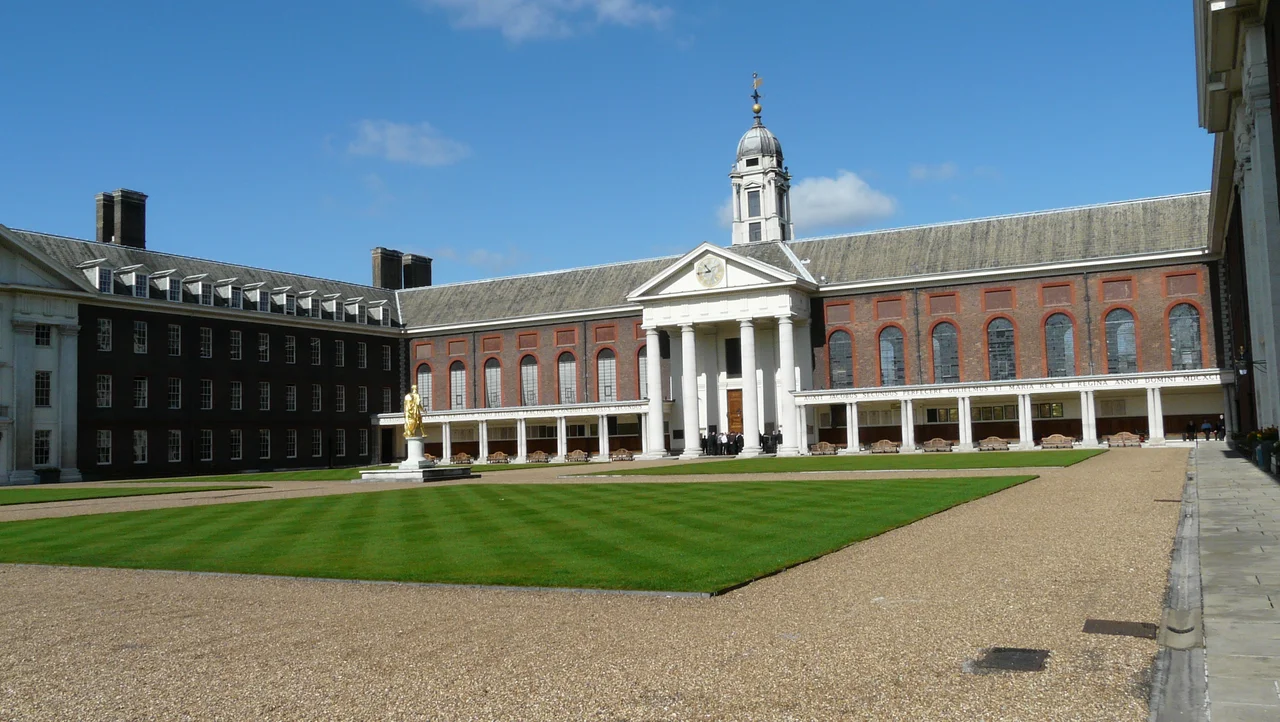

Royal Hospital Chelsea
There is a legend - difficult to verify, but stubborn - that the whole place was Nell Gwyn's idea. The orange-seller turned actress turned mistress of Charles II is said to have urged the king, sometime in the early 1680s, to do something for the country's wounded and aging soldiers. Whether or not the story is true (Peter Cunningham wrote it down in 1851 and it has refused to die), Charles II did indeed found the Royal Hospital Chelsea in 1682. He hired Sir Christopher Wren to design it. Sir Stephen Fox, then the richest commoner in the three kingdoms, donated 13,000 pounds toward the building. The aim was an almshouse - the old sense of the word 'hospital' - on the model of Louis XIV's Les Invalides in Paris. Three and a half centuries later, around 300 British Army veterans still live there, walk the grounds, wear scarlet coats on ceremonial days, and are known to the world as Chelsea Pensioners.
Wren's Quadrangles
The Royal Hospital opened its doors in 1692. Some of the first In-Pensioners admitted were soldiers wounded at the Battle of Sedgemoor in 1685, the failed rebellion against James II. Wren's design centres on Figure Court - a stately brick quadrangle facing the Thames - with two further quadrangles added to the east and west: Light Horse Court and College Court. The Wren chapel, completed in 1687, is 42 feet high and one of the finest small examples of Wren's ecclesiastical work. The State Apartments, completed between 1685 and 1688, were fully roofed days before Charles II died in February 1685. The ceiling carries James II's cypher (the king had inherited the project), the wainscoting is by William Cleere, and the limewood carving over the fireplace is by William Emmett. The grounds run to 66 acres on Royal Hospital Road in Chelsea. The gardens are Grade II listed on the Register of Historic Parks and Gardens. From May each year, the Royal Horticultural Society's Chelsea Flower Show takes over part of the grounds - an arrangement that has been running since 1913.
Blues and Scarlets
Within the hospital and the surrounding area, In-Pensioners wear the navy blue uniform known fondly as 'blues.' When they travel farther afield, they switch to the distinctive scarlet coats - long, brass-buttoned, eighteenth-century in cut - accompanied by tricorne hats for ceremonial occasions or peaked shakos otherwise. On their chests they wear the medal ribbons and rank insignia they earned in service. A pensioner who jumped with the Parachute Regiment may wear jump wings. Several now wear SAS jump wings. Contrary to a long-running urban myth - propagated by a since-repealed eighteenth-century statute about pension fraud - it has never actually been illegal to impersonate a Chelsea Pensioner. Nell Gwyn, the legend continues, is said to have proposed the scarlet because she remembered the pensioners at Coningsby Hospital in Hereford - her reputed birth town - wearing coats of the same colour. There is something appropriate about a king's mistress being remembered every time a 90-year-old veteran puts on his red coat to walk to the cheesemonger.
The First Women
For 317 years, every In-Pensioner had been a man. In March 2009, that finally changed. Winifred Phillips and Dorothy Hughes became the first women admitted as Chelsea Pensioners. Phillips had trained as a nurse, joined the Auxiliary Territorial Service in 1948, and enlisted in the Women's Royal Army Corps in 1949 while serving in Egypt; she retired after twenty-two years as a Warrant Officer Class 2. Hughes had joined the British Army in 1941 at eighteen and served with 450 Heavy Anti-Aircraft Battery in the London Division. In 1945 her battery was deployed near Dover to defend against V-1 flying bomb attacks - the ones the Londoners called doodlebugs, the ones that arrived without warning. Hughes retired as a Sergeant. The Margaret Thatcher Infirmary, opened in 2009 by Charles, Prince of Wales, houses around 100 of the more frail pensioners. Margaret Thatcher's own ashes were interred at the infirmary in 2013; her husband Denis Thatcher's in 2003. The infirmary received the highest national award for end-of-life care in 2015.
Founder's Day and the Christmas Cheeses
Founder's Day falls close to 29 May each year - Charles II's birthday and the date of his restoration in 1660. It is also Oak Apple Day, marking the king's escape after the Battle of Worcester in 1651, when he hid in the Royal Oak to avoid capture by Parliamentary forces. On Founder's Day a member of the royal family reviews the In-Pensioners on parade. In the centre of Figure Court stands a 7-foot-6-inch statue of Charles II by Grinling Gibbons, cast in copper alloy and originally gilded, then bronzed in 1787, then regilded for Queen Elizabeth II's Golden Jubilee in 2002. The annual Ceremony of the Christmas Cheeses began in 1692 - when the hospital asked a local cheesemonger to provide pensioners with cheese for the festive period. Donations from cheesemongers across the country are still presented annually. A Chelsea Pensioner cuts the ceremonial wheel with a sword. The Christmas Cake Ceremony, begun in 1949, brings a cake each year from the Australian Returned and Services League - each Australian state taking its turn. The pensioner again uses a sword.
A Cannon from Singora
Standing in the grounds next to the flagpole is a cannon with an extraordinary itinerary. It was cast around 1623 in Singora - a sultanate on what is now the Malay Peninsula - and bears the seal of Sultan Sulaiman Shah. The Siamese captured it in 1680. The Burmese took it from the Siamese in the Burmese-Siamese war of 1765 to 1767 and shipped it to Burma. The British took it from the Burmese in the Third Anglo-Burmese War of 1885 to 1887, and brought it back to Chelsea. Three hundred and sixty years of empire and counter-empire, condensed into one piece of bronze. In September 2022, the hospital served as the assembly point for foreign heads of state, leaders, and ambassadors gathering to attend Queen Elizabeth II's funeral - they boarded coaches in the courtyards Wren designed, and travelled together to Westminster Abbey. The In-Pensioners watched, in their scarlet coats. The Sovereign's mace, designed by Charles Webb and Aubrey Bowden and made by master goldsmith Norman Bassant, is now carried at all ceremonial events. Its bowl is decorated with acorns. Above sits the St Edward's Crown.
From the Air
The Royal Hospital Chelsea sits at 51.486 N, 0.158 W on Royal Hospital Road in Chelsea, central London, about three miles south-west of Westminster. Look for the long brick frontage of Wren's quadrangles facing the Thames between Battersea Bridge and Chelsea Bridge. Nearest major airports: London City (EGLC) eight miles east; London Heathrow (EGLL) twelve miles west. From cruise, find the north bank of the Thames opposite Battersea Park - the Royal Hospital is the symmetrical brick complex with extensive green gardens immediately behind it.
Nearby Stories
- Battle of Britain, Northfleet 1.1 km away
- Bayham Old Abbey 5.4 km away
- Catharine Macaulay 6.4 km away
- Hatfield rail crash 8.8 km away
- Chequers 8.9 km away
- Chelmsford Cathedral 10 km away
- Queen Victoria Hospital 13 km away
- Fishbourne Roman Palace 36 km away