_Drawn_Clarence_(Brougham)_Carriage_%26_Victoria_Memorial,_Buckingham_Palace,_Westminster,_London_(3795290693).jpg)
Royal Mews
The word "mews" means a place where birds moult. In 1377, English royal hawks were kept at Charing Cross to shed their feathers between hunting seasons, and the building took its name from the French verb muer - to moult. The hawks are long gone. The horses arrived in 1534, after a fire destroyed the king's stables in Bloomsbury. The cream stallions from Hanover came with George I in 1714. The whole place was demolished in the 1820s to make room for Trafalgar Square. None of that history survives at the original site. But the name did. It walked across London with the horses, and now sits in the grounds of Buckingham Palace - a Grade I listed stable yard where a Gold State Coach worth millions waits in a coach house, and where Range Rovers and a Renault Twizy share garage space with carriages older than the United States.
From Hawks to Horses
The original Royal Mews stood at Charing Cross, where Trafalgar Square now lies. For nearly two centuries it housed the royal falcons - prized birds kept caged during their annual moult, which is what "mewing" originally meant. Then in 1534 fire destroyed the Royal Stables in Lomesbury, the area now called Bloomsbury. Henry VIII decided he would relocate the horses to the hawks' building rather than rebuild. The hawks were sent elsewhere. The name stayed. On the "Woodcut" map of London from the 1560s, the Mews can be seen extending back toward what is now Leicester Square. When George I came from Hanover in 1714, he brought his famous cream stallions. They became the iconic horses of British coronations, used until inbreeding in the early twentieth century forced their retirement in 1920.
The Move to Buckingham Palace
In the 1760s George III began moving everyday horses to the grounds of Buckingham House, the residence he had acquired in 1762 for his wife. The Riding School, attributed to William Chambers, dates from this period - completed in 1764, with a 54-metre interior where horses are still trained today. The pediment with William Theed's sculptural motifs was added in 1859. When Victoria came to the throne in 1837 and made Buckingham Palace the monarch's principal residence, the Mews followed. By the 1850s nearly two hundred people worked there, most of them living on site with their families. Prince Albert used the back mews to stable his own personal horses. The original Charing Cross site was demolished to make way for Trafalgar Square and the National Gallery, which opened in 1838.
What's in the Coach Houses
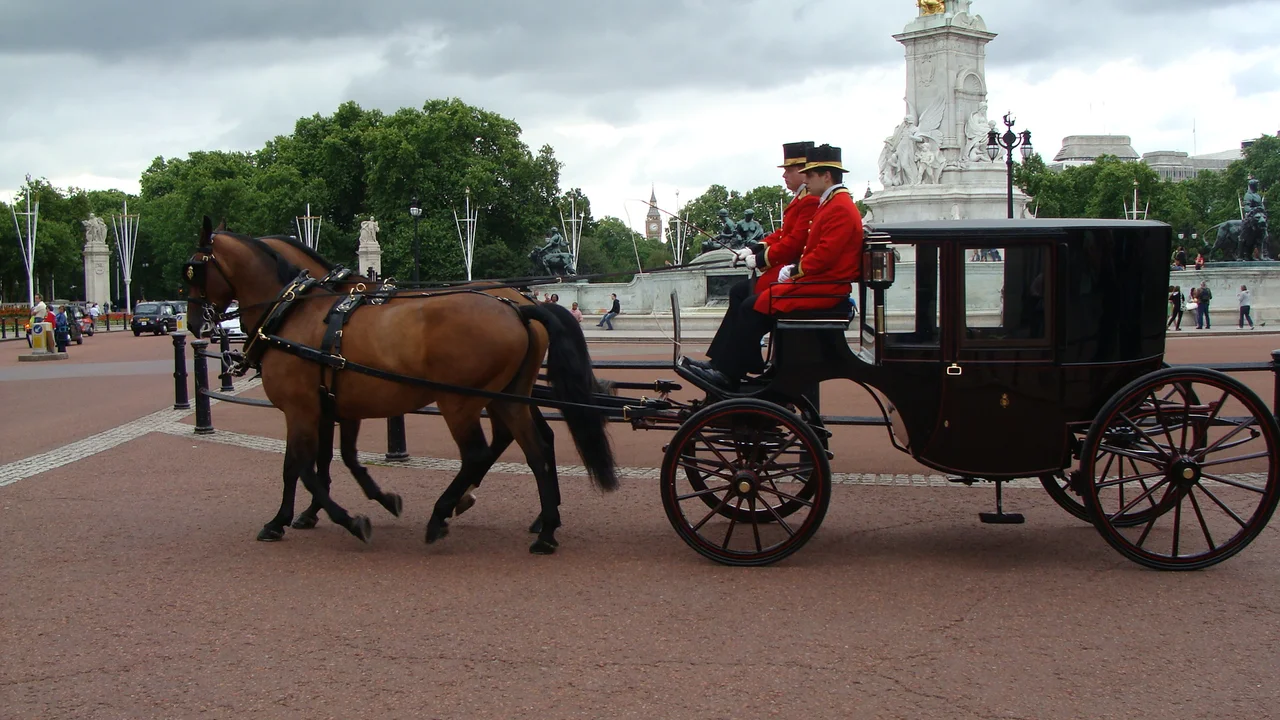
The collection is unusual because it remains in use. The Gold State Coach is brought out only for coronations and the most extraordinary state occasions - a four-ton gilt extravaganza built for George III in 1762, said to ride so badly that monarchs have complained about it for over two centuries. The 1902 State Landau, last in a long line of state landaus, was for a long time the newest royal coach until 1988, when W. J. Frecklington - a former Mews employee - delivered the Australian State Coach as a bicentenary gift. The list runs on: the Irish State Coach, the Scottish State Coach, the Glass Coach used for many royal weddings, the Diamond Jubilee State Coach (2014). There are barouches, sociables, broughams, clarences, phaetons, victorias, a rare curricle, and a Louis-Philippe charabanc presented to Queen Victoria at Windsor Castle in 1844. Some of these are driven daily.
The Modern Fleet
Edward VII established the first garage at the Mews in the early 1900s. Today the official state cars are all painted in a distinctive black-over-claret livery known as Royal Claret. Two 2012 Jaguar XJ limousines carry the registration plates NGN 1 and NGN 2. Three 2022 Range Rovers wear MYT 1, MYT 2, and MYT 3. There is a State Hearse, commissioned for the funeral of Elizabeth II in 2022. Since 2012 the Mews has acquired electric vehicles - a BMW i3, a BMW 7 Series hybrid, a Nissan van, even a Renault Twizy. The juxtaposition is the point. A working royal household needs to move people from A to B every day, in addition to producing the centuries-old pageantry. The Twizy and the Gold State Coach share a postcode.
Open to the Public, Closed to the Past
The titular head of the Royal Mews is the Master of the Horse - one of the three great officers of the Royal Household, an inherited dignity going back centuries. The executive head is the Crown Equerry, who lives on site and oversees the department. Around fifty people now live and work here, down from the two hundred of Victorian times. For most of the year, the Mews is open to visitors, who walk past the coaches and into the stables. Other Royal Mews exist - Hampton Court, Windsor, Holyrood in Edinburgh - but the one at Buckingham Palace is the operational center. The hawks would not recognize it. The name they gave it has outlasted everything but their feathers.
From the Air
The Royal Mews sits at 51.4987°N, 0.1436°W in the grounds of Buckingham Palace, central London, immediately south of the palace's garden and near Grosvenor Place. From altitude the great green expanse of Buckingham Palace Gardens forms the most obvious landmark; the Mews lies along its southern edge, with Hyde Park visible to the northwest and Green Park to the north. Nearest major airports: London City (EGLC) 6nm east, London Heathrow (EGLL) 14nm west. The yellowish stone of the palace contrasts with the dark red brick of the Mews coach houses.
Nearby Stories
- Battle of Britain, Northfleet 1.1 km away
- Bayham Old Abbey 5.4 km away
- Catharine Macaulay 6.4 km away
- Hatfield rail crash 8.8 km away
- Chequers 8.9 km away
- Chelmsford Cathedral 10 km away
- Queen Victoria Hospital 13 km away
- Fishbourne Roman Palace 36 km away