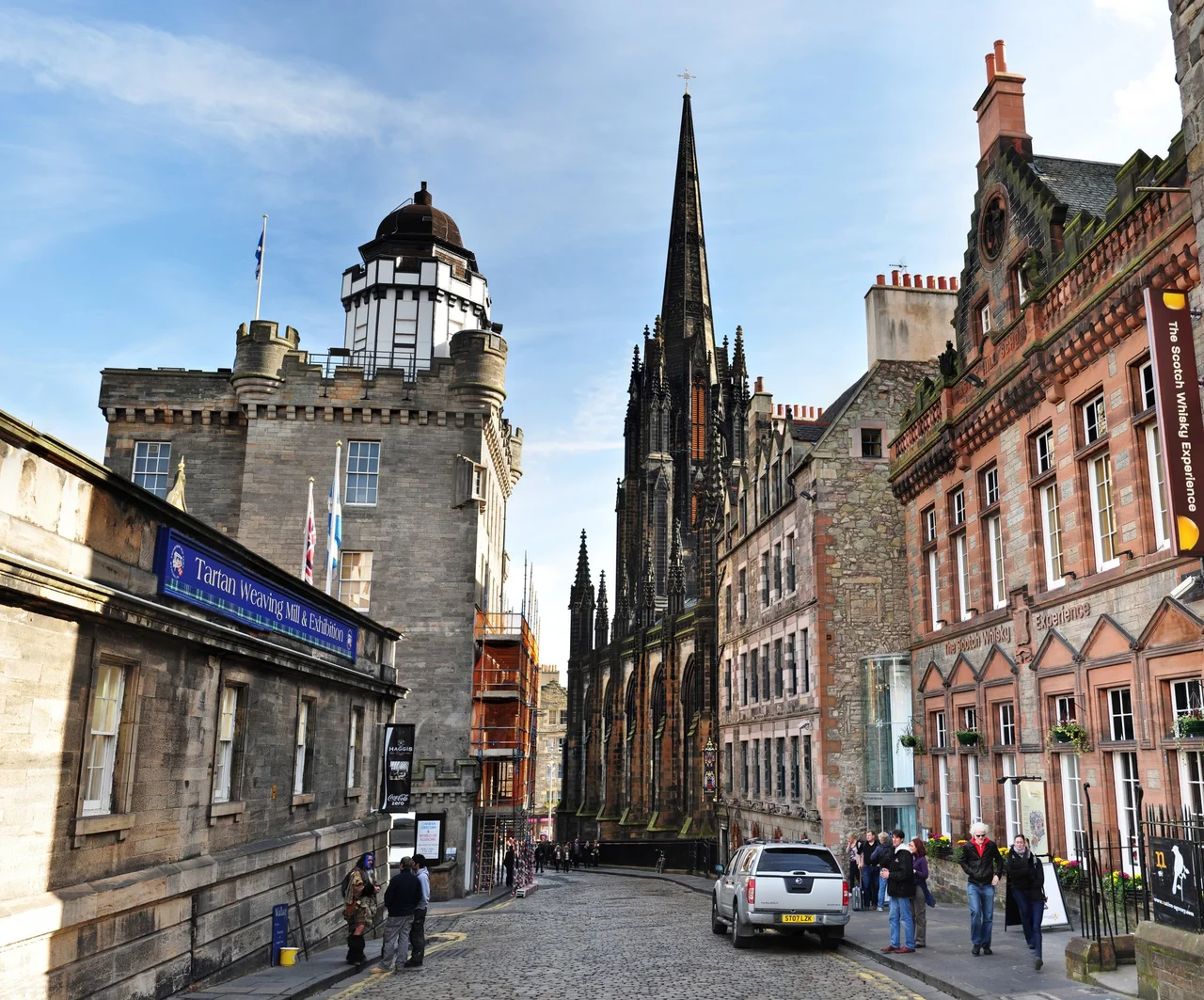

Royal Mile
Glaciers built the Royal Mile, though they did not know it. Retreating ice sheets dragged debris around the hard volcanic plug where Edinburgh Castle now sits, depositing a long tail of sediment that hardened over millennia into a ridge sloping gently east. Centuries later, humans paved that ridge into a street and ran it between two royal residences - Edinburgh Castle at the high end, 109 metres above sea level, and Holyrood Palace at the low end, 42 metres. The drop averages 4.1%. The distance, almost exactly, is one Scottish mile. Walk it from top to bottom and you have walked through nine hundred years of Scottish royalty, law, religion, riot, and tourism.
Five Streets, One Spine
The Royal Mile is not actually one street. From west to east it changes names five times: Castle Esplanade at the top, then Castlehill, then the Lawnmarket, then the High Street, then the Canongate, ending in Abbey Strand before the palace gates. The Lawnmarket got its name from a 1477 charter designating it the market for "inland merchandise" - yarn, stockings, coarse cloth, and later linen. "Land Market" softened over centuries into "Lawnmarket." The Canongate beyond the old city wall was, until 1856, an entirely separate burgh from Edinburgh, named after the Augustinian canons who travelled it from Holyrood Abbey. Steep alleys called closes run down both sides between tall stone tenements known as lands, dropping abruptly to the Cowgate to the south or Princes Street Gardens to the north.
Parliament Square and the Heart of Midlothian
About a third of the way down from the castle, on the south side, the High Street widens into Parliament Square. Until 1707, the Parliament of Scotland met here; after the Acts of Union dissolved it, the building became home to the Court of Session, Scotland's supreme civil court. St Giles' Cathedral, the High Kirk of Edinburgh, stands beside it. By the cathedral's west door, set into the cobbles, is a heart-shaped pattern called the Heart of Midlothian. It marks the location of the Old Tolbooth, the city prison demolished in the early nineteenth century. Sir Walter Scott named one of his novels after the building, and locals traditionally spit on the heart as they pass - a gesture of contempt for the prison and its keepers that has long outlasted both. Steps away, the Mercat Cross is still where royal proclamations are formally read aloud.
Fire, Rebuilding, and the Great Edinburgh Fire of 1824
In November 1824, fire broke out in a printing shop on the High Street and ran wild through the dense tenement blocks for four days. When it finished, the entire south side of the High Street between St Giles and the Tron Kirk had been gutted. Rebuilding began almost immediately, in a stepped Georgian style that survives today. The fire shaped what visitors now see; the elegant terraced rebuild reads as a unified row, but it was emergency reconstruction over the bones of older medieval buildings. Just east is Cannonball House, on whose wall a cannonball is embedded. Legend says it was fired accidentally from the castle, but the truth is more useful: it marks the elevation of Comiston Springs three miles south, which fed one of the first piped water supplies in Scotland.
Royal Entries and Public Pageants
Long before the Edinburgh Festival, the Royal Mile staged spectacle. Edinburgh goldsmiths organised a "Pageant of the Passion" for the wedding of James IV and Margaret Tudor in 1507. To celebrate the 1558 marriage of Mary, Queen of Scots, to the Dauphin of France (the future Francis II), William Lauder and William Adamson produced a show at the Salt Tron with actors playing the seven planets and Cupid, on stages decorated with artificial "summer trees" hung with tennis balls covered in gold foil. The royal entries of Mary in 1561, James VI in 1579, and Anne of Denmark in 1590 all took the same processional route up the High Street. In 1598, scholars from Edinburgh High School performed a satirical play at the Tolbooth in costumes of a Pope and Cardinals, then donated the costumes to the poor afterward.
Down to the Canongate
Past the World's End Pub - named for its position by the old Netherbow Port, the city gate beyond which lay the separate burgh of Canongate - the Royal Mile continues its descent. The Canongate runs past Moray House, now part of the University of Edinburgh; the Canongate Tolbooth, which houses The People's Story Museum; the Kirk of the Canongate; and finally the striking modern Scottish Parliament Building, designed by Enric Miralles and opened in 2004. At Abbey Strand the street arrives at the Palace of Holyroodhouse, the King's official residence in Scotland, with the ruined Holyrood Abbey behind it. A single mile of cobblestones, royal at both ends, has worked as Scotland's main stage for nearly a thousand years - and during August, when the Edinburgh Festival Fringe fills every square inch with buskers, jugglers, actors, and tourists, it works as the world's stage too.
From the Air
Located at 55.9506 N, 3.1856 W. The Royal Mile runs east-northeast from Edinburgh Castle (gcvwr) down the ridge to Holyrood Palace, about 1.6 km, dropping from 109 m to 42 m. Nearest airport is Edinburgh (EGPH), 8 km southwest. From the air the Royal Mile is the clearest spine of Edinburgh's Old Town, running between two prominent features - the castle on its volcanic plug at the west end and the palace plus Arthur's Seat at the east end. Best appreciated from 1,000-3,000 feet with the New Town's Georgian grid visible to the north.
Nearby Stories
- Ardoch Roman Fort 2.2 km away
- Craignethan Castle 3.1 km away
- Haddington 3.8 km away
- Balvaird Castle 4.3 km away
- Battle of Kilsyth 9.4 km away
- Siege of St Andrews Castle 9.9 km away
- Neidpath Castle 11 km away
- Melrose Abbey 15 km away