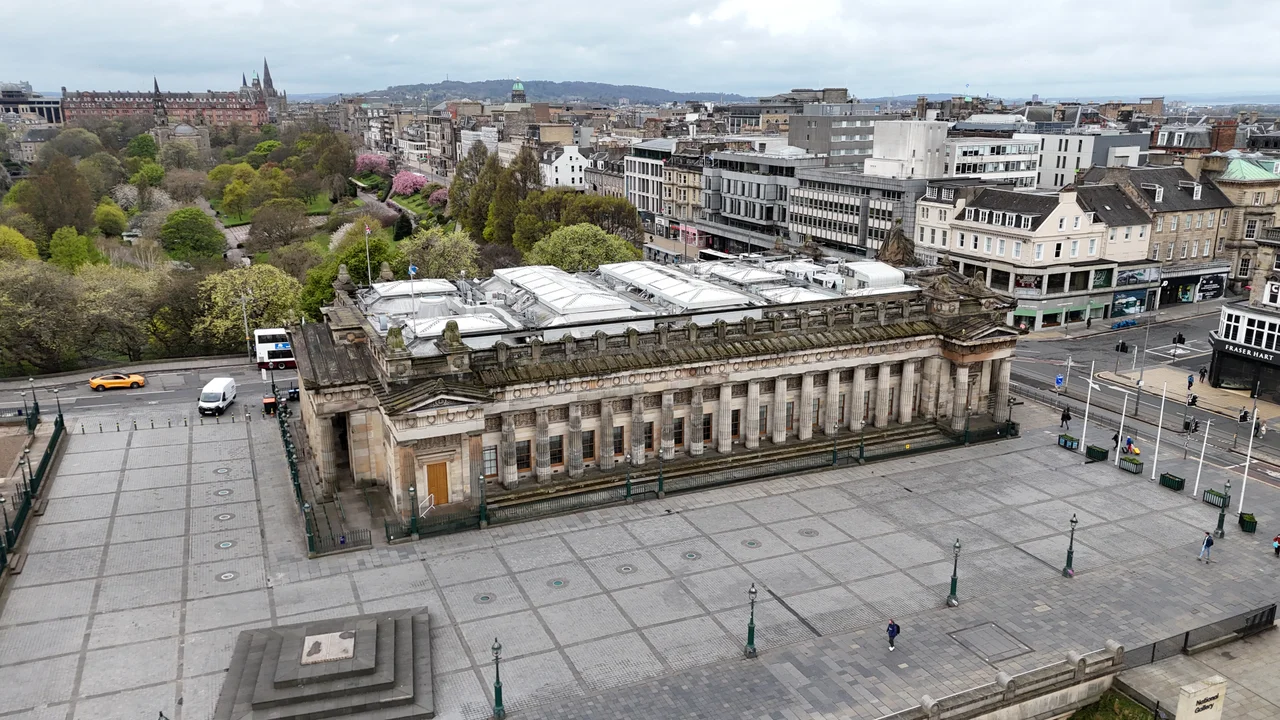

Royal Scottish Academy
Thirteen artists met in a back room above Stewart's Rooms on Waterloo Bridge in Edinburgh on 27 May 1826 to make a declaration of independence. They were tired of the Royal Institution, which they considered too elitist, too dominated by patrons rather than working artists. So they walked out and founded their own body: the Scottish Academy of Painting, Sculpture, and Architecture. Eleven painters, one architect, one sculptor, and George Watson as their first president. Within twelve years they had a royal charter and a new name - the Royal Scottish Academy - and within ninety years they had taken over the very building their rivals once occupied at the foot of The Mound.
Two Temples on The Mound
The story of the RSA is bound up with two buildings that share a slope of artificial land in central Edinburgh. The Mound itself is the long earthen causeway built from spoil dumped during construction of the New Town in the late eighteenth century, creating a bridge between the Old Town and the New across the drained Nor Loch. At its base, on Princes Street, William Henry Playfair designed two neoclassical temples in succession: the Royal Institution building in 1822-26 (now the RSA Building), and the National Gallery of Scotland in 1859 just behind it. Both have the same Greek-temple language of columns, pediments and crisp ashlar. From the air or from Calton Hill they read as a matched pair, anchoring the visual centre of the city.
From Tenants to Owners
When the RSA broke away from the Royal Institution in 1826, the new body had no building of its own. For decades it rented exhibition space. One of its central aims was to found a national gallery for Scotland, which it achieved in 1859 when Playfair's National Gallery opened. The RSA shared that gallery for over fifty years - its annual exhibitions hanging alongside the Old Masters collection it had originally lobbied to create. In 1911 the Royal Institution disbanded and the RSA was granted permanent tenancy of the older Playfair building next door. From then on the building has been known as the Royal Scottish Academy, although it is technically managed by National Galleries Scotland under a 1910 Order that grants the RSA permanent administration offices and exhibition rights.
Academicians and the Diploma Work
The RSA is run by artists, for artists. Its membership consists of Academicians (RSA) and Associates (ARSA), elected by their peers from across painting, sculpture, architecture and printmaking. Honorary Academicians (HRSA), elected from outside Scotland, complete the body - currently 30 Honorary and 104 full members. To become a full Academician, an Associate must submit a Diploma work into the permanent collection - a piece chosen by the artist to represent their best work, which the Academy then holds in perpetuity. The president uses the postnominal PRSA while in office and PPRSA afterward. In 2018 Joyce W. Cairns became the first female president in the Academy's 192-year history. The current president is Gareth Fisher.
The Guthrie and the Granton Vault
The RSA gives the Guthrie Award annually to Scottish-based artists - it has done since 1920, longer than the Turner Prize has existed. Other awards include the Keith Award, the Latimer Award, and architecture prizes specific to Scottish practice. The Academy's historic collection - over 180 years of submitted Diploma works, plus archives of letters, sketches, photographs, and ephemera - is stored at the National Museums Collection Centre in Granton, on Edinburgh's northern coast. Researchers can request access; selections come back to The Mound for occasional historical displays. The Playfair Project, a major refurbishment completed in the early 2000s, reconnected the RSA building with the Scottish National Gallery behind it via an underground link, sharing services and exhibition flow. The two Greek temples on The Mound, separate buildings put up thirty-three years apart, now function as one continuous gallery complex.
From the Air
Located at 55.9517 N, 3.1964 W, at the foot of The Mound in central Edinburgh, directly between Princes Street and the Old Town ridge. Nearest airport is Edinburgh (EGPH), 8 km southwest. From the air the RSA Building and the Scottish National Gallery behind it form a recognisable pair of pale neoclassical temples set between the green band of Princes Street Gardens and the dark mass of the Old Town cliff. Best appreciated from 1,000-3,000 feet with Edinburgh Castle visible to the west.
Nearby Stories
- Ardoch Roman Fort 2.2 km away
- Craignethan Castle 3.1 km away
- Haddington 3.8 km away
- Balvaird Castle 4.3 km away
- Battle of Kilsyth 9.4 km away
- Siege of St Andrews Castle 9.9 km away
- Neidpath Castle 11 km away
- Melrose Abbey 15 km away