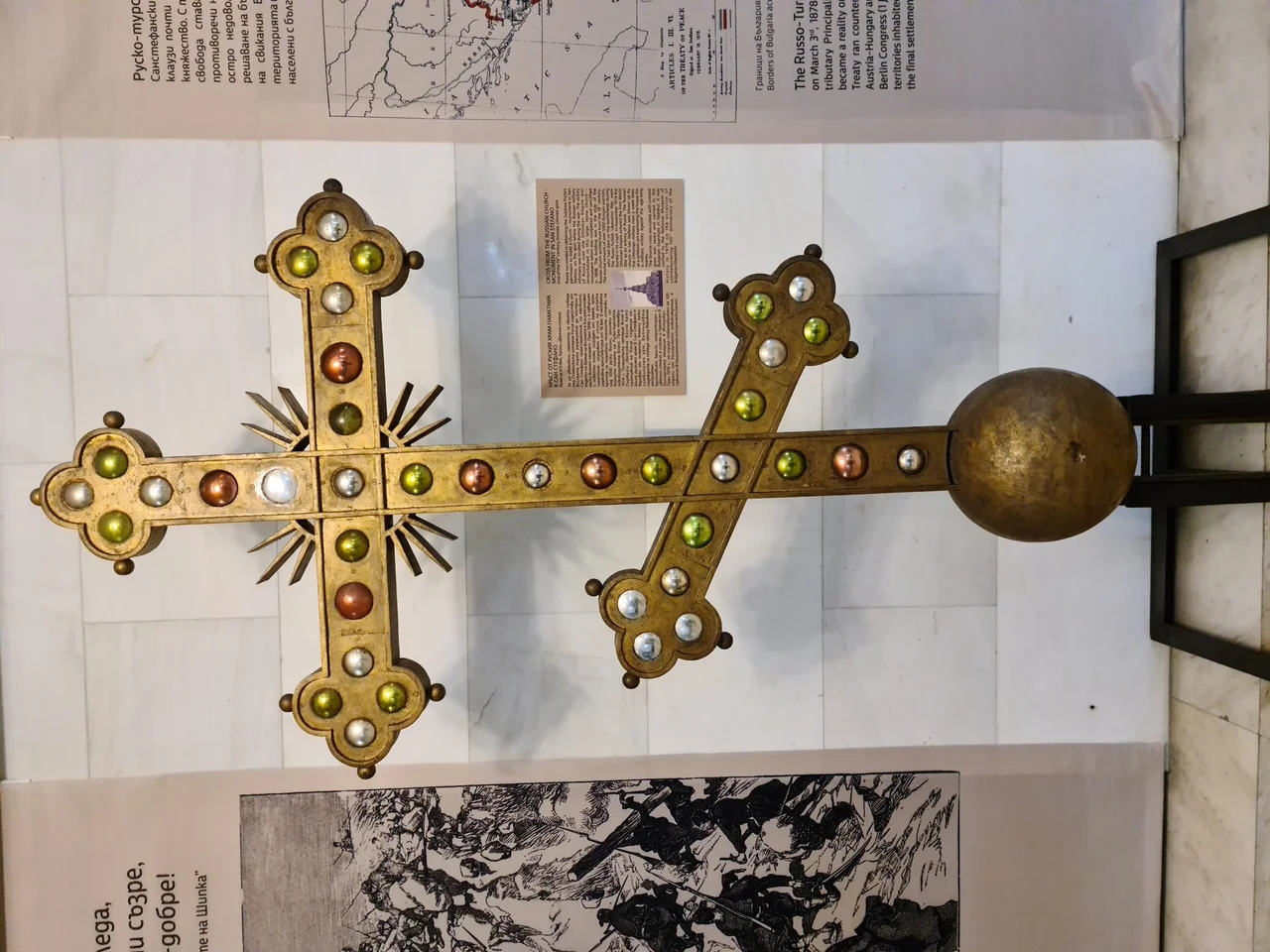

Russian Monument at San Stefano
In 1914, a man named Fuat Uzkınay pointed a camera at a building being torn down in the village of San Stefano, just west of Constantinople, and what he captured became the oldest known film made in Turkey. The building was a monument the Russian Empire had built to honor its soldiers killed in the Russo-Turkish War of 1877–1878. Its demolition, ordered by Enver Pasha as the Ottoman Empire entered World War I, was an act of political erasure — a stone memorial to Russian military presence on the Bosphorus destroyed at the moment that presence had become intolerable. The film survived. The monument did not.
What the Monument Was
The Russian Monument at San Stefano was large and deliberately so. Covering six acres on a hill above the village, it was built between 1895 and 1898 from grey rough-dressed granite accented with white French stone — materials that communicated permanence and imperial confidence. The complex combined Orthodox church architecture with commemorative military form. At its base was a charnel house holding the remains of 5,000 Russian soldiers who had died in the war of 1877–1878. Above that, a chapel rose to a campanile and a towering spire. The main entrance carried a painting of Christ, flanked by images of Vladimir the Great and Alexander Nevsky — saints whose names were bound to Russian national identity as much as to Orthodox devotion. Crenelated walls completed the ensemble, giving the whole structure the silhouette of a fortress-church. Its designer remains uncertain: Russian sources point to an architect named Vladimir Suslov, Turkish records to someone called Bozarov. What is not uncertain is the intention. This was a monument built to be seen, to be permanent, and to mark the spot where Russia had come very close to dictating the terms of Ottoman survival.
The War It Commemorated
The Russo-Turkish War of 1877–1878 ended badly for the Ottoman Empire. Russian forces crossed the Danube, pushed through Bulgaria, and reached the village of San Stefano — steps from Constantinople — before a ceasefire was negotiated. The Treaty of San Stefano, signed in that village in March 1878, imposed harsh terms: large territorial concessions, recognition of Bulgarian autonomy, and an indemnity that strained the Ottoman treasury for years. The treaty was subsequently revised at the Congress of Berlin, with European powers reining in Russian gains, but the military reality had been plain: Russian armies had stood on the edge of the Ottoman capital. The monument built on that hill between 1895 and 1898 was a physical reminder of that fact, visible from the Marmara shore, a statement in stone about who had won and who had lost. For the Ottoman Empire, it was not a comfortable thing to see across a generation of peacetime.
Demolition and the First Turkish Film
When the Ottoman Empire entered World War I in November 1914, it declared jihad and aligned itself with Germany against Russia. The political logic followed quickly to the monument on the hill. Ismail Enver Pasha, the minister of war, ordered its demolition. The charnel house, the chapel, the spire, the crenelated granite walls — all came down. Fuat Uzkınay filmed the process, and his footage of the demolition, titled "Demolition of the Monument at San Stefano" in Turkish, is recognized as the earliest known film produced in Turkey — though the film itself is lost, the last surviving copy believed destroyed around 1941. It was later embraced in the 1940s as the symbolic birth of Turkish cinema, woven into a national cultural narrative. The film records an act of destruction; the cultural history made of it something more ambivalent. What the camera caught was real: workers, cranes or ropes or both, and a monument unmade. The 5,000 soldiers whose remains rested in the charnel house had no further say in any of it.
What Remains
The monument has been gone for more than a century. The site in what is now the Yeşilköy neighborhood of Istanbul has been built over, the hill absorbed into a densely inhabited district. San Stefano itself — the name, the village identity — disappeared in 1926 when the Turkish government renamed it Yeşilköy, meaning Green Village. The Treaty of San Stefano still bears the old name; so does San Stefano Peak on Rugged Island in the South Shetland Islands, Antarctica, named in connection with the treaty. The film survives in archives. Historical photographs show the monument in its completeness: the spire rising above the Marmara shore, the granite courses tight and certain, the whole structure announcing an imperial ambition that lasted less than twenty years in stone. Memory is what remains — contested, layered, and preserved partly by the very act of destruction that a camera happened to record.
From the Air
The former site of the Russian Monument at San Stefano lies at approximately 40.962°N, 28.811°E in the Yeşilköy neighborhood of Bakırköy, Istanbul. The hill on which it stood overlooks the Marmara Sea coastline; from the air at 1,500–2,500 feet the coastal topography of Yeşilköy is clearly visible. The former Istanbul Atatürk Airport (LTBA) lies less than 2 km to the north — the old village of San Stefano was its original neighbor. Nearest currently operating major airport is LTFM (Istanbul Airport), approximately 25 km northeast. Approach from the south over the Sea of Marmara provides the best orientation to the shore where the monument once stood.
Nearby Stories
- Istanbul Canal 5 km away
- Polonezköy 8.1 km away
- MV Struma 8.9 km away
- Sea of Marmara 11 km away
- HMAS AE2 42 km away
- Bandırma 75 km away
- Sangarius Bridge 101 km away
- Edirne 135 km away