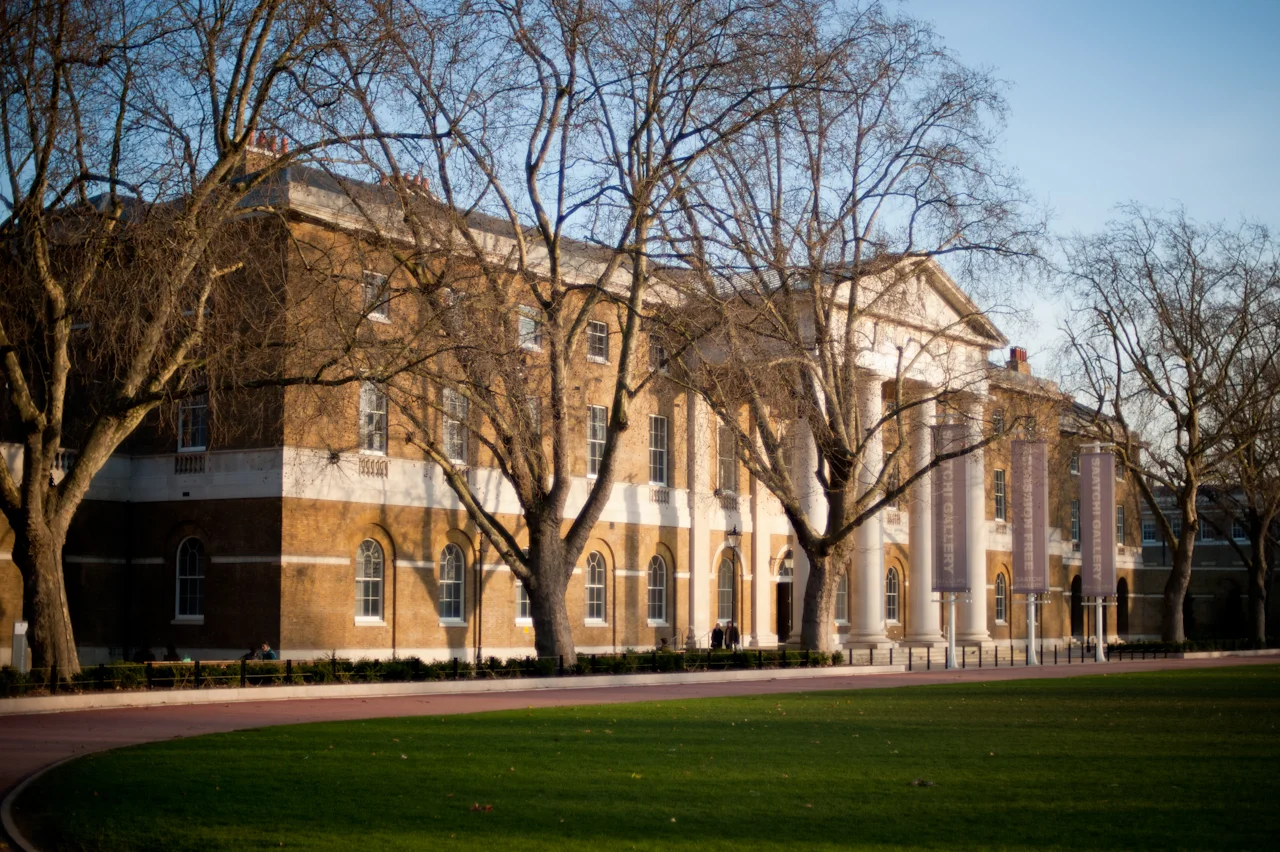

Saatchi Gallery
A cow's head, eaten by flies, in a glass vitrine. That was the centerpiece of Charles Saatchi's first Young British Artists show in 1992, and it announced that something strange was happening in a disused paint factory on Boundary Road. The advertising magnate who had helped Margaret Thatcher win an election was using his fortune to buy art that disturbed people for a living. The Saatchi Gallery, which opened in 1985 and now occupies the 70,000-square-foot Duke of York's Headquarters in Chelsea, has been London's most argumentative contemporary art space for four decades - alternately celebrated and excoriated, sued and sued back, but rarely ignored.
The Paint Factory Years
Boundary Road, St John's Wood, 1985. A 30,000-square-foot former paint factory in a quiet residential street, painted white inside, became Britain's introduction to American minimalism and pop. The opening show that ran from March to October featured Donald Judd's boxes, Brice Marden's panels, Cy Twombly's scribbled canvases, and Andy Warhol's silkscreens. For Twombly and Marden, it was their first UK exhibition. The next year brought Anselm Kiefer's burned landscapes and Richard Serra's steel sculptures - so massive that the gallery demolished the caretaker's adjoining flat to make room for them. London had nothing else like it. A private collector was operating a museum-scale space and showing work that the country's official institutions were too slow, too cautious, or too underfunded to chase. The Tate watched. So did a generation of art students.
Hirst, Sharks, and Sensation
Then Saatchi reversed course. He sold his American collection and bet on a different bet: the kids. In 1988 a 23-year-old Damien Hirst had organised a show called Freeze in a disused Port of London Authority building, gathering his Goldsmiths classmates. Saatchi bought their work, scoured London art-school degree shows for more, and in 1992 mounted his first Young British Artists exhibition. The cow's head was Hirst's. The shark suspended in formaldehyde - The Physical Impossibility of Death in the Mind of Someone Living - came soon after, bought for fifty thousand pounds in 1991 and eventually sold for nearly seven million. In 1997 Sensation opened at the Royal Academy with 110 works by 42 artists from the collection. It drew over 300,000 visitors and a hail of ink and eggs thrown at Marcus Harvey's portrait of the child-murderer Myra Hindley, made from infant handprints. When the show reached the Brooklyn Museum two years later, Mayor Rudolph Giuliani tried to defund the museum over Chris Ofili's elephant-dung Madonna. The lawsuit went against Giuliani. The artists became famous.
Moving House, Twice
In 2003 the gallery moved to County Hall on the South Bank, the Greater London Council's old neo-Baroque headquarters across the Thames from Parliament. A thousand guests came to the launch. Spencer Tunick staged a 'nude happening' with 200 naked people. Hirst, however, refused to acknowledge the retrospective, furious that a Mini Cooper he had decorated with charity spots was hung as serious work. 'I'm not Charles Saatchi's barrel-organ monkey,' he told the press. The relationship with the landlords soured faster. By 2005 a judge ordered the gallery off the premises for 'deliberate disregard' of its lease, and the corporate entity that ran the gallery was wound up with debts of 1.8 million pounds. Saatchi called the departure 'tragic.' On 9 October 2008, the gallery reopened in Chelsea's Duke of York's Headquarters - a former military building near Sloane Square - with The Revolution Continues: New Art from China, twenty-four artists working in the long shadow of the Cultural Revolution. The Financial Times called it the most persuasive showing of contemporary Chinese art Britain had yet seen.
Charity, Reversal, and the Long View
Saatchi has spent decades being accused of manipulating the art market by buying young artists in bulk, anointing them, and selling at the peak. He has also given away thousands of works. In 1999 the gallery donated 100 pieces to the Arts Council's lending collection. In 2000, 40 more went through the National Art Collections Fund to eight regional museums. In 2002, 50 artworks were given to Paintings in Hospitals, which lends originals to NHS wards. In 2019 the gallery itself became a registered charity. Recent exhibitions have included a touring Tutankhamun show, JR: Chronicles, and London Grads Now - a 2020 exhibition that handed the Chelsea galleries to fine-art graduates whose degree shows had been cancelled by the pandemic. Saatchi has admitted that most YBAs will end up as 'nothing but footnotes' in history. He may be right. But while the footnotes were being written, he gave them the brightest rooms in London.
From the Air
Located at 51.4906°N, 0.1589°W in the Duke of York's HQ off King's Road, Chelsea, near Sloane Square. Recommended viewing altitude 2,000-3,000 feet. The brick complex sits between the Thames and Hyde Park; Heathrow (EGLL) lies 14 nm west, London City (EGLC) 7 nm east-northeast. Look for Sloane Square's distinctive cross-roads pattern just north of the river bend at Chelsea Bridge.
Nearby Stories
- Battle of Britain, Northfleet 1.1 km away
- Bayham Old Abbey 5.4 km away
- Catharine Macaulay 6.4 km away
- Hatfield rail crash 8.8 km away
- Chequers 8.9 km away
- Chelmsford Cathedral 10 km away
- Queen Victoria Hospital 13 km away
- Fishbourne Roman Palace 36 km away