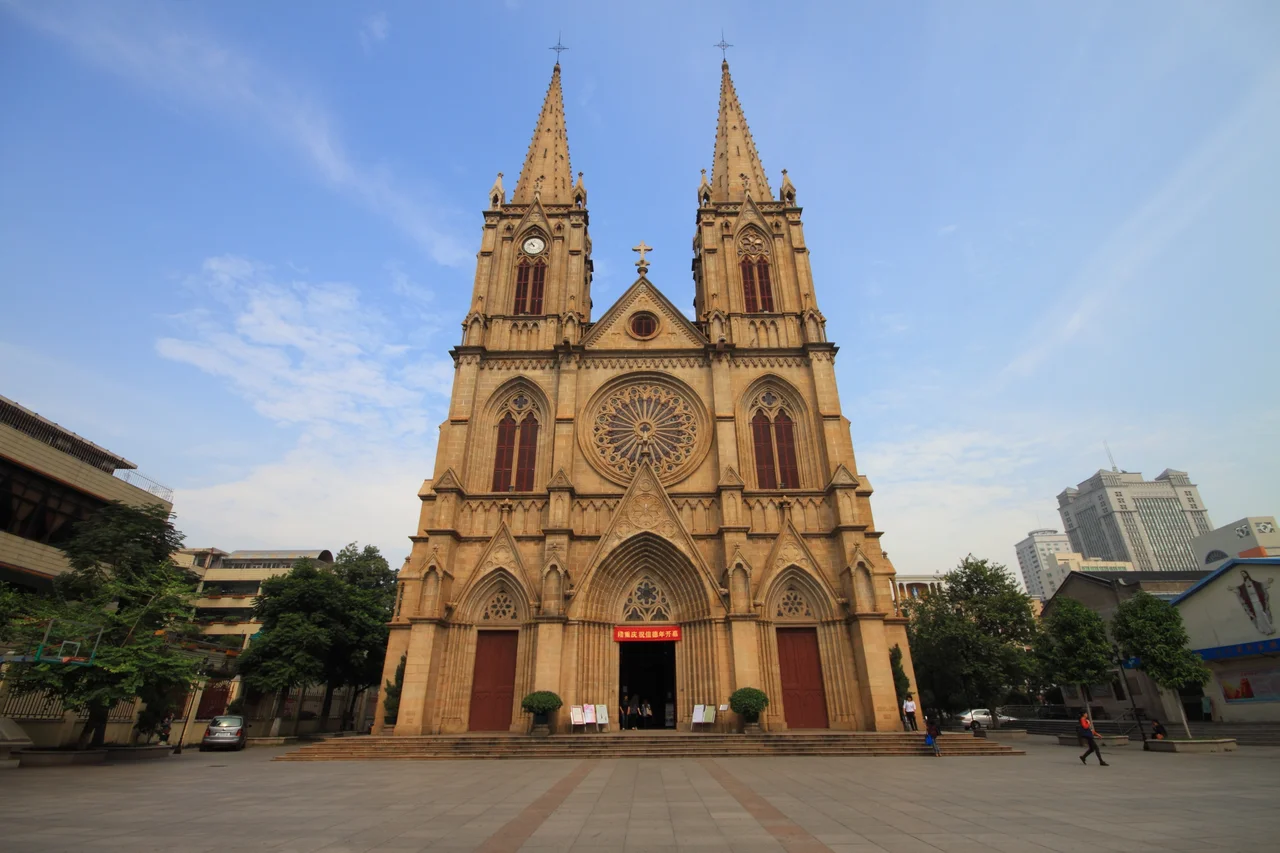

Sacred Heart Cathedral (Guangzhou)
Locals call it the Stone House, and the name is exactly right. Where other grand churches might use limestone or brick, the Sacred Heart Cathedral in Guangzhou is built entirely of granite — walls, pillars, twin towers, all of it cut from the same hard gray stone. The blocks were quarried from the Four Hills of Kowloon and carried north by sailing ship. When you stand inside and look up at the 28.2-meter nave, you are surrounded by material that crossed the Pearl River estuary on flat-bottomed boats, hauled up by workers who had never seen a Gothic cathedral before.
A Viceroy's Ruin, a Bishop's Ambition
The ground on which the cathedral stands had a more turbulent origin than most church sites. It was the official residence of the Viceroy of Guangdong and Guangxi during the Qing dynasty — one of the most powerful administrative positions in southern China. During the Second Opium War, the residence was destroyed and Viceroy Ye Mingchen was captured by the British. The land sat in contested limbo until 1861, when the Paris Foreign Missions Society signed an agreement with the Qing government to take possession of the site. The impetus came from an imperial edict originally issued by the Daoguang Emperor in 1846, promising compensation for mission properties taken during earlier hostilities. In his decree approving the transfer, the Xianfeng Emperor wrote a sentence that reads more like a prayer than a legal instrument: "from now on, war should be stopped and peace be sincerely kept forever." Construction began that same year, on June 28, the Feast of the Sacred Heart.
Napoleon's Cathedral
The funding came, primarily, from Paris. When Bishop Philippe François Zéphirin Guillemin, the first vicar apostolic of Guangdong, met with Napoleon III in 1858, the emperor — urged by his wife Eugénie — offered a personal grant of 500,000 francs. In 1873, the French National Assembly passed a further allocation of 75,000 francs, approved by a vote of 491 to 100. The architects, Léon Vautrin and Charles Hyacinthe Humbert, both of Nancy, modeled the facade on the Basilica of St. Clotilde in Paris, and the nave and apse were inspired by Toul Cathedral. The result was thoroughly French Gothic transplanted to subtropical China — pointed arches, ribbed vaulting, 14 side chapels, twin towers rising 52.76 meters above Yide Road. Bishop Guillemin never saw it finished. He died in Paris in 1886, at age 72, two years before the cathedral was completed in 1888 after 25 years of construction.
The Foreman from Jiexi County
The cathedral could not have been built without Cai Xiao. The French missionaries and their architects arrived with plans for a structure unlike anything local workers had ever erected — no Chinese craftsman at the time had built a Gothic cathedral, and communication between the French supervisors and Chinese laborers was severely limited by language. Progress was slow for years. Eventually, the French employed Cai Xiao, a man from Jiexi County in eastern Guangdong, as foreman. He had spent years building stone houses in his hometown and brought methods that translated European structural intentions into something Chinese workers could execute. He barely left the site after taking the job. The cathedral's 25-year construction spanned most of his working life, but he lived to see it finished. The cathedral's floor area is 2,924 square meters. Granite blocks, quarried by hand from the hills of Kowloon, were shipped by sail across the estuary and dressed by workers who learned as they built.
Stone That Outlasted Empire
The cathedral has endured more than most buildings in Guangzhou. It survived the Sino-Japanese War, though the conflict destroyed many of the 19th-century stained glass windows. The Cultural Revolution brought a different kind of damage: the remaining original glass was smashed, and the cathedral was closed. Restoration came after 1980. A major renovation project between 2004 and 2006, costing 26 million yuan, rebuilt the entire roof while preserving the rib vaults below — a precise and technically demanding undertaking. New stained glass, ordered from a Philippine specialist, now fills the windows; it carries English descriptions rather than the Latin and French of the original French glass, a small marker of the cathedral's changed context. The church holds Masses in Cantonese, Mandarin, Korean, and English, reflecting the cosmopolitan congregation that now gathers under its granite arches. It is the largest Gothic-style cathedral in China and Southeast Asia, and the seat of the Archbishop of Guangzhou.
From the Air
The Sacred Heart Cathedral is located at 23.1173°N, 113.2548°E on Yide Road in Guangzhou's Yuexiu District, approximately 300 meters north of the Pearl River. Guangzhou Baiyun International Airport (ZGGG) is approximately 20 km to the north. The cathedral's twin towers at 52.76 meters are not visible from cruising altitude amid the surrounding urban density, but the Pearl River's north bank is a clear geographic reference. At 1,000 feet AGL on a southbound approach over central Guangzhou, the river bend near Shamian Island — approximately 1 km west — is a useful visual marker for the old city district.
Nearby Stories
- Shunde 12 km away
- 2015 Shenzhen Landslide 15 km away
- Mount Luofu 23 km away
- Qingyuan Maglev Tourist Line 32 km away
- Kaiping 56 km away
- Heyuan 90 km away
- Chikan, Kaiping 92 km away
- Erlitou Site Museum of the Xia Capital 1257 km away