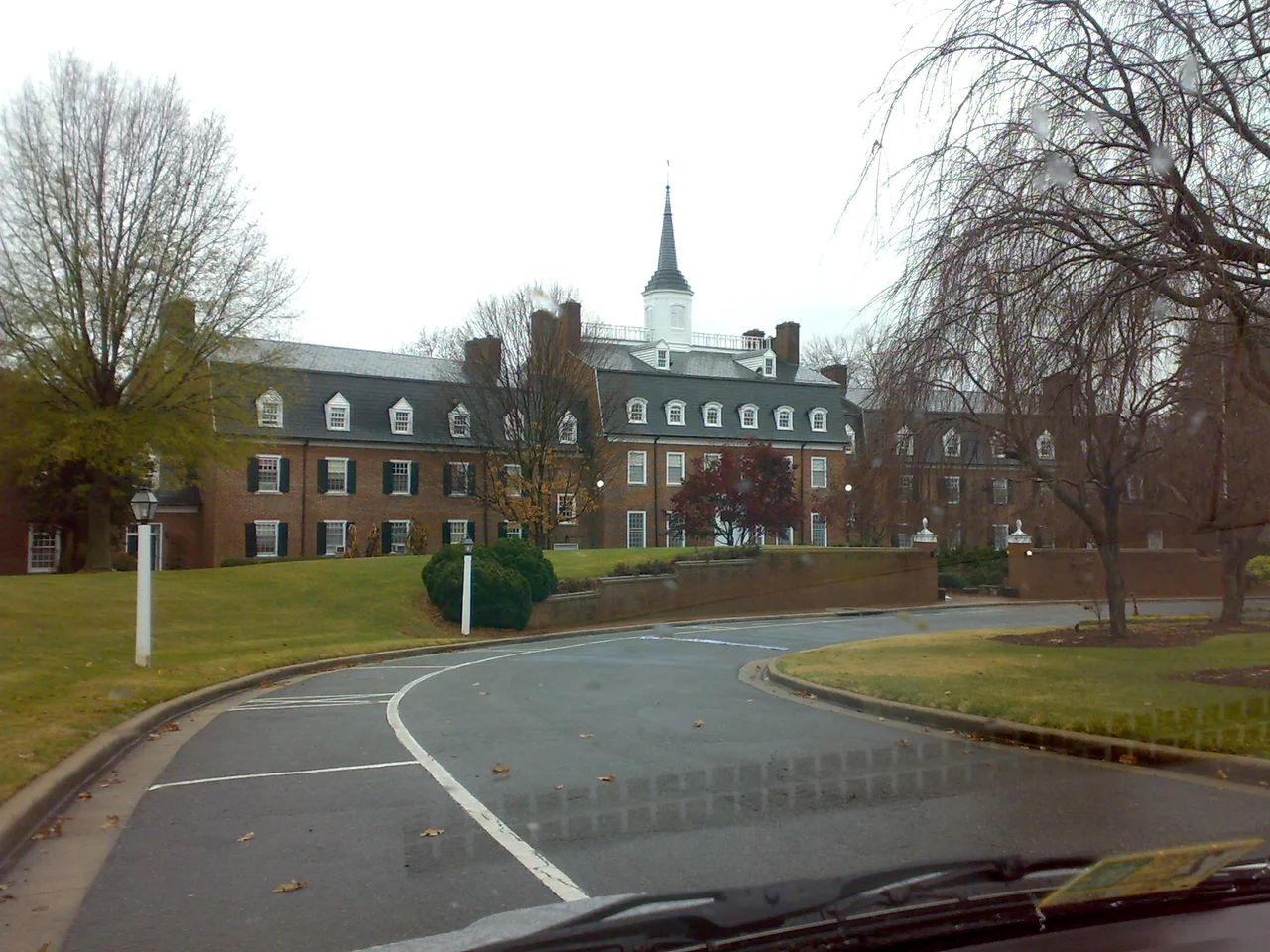

Salem Academy
Sixteen girls and women walked roughly five hundred miles from Bethlehem, Pennsylvania, to a Moravian settlement called Salem in colonial North Carolina. Most of them walked on foot. The year was the early 1770s. One of them, Elisabeth Oesterlein, was seventeen years old, and on April 22, 1772, she became the first teacher of what was then called the Little Girls' School. There were very few girls' schools anywhere in colonial America in 1772. There were almost none in the South. Salem Academy has not closed its doors in the two and a half centuries since, through the American Civil War, a nineteenth-century measles epidemic, and the rest of what those two centuries contained.
Why the Moravians
The Moravian Church, then a small Protestant community with European roots in what is now the Czech Republic, held an idea that was unusual for its time: that girls deserved an education comparable to the one given boys. The Moravians did not invent the principle, but in eighteenth-century North Carolina they were among the few people willing to staff a school to act on it. The Little Girls' School began as a primary school for the daughters of Salem's Moravian families. It began accepting boarding students from outside the community in 1802, almost three decades into its existence, and word spread quickly enough that families across the South began sending daughters there. The school grew steadily through the nineteenth century. By the 1860s it was offering college-level coursework, and in 1907 it formally became Salem Academy and College, splitting into a high school and a degree-granting college that share a campus to this day.
Sarah Childress Polk and Other Alumnae
Sarah Childress Polk, who attended Salem from 1817 to 1819, went on to marry James K. Polk and serve as First Lady of the United States from 1845 to 1849. Her education here was a rare privilege at the time, particularly in a slaveholding South where most white women received only basic literacy and most Black women, enslaved or free, were legally barred from formal schooling altogether. Among Salem Academy's later notable alumnae are Elizabeth Campbell, who founded WETA-TV in Washington, D.C.; Tillie Kidd Fowler, a member of the U.S. House of Representatives from Florida; the chef and television personality Vivian Howard; the singer-songwriter Marshall Chapman; the actress Rolonda Watts; and Sarah T. Hughes, the federal judge who swore in Lyndon B. Johnson aboard Air Force One on the afternoon of November 22, 1963, the only woman ever to swear in a U.S. president.
On the Campus
Salem Academy shares its campus with Salem College on the edge of historic Old Salem, the carefully preserved Moravian town where the school began. Many of the buildings around the academy date to the eighteenth and early nineteenth centuries; some predate the United States. The school is now an independent institution but retains key Moravian traditions. The senior vespers, held at the close of every fall term, includes a Moravian Lovefeast, a candlelight choral service in which seniors wear white dresses, sing carols, and serve coffee and buns in the eighteenth-century pattern. Salem Academy is the oldest private school in North Carolina and the fourth-oldest boarding school in the United States, a position it holds through sheer continuous operation: a school that has never had a year in which it did not teach.
Smoosh Cake and the Saber
What a school carries through 250 years are the small things. The mascot is the Saber. The school colors are purple and gold. At the Athletic Picnic each fall, the entire student body learns whether it has been assigned to the purple team or the gold team for the year, and a school year of friendly rivalry begins. At the Ring Banquet, freshmen host an evening with a theme only they know, while seniors run down an aisle to receive their class rings. At the Smoosh Cake Banquet, every senior is given a cupcake containing small gems that, by tradition, foretell that student's future. Senior Day, the day after the Ring Banquet, ends with skits and the singing of the senior song to the rest of the school over an outdoor lunch. The dress code for the auditorium stage is semi-formal: blazers, shirts, and ties for men, formal attire generally. The traditions are unselfconsciously precious to the people who carry them, and they accumulate.
The Long View
About a quarter of Salem Academy students each year come from outside the United States, from countries that have varied over the decades to include Germany, South Korea, Trinidad, Albania, Dominica, Lithuania, the United Kingdom, the Bahamas, and China. Salem requires twenty academic credits for graduation, including four in English, three in a world language, four in mathematics, three in history, and three in science, plus physical education, religion, and fine arts. A three-week January term allows juniors and seniors to pursue internships off-campus and travel domestically or abroad with faculty members. The Class of 2017 was reported with a 100 percent college acceptance rate and more than $3 million in scholarship offers. The arithmetic adds up the same way it did in 1772: the seventeen-year-old teacher and her sixteen students became, over time, an institution whose graduates can be found on every continent. A school's longevity is measured in classes that did not stop arriving.
From the Air
Located at 36.09 degrees north, 80.24 degrees west, on the southern edge of downtown Winston-Salem, North Carolina, in the historic Old Salem district. The campus sits on a small ridge overlooking the city; from the air it is identifiable as a cluster of brick buildings with the distinctive Moravian church spire visible at the heart of Old Salem just north of the academy. Best viewed below 3,000 feet AGL. Nearest tower-served airport is Smith Reynolds (KINT) at Winston-Salem, about 2 miles north-northeast; campus is within KINT's Class D shelf. Piedmont Triad International (KGSO) lies about 20 miles east-northeast. Contact KINT tower before low overflight.
Nearby Stories
- Battle of Wetzell's Mill 5 km away
- Hanging Rock State Park 5.9 km away
- Mebane's Bridge 11 km away
- 2025 North Carolina Cessna Citation II Crash 13 km away
- Wil-Cox Bridge 16 km away
- North Wilkesboro Speedway 19 km away
- Galax, Virginia 31 km away
- Deep River Camelback Truss Bridge 60 km away