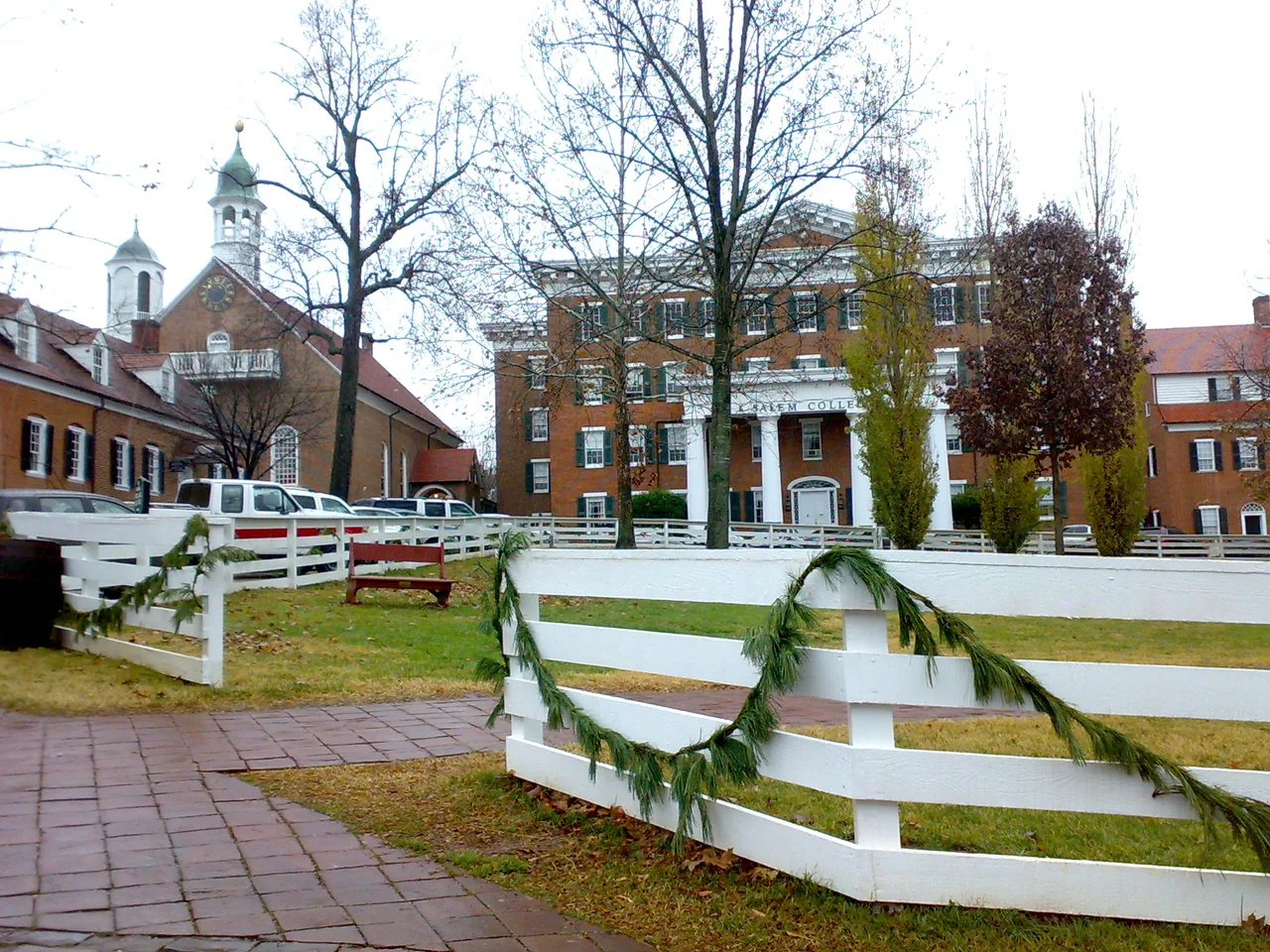

Salem College
Salem College does not advertise its age the way some institutions do. The fact sits quietly in the catalog: a 1772 founding date, an unbroken chain of women teaching women on essentially the same campus for 254 years, the oldest continuously operating women's educational establishment that is still a women's college in the United States. Walk through the gates today and the eighteenth-century Moravian buildings of Old Salem rise on either side, the cobblestones uneven where they have always been uneven, and the small private campus where Sarah Childress Polk studied as a girl now educates students from Nepal and Ethiopia and Myanmar alongside students from across North Carolina.
April 22, 1772
On April 22, 1772, the Moravian settlement of Salem opened a primary school for girls and called it, simply, the Little Girls' School. The Moravians had carried their belief in equal education for boys and girls across the Atlantic from central Europe and down the Great Wagon Road to North Carolina. Sister Elisabeth Oesterlein, who had traveled from Bethlehem, Pennsylvania, in 1766 at age seventeen, was hired as the first teacher. The school became a boarding institution in 1802. In 1866 it took the name Salem Female Academy. It began awarding college diplomas in 1890. By 1907 the institution officially became Salem Academy and College, with the high school and the degree-granting college sharing the same campus next to Old Salem. The chronology reads tidily on paper. The two-and-a-half centuries it represents do not.
Hanna and Anna Maria
The school's record on accepting students from diverse backgrounds is genuinely older than the United States, and it carries complications worth naming. Moravian records show that two enslaved African American girls were accepted at Salem in the eighteenth century. Hanna, age ten, entered the school in 1785. Anna Maria Samuel attended Salem and lived in the Single Sisters' House from 1793 to 1795. Their attendance was unusual in the slaveholding South and was not unconnected to the complicated relationship the Moravians maintained with slavery, which they practiced and only gradually abandoned. Hanna and Anna Maria were enrolled at a school for white girls inside a town built in part by enslaved labor. The fact of their education does not erase the context. It does mean that two specific African American girls learned to read inside this building. Their names are recorded; their lives outside the school records are not. Salem includes them in its history because they belong in it.
Sarah Childress Polk and the Long Roll
Among Salem's most prominent alumnae is Sarah Childress Polk, who studied at Salem from 1817 to 1819 and went on to serve as First Lady of the United States from 1845 to 1849 as the wife of President James K. Polk. Other alumnae include Emma Augusta Lehman, an 1864 graduate who taught at Salem for fifty-two years and worked as a poet, naturalist, and botanical collector. The actress Celia Weston is a graduate. The long-distance runner Sarah Covington Fulcher, who completed a 2,700-mile run across Australia and the world's longest continuous solo run, attended. The notable alumnae list runs through politicians, physicians, journalists, religious leaders, and educators; Lu Long Ogburn Medlin won Miss North Carolina in 1951. The pattern is consistent: women in fields women historically were either pushed out of or barred from.
What Salem Teaches Now
Salem College today offers a Bachelor of Arts, a Bachelor of Science, a Bachelor of Science in Business Administration, a Master of Arts in Teaching, and a Master of Education. On February 24, 2021, the college announced a strategic shift to focus on preparing students for health leadership, repositioning itself as the only college in the country dedicated to elevating and expanding the role of women in health leadership. Enrollment is small: 549 students at last public count, including undergraduate, graduate, and adult continuing-education students. A cross-registration arrangement with Wake Forest University lets Salem undergraduates take Wake Forest classes, and vice versa; several Salem students even play in Wake Forest's marching band. Salem is also home to the Salem College Center for Women Writers, which hosts an annual writing contest and a calendar of workshops and lectures.
Spirits and Traditions
The college's athletic teams compete as the Spirits in NCAA Division III, in the USA South Athletic Conference, which they joined in 2016. Before that they competed in the Great South Athletic Conference, where they accumulated tournament titles in volleyball and regular-season honors in soccer. The traditions, though, are what students tend to carry with them. Founders' Day Convocation marks each April 22 with formal remembrance. Fall Fest brings the campus together at the start of every academic year. The Big/Little process pairs each new student with an upperclass mentor, a sorority-style scaffolding without the sorority. Students participate in over forty clubs. Old Salem outside the gates carries on as a working historic district; inside the gates, the college that began in 1772 with Elisabeth Oesterlein and a handful of girls continues to be exactly what it was always meant to be: a place where women come, study, and graduate. Two and a half centuries, and counting.
From the Air
Located at 36.09 degrees north, 80.24 degrees west, on the southern edge of downtown Winston-Salem, North Carolina, adjacent to the historic Old Salem district. The campus shares a small ridge with Salem Academy and is identifiable from the air by the cluster of brick eighteenth- and nineteenth-century buildings just south of the Old Salem core. Best viewed below 3,000 feet AGL. Nearest tower-served airport is Smith Reynolds (KINT) at Winston-Salem, about 2 miles north-northeast; the campus is within KINT's Class D shelf. Piedmont Triad International (KGSO) lies about 20 miles east-northeast. Contact KINT tower before low overflight.
Nearby Stories
- Battle of Wetzell's Mill 5 km away
- Hanging Rock State Park 5.9 km away
- Mebane's Bridge 11 km away
- 2025 North Carolina Cessna Citation II Crash 13 km away
- Wil-Cox Bridge 16 km away
- North Wilkesboro Speedway 19 km away
- Galax, Virginia 31 km away
- Deep River Camelback Truss Bridge 60 km away