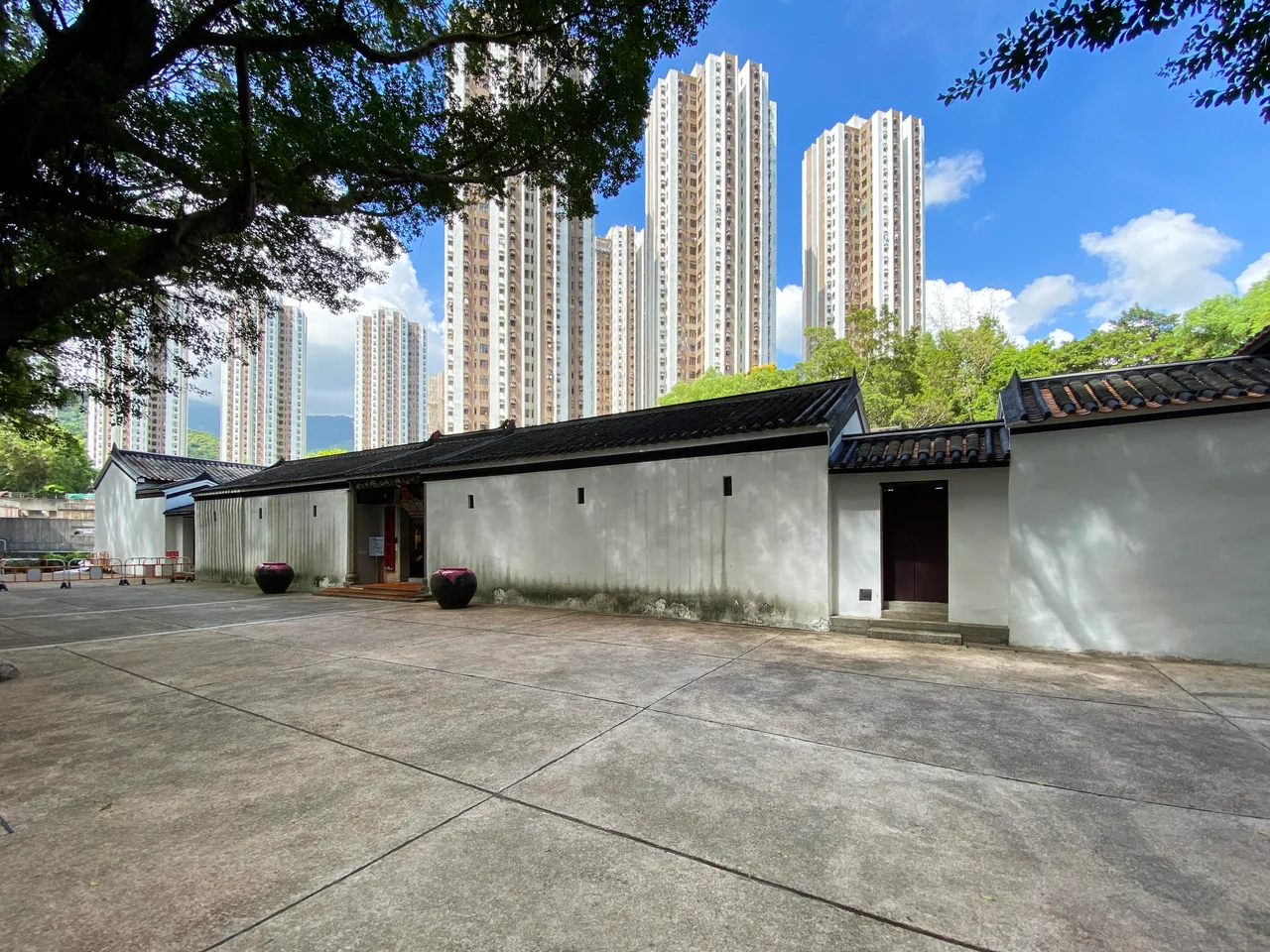

Sam Tung Uk Museum
Three rows of houses — that is what the name means. Sam Tung Uk: three-ridge dwelling, a floorplan reduced to words. In 1786, a Chan clan patriarch named Chan Yam-shing chose this patch of the New Territories and built a walled village in that precise, deliberate configuration. His clan had made a long journey to get here — from Fujian province, south into Guangdong, and finally to Hong Kong's coastlands, where they turned marsh into paddies and built a community that would last nearly two centuries. Today, those three rows of houses still stand in Tsuen Wan, marooned in time inside one of Hong Kong's densest urban districts.
Stone Walls, Moving Roots
The Chan clan were Hakka people — literally "guest families," migrants whose long southward drift through Chinese history left them perpetual newcomers in whatever region they settled. They spoke a distinct dialect, the name Chen pronounced chin2 or tshin2 on the tongue, and they built in a distinct style: compact, inward-looking walled villages designed to protect both the family and its ancestral tablets. Chan Yam-shing raised Sam Tung Uk during the Qing dynasty, when the New Territories were still agricultural land dotted with clan settlements. The village held an entrance hall, an assembly hall, an ancestral hall at its heart, and houses arranged in ranks on either side. It was a world designed to be self-sufficient, turned inward from whatever lay beyond the walls.
From Village to Monument
The village thrived for roughly 190 years before the pressures of Hong Kong's post-war urbanisation made rural clan life unworkable. Residents left for the city. By April 1980, Sam Tung Uk stood empty — a ghost of stone and tile surrounded by rising towers in what was becoming a major industrial and residential district. The Hong Kong government moved quickly. In March 1981, Sam Tung Uk was declared a historic monument, giving it legal protection. Between 1986 and 1987, government funds paid for a careful restoration that returned the buildings to something approaching their original condition. The work was good enough to earn international recognition: the Pacific Asia Travel Association's Pacific Heritage Award in 1990.
What the Halls Hold
The museum that opened in the restored village is not a conventional one. The entrance hall, assembly hall, and ancestral hall are preserved in their original form, along with twelve of the original residential houses. Walk through them and you encounter the material world of Hakka village life: farming tools with worn handles, ceramic jars, woven baskets, domestic objects that spoke of a particular way of feeding and sustaining a family. These items occupy the permanent collection, unchanged from season to season. The main exhibition hall, positioned at the far end of the complex, changes its displays roughly every six months, offering a reason to return. A separate orientation room documents the restoration process itself — the choices made, the techniques used, the evidence uncovered.
A Free Museum in a Busy City
There is something quietly remarkable about Sam Tung Uk's position in contemporary Tsuen Wan. The MTR station that bears the district's name is minutes away; towers press in on every side. Yet the museum opens its gates free of charge almost every day of the year — closed only on Tuesdays, Christmas Day, Boxing Day, New Year's Day, and the first three days of the Lunar New Year. Admission has always been free. The decision to keep it that way, in a city where space and access both carry prices, means the village functions less like a heritage showpiece and more like a genuine public amenity — a place where the particular history of one Hakka clan becomes available to anyone who walks through the gate.
The Persistence of Three Rows
What remains extraordinary about Sam Tung Uk is not the restoration itself but the fact that anything remains to restore. Walled villages were once scattered across Hong Kong's New Territories, built by the five great clans and dozens of smaller ones over centuries of settlement. Most were demolished during the post-war building boom that transformed Hong Kong's landscape. Sam Tung Uk survived partly through luck, partly through the unusual speed with which Hong Kong's government acted after the last resident departed. Walking its narrow lanes, between the low tile-roofed houses and the stone walls that once kept the outside world at bay, offers a genuine encounter with what rural Hong Kong once looked and felt like — not reconstructed, but restored.
From the Air
Sam Tung Uk Museum sits at approximately 22.372°N, 114.120°E in Tsuen Wan, in the western New Territories. From the air at 2,000–3,000 feet, Tsuen Wan appears as a dense urban grid pressed against the hills to the north and Rambler Channel to the south. The museum's compact walled footprint is difficult to pick out among the surrounding tower blocks, but the district is easily identified by its industrial waterfront and the container facilities along the shore. The nearest major airport is Hong Kong International Airport (VHHH) on Lantau Island, roughly 15 km to the southwest across the harbour. Kai Tak's former site is visible to the southeast. Approach from the west over the channel provides the clearest view of the Tsuen Wan urban area.
Nearby Stories
- Chapel of St. Francis Xavier 3.5 km away
- Cuiheng 4.1 km away
- 2015 Shenzhen Landslide 16 km away
- Shunde 31 km away
- Wanshan Archipelago 37 km away
- Nanxiong Formation 96 km away
- Heyuan 149 km away
- Checheng Fu'an Temple 629 km away