.JPG)
Sandbach
On the afternoon of 3 September 1651, the Sandbach summer fair was in full swing on the town common when about a thousand exhausted Scottish cavalry rode through, retreating from their defeat at the Battle of Worcester. The encounter that followed, brief and chaotic, gave the common its name. Scotch Common, it has been called ever since. That afternoon was the only notable event of the Civil War to happen in Sandbach, but the town has rarely lacked for something to put on the map: two Anglo-Saxon crosses in the market square, a Royal Charter from Elizabeth I in 1579, the founding of Foden truck-making in 1933, and a brass band that has won the British Open.
Two Crosses and a Market Charter
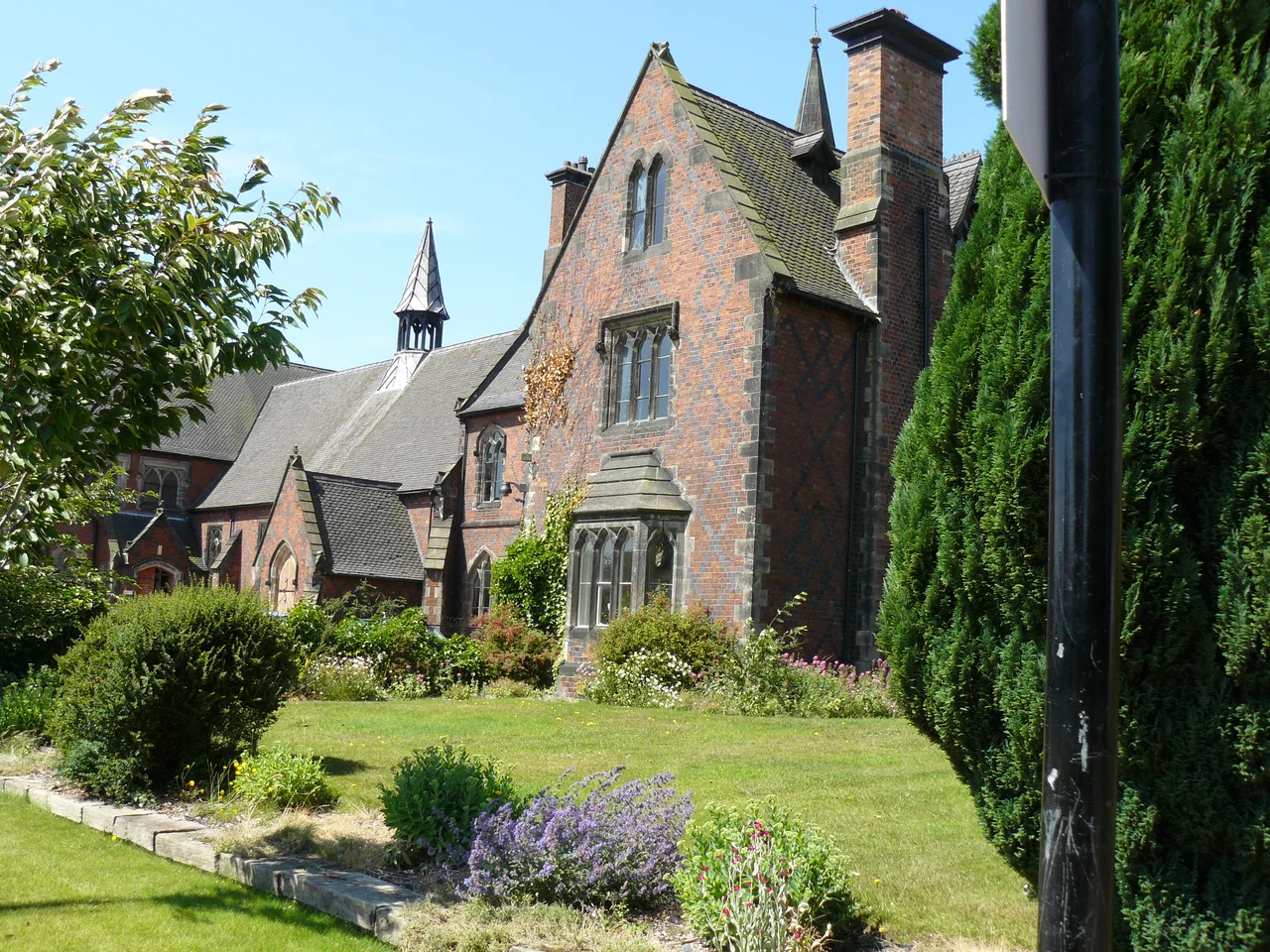
Sandbach has been a market town since 1579, when Elizabeth I granted the Royal Charter that secured its right to hold fairs and markets. The cobbled market square is anchored by the Sandbach Crosses, two Anglo-Saxon stone crosses now dated to the ninth century, thrown down during the Reformation or the Civil War and reassembled in 1816. They are recorded as a Grade I listed building and a scheduled monument, the heritage system's two highest protections. The square is ringed by a remarkable concentration of listed buildings, including Sandbach School, St Mary's Church and the Old Hall Hotel, with many of the public houses on the side streets, like the Lower Chequer, listed for their service as stage-coach stops in the eighteenth and nineteenth centuries. The architect Sir George Gilbert Scott, whose practice would later design the Albert Memorial and St Pancras Station, designed Sandbach Literary Institute, Sandbach School, the Church of St John the Evangelist at Sandbach Heath, and the local almshouses, and restored St Mary's.
Silk, Trucks and ERF
Industry came to Sandbach in the form of silk mills, which by 1836 were employing 554 people, including 98 boys and girls under the age of twelve. Children working at that scale and at those ages was a feature of mid-Victorian textile manufacturing, and the conditions were dangerous, the hours long, the bodies often broken; the Cheshire silk industry was part of a national story of cheap child labour that British reformers spent the rest of the nineteenth century trying to end. The railway arrived in 1842, with Sandbach station opening to the west of the town centre in Elworth. By the time the silk industry declined, a different trade was emerging. Edwin Foden began making steam wagons in the area in the late nineteenth century, and his sons spun out a company that became Foden Trucks; in 1933 the family company ERF was founded by a breakaway branch. Trucks would carry Sandbach's industrial identity through the twentieth century, even after the manufacturer itself eventually closed down.
Foden's Band
Foden's Band, founded as the works band of the Foden truck company, is one of the most successful brass bands in the world. It has won the British Open Brass Band Championship multiple times, most recently in 2023, and competes in the championship section of the UK brass band system. The band stayed in Sandbach even after the truck-maker that gave it its name closed; it remains a centre of local identity and a magnet for young brass players from across the country. The Lions Youth Brass Band and Roberts Bakery Band are also based in the town, making Sandbach one of the densest concentrations of competitive brass bands in England. Sandbach Choral Society, founded in 1947, sings regular concerts in the town hall and at St Mary's Church.
Wetlands, Wildlife and a Naval Adoption
Sandbach Flashes, a group of fourteen separate waterbodies west of the town, are designated by Natural England as a Site of Special Scientific Interest. At least 225 species of bird have been recorded on the Flashes, making them a quiet but significant stop on north-west England's birding map. Sandbach has the sort of civic history that produced quiet attachments to large things. In Warship Week in December 1941, with Britain three years into the Second World War and stretched thin, the town adopted HMS Vimiera as its affiliated ship. The Vimiera was lost on 9 January 1942 when she struck a mine in the Thames Estuary off the East Spile Buoy, with the loss of 96 of her crew. The names of those sailors and their families are part of what attaches the town to its wartime past.
Local People, Distant Lives
Sandbach has produced and harboured an unusual cast of people. Anthony Palmer, born at Brereton Green in 1819, was a soldier who became one of the early recipients of the Victoria Cross. John M. Allegro, the archaeologist and Dead Sea Scrolls scholar, lived and died here, his scholarship still controversial decades after his death. Blaster Bates, born Derek Macintosh Bates in 1923, was a demolition expert and after-dinner speaker whose stories of dynamiting old factories made him an unlikely celebrity. Denise Coates, the billionaire co-founder of Bet365, lives in Betchton in the parish. Yvette Fielding, the television presenter who built a second career as a paranormal investigator, lives nearby. The pronunciation, for the record, is sand-batch; Lippincott's Gazetteer of 1902 felt strongly enough about it to make a note. Locals are happy to correct anyone who gets it wrong.
From the Air
Sandbach sits at 53.15N, 2.37W on the Cheshire Plain, about 50 metres elevation. From the air, the town is identifiable by Junction 17 of the M6 motorway at its eastern edge and the Sandbach Flashes wetlands group to its west. The Crewe to Manchester railway line runs west of the town centre through Elworth. Nearest airports: Manchester (EGCC) 35 km north, Hawarden (EGNR) 50 km west, Liverpool (EGGP) 65 km northwest. The Lovell Telescope at Jodrell Bank, 18 km north-northeast, makes a useful day-VFR landmark.
Nearby Stories
- Battle of Rowton Heath 1.1 km away
- Knowsley Hall 1.7 km away
- Old Trafford 2.9 km away
- Tutbury Castle 7.2 km away
- Haddon Hall 7.5 km away
- Whittington Castle 14 km away
- Stafford Castle 16 km away
- Wentworth Castle 19 km away