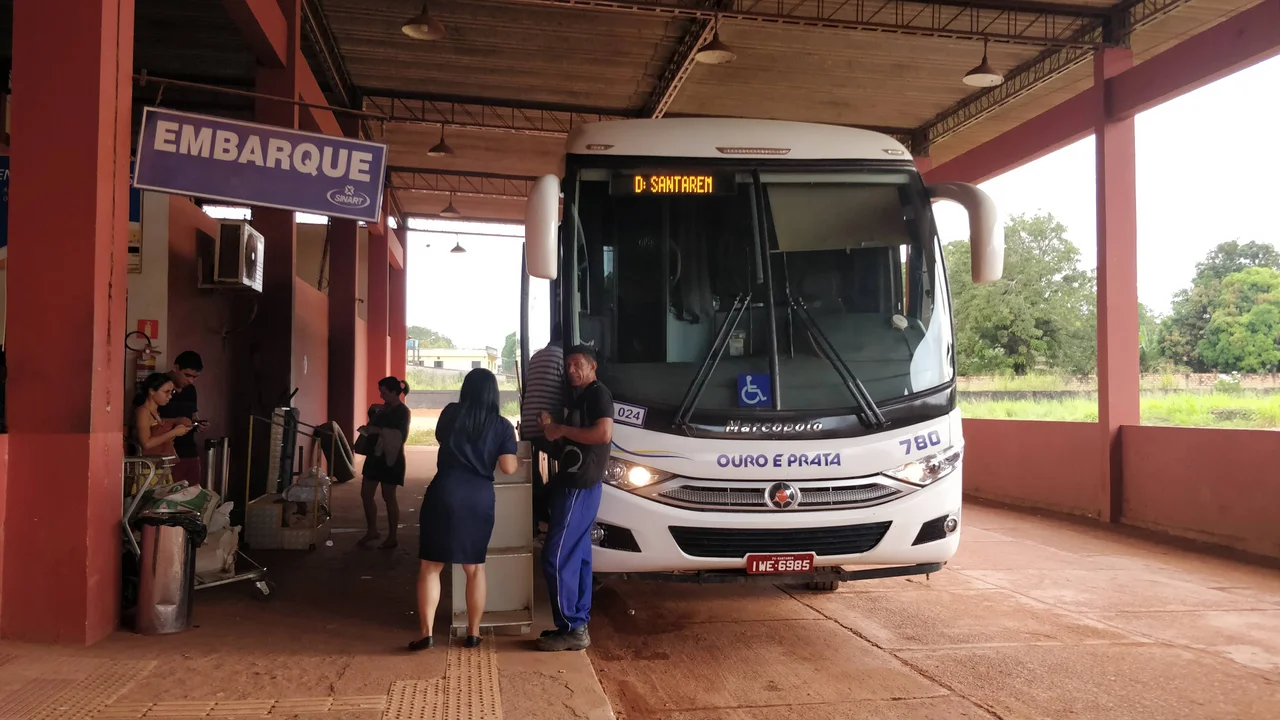

Santarém
The Amazon carries silt from the Andes, a thousand kilometers and more of glacial flour and Andean mud suspended in warm water, and by the time it reaches the front of Santarém it is the color of weak coffee with milk. The Tapajós arrives from the south out of clearer country, a deep blue river running through sandy basins. They meet at the Santarém waterfront and run side by side for kilometers, refusing to mix. Locals call it o encontro das águas, the meeting of the waters, and the boundary is so sharp you can reach over the side of a boat and feel the temperature change: cooler on the Amazon side, warmer on the Tapajós. It is the first thing a traveler sees arriving here and the last thing they forget.
Thirty-Six Hours from Manaus
The classic way to arrive is by riverboat. From Manaus, upstream and west, the trip takes about 36 hours. From Belém at the Amazon's mouth, it takes 60 to 70. Boats leave Manaus every day except Sunday; three boats operate most days of the week, but only one runs on Wednesdays and costs ten reais more than the usual first-class rate. First class on an Amazon boat is the top deck, where travelers string hammocks between the rails and sleep, eat, talk, and watch the river go by at the 10-12 knot pace of the diesel engines. Prices run 150 to 170 reais for the Manaus-Santarém leg, roughly the cost of a cheap hotel night elsewhere. The boat is not glamorous. It is transportation, the way trains are transportation in other parts of the world, and the whole of middle Amazon life is visible from the deck: the floating villages, the canoes going out to sell fish to passing boats, the church steeples of one riverside town after another.
The Caribbean in Brazil
Santarém's biggest single draw is not Santarém itself but Alter do Chão, a village about 35 kilometers downriver along the Tapajós. The Guardian once called its beach the most beautiful in Brazil. The water is warm and clear, the sand white, and during the dry season from August to January a long crescent of beach emerges from the river to form what is essentially a tropical island connected to the shore by shallow water. The effect is disorienting: you are a thousand kilometers from any ocean, in the middle of the Amazon basin, swimming in what appears to be a Caribbean bay. Alter do Chão also hosts Sairé, one of the most important folklore festivals in the Amazon region, held annually in September. Two rival boi-bumbá groups, Tucuxi and Cor-de-Rosa, perform ritual dances that compete for the crowd's favor across two nights, a pageant that marks the intersection of Catholic and indigenous religious traditions.
The Amazonian Table
The food here is Amazonian in the way that Tokyo food is Japanese: it is the regional style as it appears in its most comfortable setting. Tacacá, the hot soup of tucupi broth, jambu leaf, dried shrimp, and yellow manioc starch, is eaten from a gourd on street corners and in bars. Pato no tucupi is duck cooked in the same tucupi broth, a Belém specialty but available everywhere in Pará. Pirarucu, the giant Amazon fish that can reach three meters long, appears in escabeche sauce or grilled with farofa de piracuí (a toasted cassava flour with dried fish). Macaxeira is boiled cassava, served as a starchy side. And then the fruits: cupuaçu in creams and ice creams and chocolates, açaí in bowls thick with banana and granola, bacaba and graviola in fresh juices that taste nothing like anything from Europe or North America. The Brazil nut biscuit, a local specialty, uses the same nuts collected from Tapajós National Forest thirty kilometers south.
Where to Go Next
The city has two ports. Docas do Pará, the main port, handles boats to Manaus and Belém, the long hauls. A smaller port near Praça Tiradentes handles the local run up the Tapajós and across the Amazon: to Monte Alegre, to Macapá (though boats advertised for Macapá actually dock at Santana), to small communities accessible only by river. Itaituba, fifteen hours by boat up the Tapajós or eight by bus, is the jumping-off point for Amazônia National Park. Alenquer, on the north bank of the Amazon, puts you two hours by taxi from Vale do Paraíso, an eco-resort built around the Véu da Noiva waterfall. And Fordlândia, Henry Ford's failed 1928 rubber plantation turned ghost town, is 300 kilometers upriver on the Tapajós, reachable only by boat, a destination for travelers interested in industrial ruins and cautionary American history. Free wifi at Praça da Matriz. Wednesdays at Vila Arigó, pay ten reais for a cab and find live pagode in the open air at plastic tables under the stars.
From the Air
Santarém sits at 2.44 S, 54.71 W at the confluence of the Tapajós and Amazon rivers. Santarém-Maestro Wilson Fonseca Airport (SBSN) is the regional field, with daily flights to Manaus, Belém, and Brasília. Recommended viewing altitude 4,000-7,000 feet for a clear view of the meeting of the waters along the city's 20-kilometer waterfront. The color contrast between the blue Tapajós and the brown Amazon is visible from cruising altitude and stretches downriver for many kilometers before the waters gradually merge.
Nearby Stories
- Amazon River 39 km away
- Tapajós National Forest 108 km away
- Fordlândia 137 km away
- Terra do Meio Ecological Station 159 km away
- Parintins 174 km away
- Serra do Pardo National Park 394 km away
- Oyapock 487 km away
- Caverna do Maroaga Environmental Protection Area 518 km away