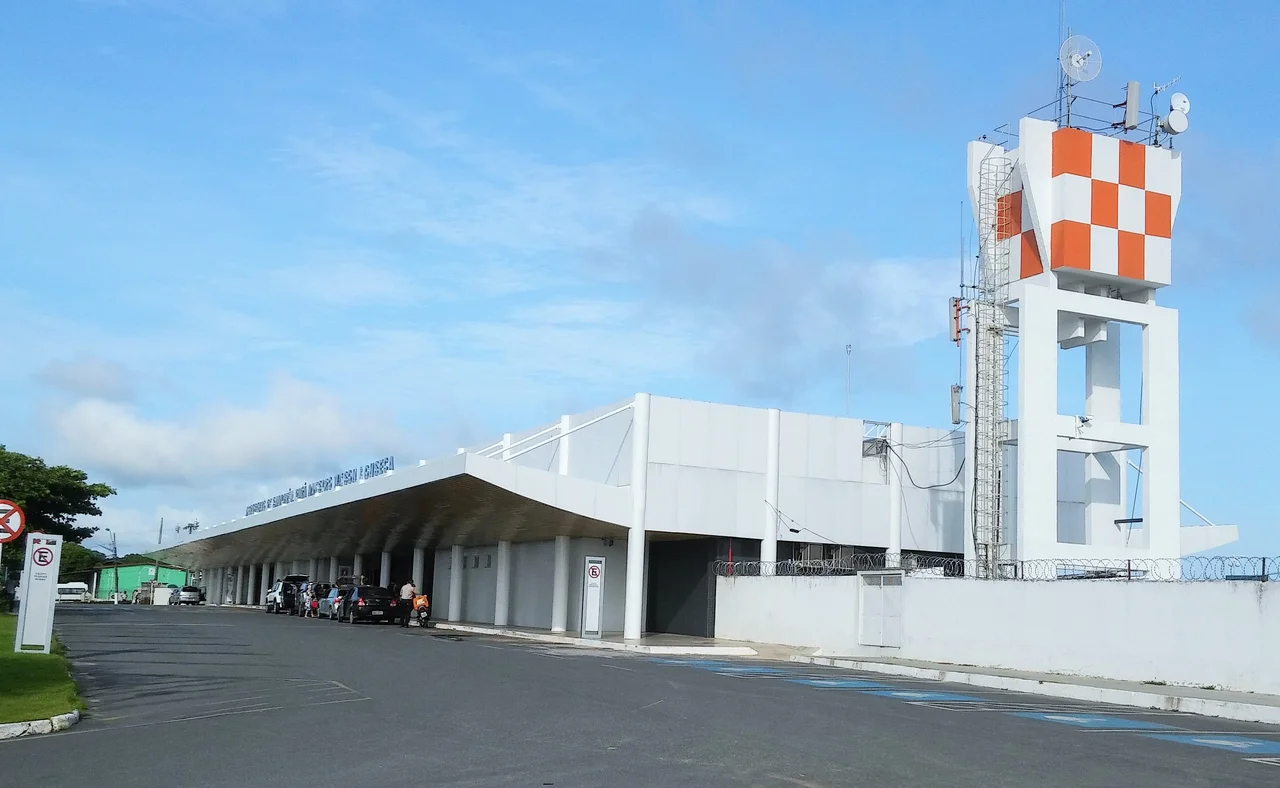

Santarém-Maestro Wilson Fonseca Airport
Wilson Dias da Fonseca never flew a plane. He was a composer, born in Santarém in 1912, a musician who spent his life writing for and conducting regional orchestras, documenting the folk traditions of Lower Amazon cities. Four years after his death in 2002, Santarém named its airport after him by federal law in 2006, the kind of gesture that is easy to miss but says something specific about what this city chooses to commemorate. The airport sits 15 kilometers from downtown, at the fifth-busiest airfield in northern Brazil. Its ICAO identifier is SBSN. It is named for a conductor. The symbol is not an accident.
A Strategic Position
Geography gave this airport a job before it had terminals. Santarém is almost exactly halfway between Manaus and Belém, the two metropolitan anchors of the Brazilian Amazon. Any flight crossing the basin has an alternate here. When Manaus weather goes bad or Belém closes for fog, SBSN absorbs the diverts. The airport opened on March 31, 1977, administered initially by the Brazilian Air Force, then transferred to Infraero, the federal airport agency, in the early 1980s. It replaced an older field, now a neighborhood of Santarém called Old Airport, whose runway was paved over and converted into an avenue with squares and event venues. In August 2022, the AENA consortium won a 30-year concession to operate the airport. Six airlines currently fly here, connecting Santarém to Brasília, Belém, Manaus, and seasonally to cruise and cargo routes.
The TABA Crash, 1995
On November 28, 1995, a TABA Fairchild Hiller FH-227 cargo flight from Belém Val de Cans to Santarém was attempting its second approach when it went down. The registration was PP-BUJ. A passenger was riding in the co-pilot's seat, a common practice on cargo flights of that era but one that left no one available to back up the captain when things went wrong. The crew of two died. Of the two other occupants, one died. The investigation noted the approach conditions and the crew's procedural response. TABA, Transportes Aéreos da Bacia Amazônica, had operated Amazonian routes since 1976 and would continue for several more years before consolidating with other regional carriers. The 1995 accident is the deadliest in the airport's history and the one most often cited when pilots discuss SBSN's approach challenges, particularly during the wet season when convective weather builds quickly over the river confluence.
Three More, Each Different
Three other fatal or near-fatal incidents have shaped the airport's safety record. On September 11, 2008, a W&J Táxi Aéreo Embraer 711C Corisco cargo flight from Alenquer ran out of fuel and ditched in the Tapajós River eleven kilometers from the runway. The pilot and one passenger were pulled from the water by a passing boat. The body of the third occupant was found 800 meters from the crash site. On September 29, 2011, a Beechcraft Bonanza lost radio contact shortly after departure. Investigators later found it had crashed in a nearby community, the tail section having failed in flight due to corrosion from poor maintenance. The pilot and passenger died. On September 7, 2017, a Piquiatuba Táxi Aéreo Cessna 210 on a medevac flight lost power, diverted toward SBSN, and landed on a beach four kilometers east of the runway. All four occupants survived. The investigation revealed chronic fuel starvation across the operator's flights, and CENIPA, Brazil's aeronautical accident investigation bureau, recommended Piquiatuba's license be suspended. The recommendations highlight a recurring pattern in Amazonian general aviation: operators flying maintenance-deferred aircraft over terrain where options are limited.
The Composer and the Runway
The decision to name this airport after Wilson Fonseca rather than a general or a politician is unusual among Brazilian regional airports. Most carry the names of presidents, governors, air marshals, and the occasional bishop. Santarém's airport carries the name of a man who wrote orchestral arrangements of Amazonian folk melodies, who conducted at concerts in the old Teatro Municipal, who collected and notated the songs sung by boatmen on the Tapajós. His name now floats in the transmission of every SBSN clearance. A Gol 737 taxiing toward runway 10 is, in some small bureaucratic sense, taxiing through Wilson Fonseca. Two cannons from the 17th-century Fortress of Tapajós sit at the passenger terminal, visible as you walk out to board. Everything about the airport says something about what Santarém values: the musician, the cannons, the position at the river confluence that is neither Manaus nor Belém but an alternative to both. The river is always there below the approach, the Tapajós running clear blue into the brown Amazon, refusing to mix.
From the Air
Santarém-Maestro Wilson Fonseca Airport (SBSN) sits at 2.42 S, 54.79 W, 15 km from downtown Santarém. Single runway 10/28, 2,400 meters, asphalt. Field elevation 198 feet. Expect seasonal convective weather during the November-May wet season, often building dramatically over the Amazon-Tapajós confluence in the late afternoon. The airport serves as an alternate for flights between Manaus (SBEG) and Belém (SBBE), and is fifth-busiest in the North Region of Brazil. Access to downtown is via the Fernando Guilhon Highway, about 20 minutes by car or bus.
Nearby Stories
- Amazon River 39 km away
- Tapajós National Forest 108 km away
- Fordlândia 137 km away
- Terra do Meio Ecological Station 159 km away
- Parintins 174 km away
- Serra do Pardo National Park 394 km away
- Oyapock 487 km away
- Caverna do Maroaga Environmental Protection Area 518 km away