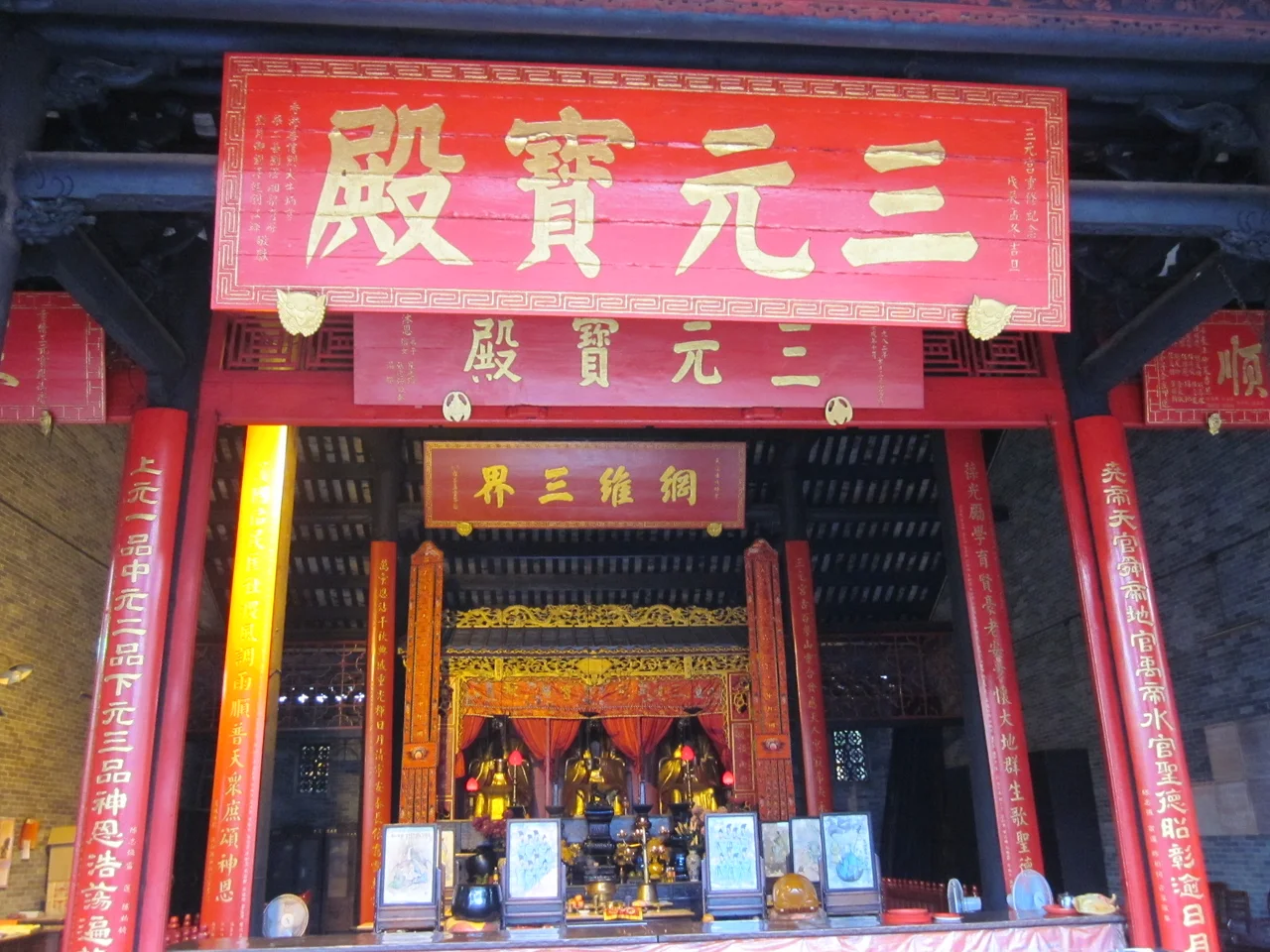

Sanyuan Palace
The temple has been called Bei Miao, Yuegang Yuan, Wuxing Temple, and Sanyuan Palace — four names across roughly two thousand years of continuous spiritual use on the same hill in Yuexiu District. Not many places in Guangzhou can say the same. The city has been rebuilt so many times by commerce, war, and ambition that most of its old fabric is gone. Sanyuan Palace persists, badly damaged, reopened, restored, and still active, its incense rising most mornings above a neighborhood that was once forest and is now apartment towers.
From Kingdom to Temple
The temple's founding reaches back to the Nanyue Kingdom, the southern Chinese state that occupied what is now Guangdong and neighboring regions from approximately 204 to 111 BCE. At that time the site was known as Bei Miao — the Northern Temple. When the Nanyue Kingdom fell to Han conquest, the temple fell with it into disuse. Centuries passed. Then, in the early Jin dynasty, during the second year of the Daxing era of Emperor Yuan of Jin, the site was brought back to life by an unusual arrangement. Nanhai governor Bao Jing revived the temple not for himself but for his daughter, Bao Gu, a Taoist practitioner and physician who is remembered in Chinese tradition for treating patients with moxibustion and providing medical care to the local poor. Bao Jing renamed the complex Yuegang Yuan, and his daughter cultivated her practice here. A small shrine to Bao Gu remains in the temple to this day, honoring a woman whose medicine mattered to ordinary people in ways that outlasted dynasties.
A Temple That Changed Its Allegiance
Few religious sites in China have switched affiliations as many times as Sanyuan Palace. During the Tang dynasty, the complex was converted to Buddhism and renamed Wuxing Temple, reflecting the era's enthusiastic state patronage of Buddhist institutions. It remained Buddhist for centuries. Then, during the reign of the Wanli Emperor in the Ming dynasty, the complex was renovated and converted back to Taoism. The renaming to its current name — Sanyuan Palace, Palace of the Three Yuan — came later, during the Chongzhen Emperor's reign, when the Three Yuan Emperors were formally enshrined in the main hall at the recommendation of the Imperial Observatory. The Three Great Emperor-Officials at the heart of the dedication are Taoist deities associated with heaven, earth, and water — ancient figures whose worship predates any of the formal religious traditions that later claimed them. In 1700, during the Kangxi Emperor's reign, the abbot Du Yangdong undertook a major expansion of the complex. The temple reached the scale for which it is now known: Guangzhou's largest Taoist temple, its courtyards and halls spread across a significant section of the Yuexiu hillside.
The Cultural Revolution and What Was Lost
During the Cultural Revolution, Sanyuan Palace suffered what so many Chinese religious sites suffered in the late 1960s. Red Guards entered the complex, smashed the statues of the deities, and destroyed valuable cultural relics that had accumulated over centuries of patronage. Religious activity was prohibited and the temple was forcibly occupied. What exactly was lost is difficult to say fully — records of what the temple held before 1966 are incomplete. Among the surviving artifacts that can be documented is a stone statue of Guanyin, the bodhisattva of compassion, dated to the Tang dynasty. That it survived is something. Much else was not so fortunate. The Sino-Japanese War earlier in the century had already destroyed other relics. By the time the Cultural Revolution ended, the temple had been stripped of much of its material heritage, leaving architecture without adornment.
Restoration and Return
In July 1982, Guangzhou's People's Government reopened Sanyuan Palace and restored its status as an active Taoist temple. Reconstruction continued through the 1980s; the temple was fully restored by 1990. In December 1989, it was listed as a municipal cultural and heritage site. Today the temple receives regular worshippers alongside visitors curious about its layered history. The incense smoke that drifts through the courtyards on ordinary weekdays is not performative — people come here to pray, to ask for health and luck and guidance, as they have in various forms since the Nanyue era. The halls are dedicated to the Three Great Emperor-Officials in the main compound, with Bao Gu's shrine tucked to one side: the healer's memory still honored in the temple her father built for her practice, in the city where she cared for people who had no one else to call on.
From the Air
Sanyuan Palace is located at 23.1375°N, 113.2580°E in Yuexiu District, Guangzhou, on the slopes of Yuexiu Hill. Guangzhou Baiyun International Airport (ZGGG) is approximately 17 km to the north. The temple grounds are not individually distinguishable from the air amid the dense Yuexiu District development, but Yuexiu Park — a large green area immediately to the east — provides a clear visual reference from low altitude. The Pearl River is visible approximately 2 km to the south. At 1,500 feet AGL heading south over central Guangzhou, the park's greenery stands out clearly against the surrounding urban fabric.
Nearby Stories
- Shunde 12 km away
- 2015 Shenzhen Landslide 15 km away
- Mount Luofu 23 km away
- Qingyuan Maglev Tourist Line 32 km away
- Kaiping 56 km away
- Heyuan 90 km away
- Chikan, Kaiping 92 km away
- Erlitou Site Museum of the Xia Capital 1257 km away