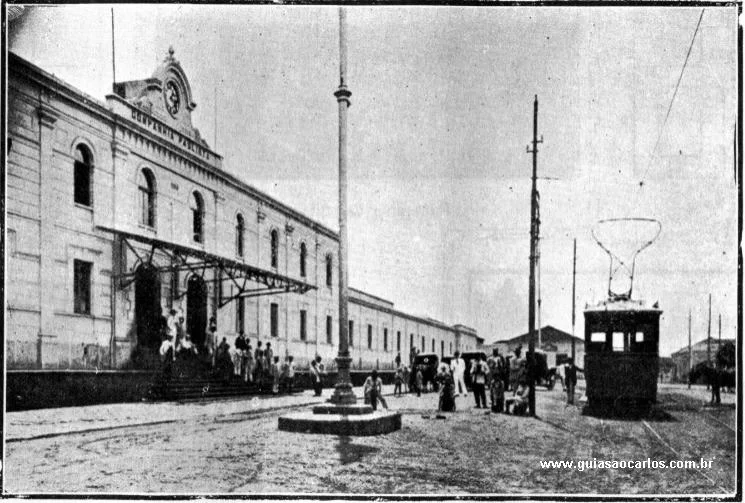

São Carlos Railroad Station
The last passenger train pulled out of São Carlos on March 15, 2001, bound for Araraquara, and with it went more than a century of arrivals and departures - coffee barons in linen suits, Italian immigrants with cardboard suitcases, schoolchildren pressing noses against the windows. Today the station still stands at the edge of the city's historic polygon, its 250-meter platform intact, its metallic roof still stretching 160 meters over empty tracks. But the building has not fallen silent. It is the Estação Cultura now, and what it preserves is harder to move by rail than coffee ever was: memory.
Rails to the Coffee Coast
The first station went up in 1884, built of exposed English brick by Rio Clarense, a company owned by Major Benedito Antonio da Silva and the Arruda Botelho family of the Count of Pinhal. That original structure did not last. When the Companhia Paulista de Estradas de Ferro bought the line in 1892, it had bigger ambitions than bricks could hold. Two branches needed to join the trunk here - Ribeirão Bonito heading toward Novo Horizonte, Água Vermelha running out to Santa Eudóxia - both built to drain coffee from the fertile red earth and funnel it south to the port of Santos. The old building came down. A new one began rising in 1908.
The Giongo Brothers' Ornament
Three Italian brothers - Abel, Séttimo, and Bruno Giongo - gave the station its face. They enlarged the upper floor and layered on the eclectic ornament that still catches the afternoon sun: pilasters, cornices, window framings that refuse to settle into any single style. The building opened in 1912, the largest station on the Companhia Paulista line along with Campinas, and for nearly nine decades it did what stations do. Freight and passengers moved through. Warehouses of exposed masonry, built in 1895, crowded the northwest corner. Maintenance workshops sprawled to the south. The CIAR forgery stood to the north until the 1960s, when it came down to make room for the Quatro de Novembro viaduct.
What Replaced the Trains
Passenger service ended in 2001, and FEPASA was fully deactivated by 2003. The trunk line now carries only freight for América Latina Logística, rolling through without stopping. But the station itself was given another life. The municipal Pró-Memória Foundation moved in, organizing three units inside the old halls: the city's Historical and Public Archive, its Architectural Patrimony division, and its Research and Dissemination office. In 2012, a Baldwin 4-4-0 locomotive called Maria Fumaça was restored and put on display, a Smoking Mary steaming nowhere but still watched by model railroad enthusiasts who gather here to remember.
Calixto in the Land of Pinhal
Inside the Museum of the Estação Cultura, eight frescoes by Benedito Calixto line the walls of a permanent exhibition titled Benedito Calixto in the Land of Pinhal. Calixto painted them originally for the old Episcopal Palace of São Carlos; they now belong to the municipality. His landscapes and scenes of Brazilian life give the station a second cultural identity - not just a preserved object but an active museum. In 2009, São Carlos hosted the 13th Frateschi Ferromodeling Convention here, one of the largest model railroad events in Latin America. The station still draws crowds, though the trains they come to see run on tabletops now.
A Listed Building
In 2021 the Pró-Memória Foundation formally designated the station a listed building, category 1, in the city's inventory of heritage assets. The designation was published in the municipal Government Gazette on March 9 of that year. The building sits within the historic polygon that traces the urban fabric of São Carlos as it existed in the 1940s - a deliberate outline of what deserves protection. From the air, the station's long covered platform still reads like a scar along the old trunk line, a thin metallic line pointing toward Campinas and, beyond it, the sea the coffee once crossed to reach the world.
From the Air
Located at 22.02°S, 47.90°W, São Carlos railroad station sits at approximately 856 meters elevation on the western São Paulo plateau. The 250-meter covered platform runs along the old Companhia Paulista trunk line, visible as a linear feature through the city's historic polygon. Nearest airport: São Carlos Airport (Mário Pereira Lopes, SBSC), 15 km away. Ribeirão Preto Airport (SBRP) is 90 km northwest. Recommended viewing altitude: 3,000-5,000 feet AGL for station complex detail.
Nearby Stories
- Brazilian Air Force Academy 15 km away
- Torrinha 22 km away
- Pederneiras 27 km away
- Vassununga State Park 42 km away
- Titanochampsa 58 km away
- Bauru 63 km away
- Itapira 67 km away
- Poços de Caldas 93 km away