.jpg)
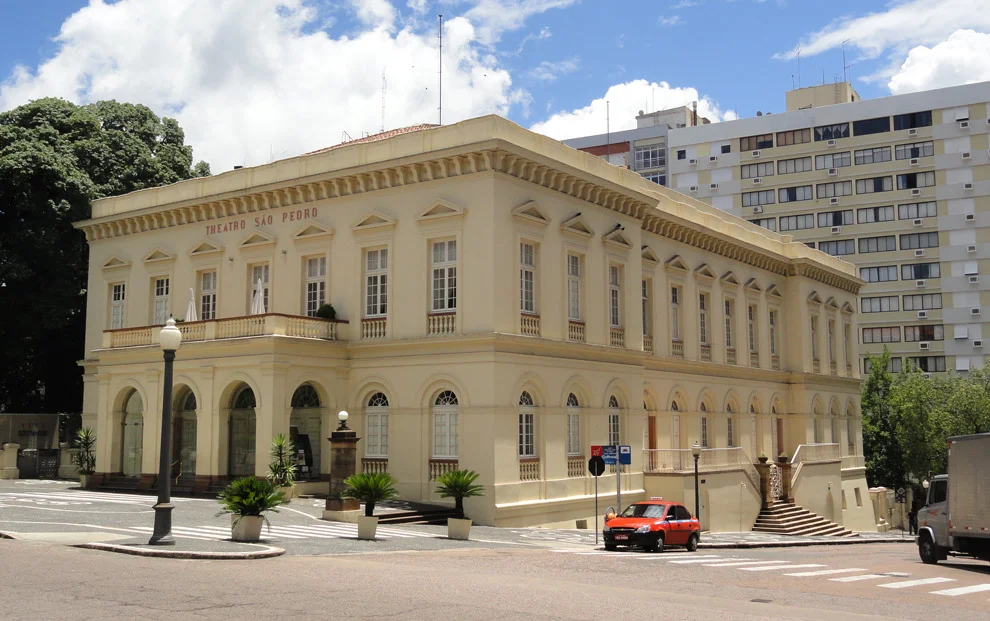
São Pedro Theatre
In 1991, when politics threatened to push Eva Sopher out of the theatre she had spent two decades rescuing, the response was not a petition or a press conference. People came to the corner of Praça Marechal Deodoro, joined hands, and formed a human chain around the building. They had watched this woman pull the Theatro São Pedro back from ruin, and they were not about to let anyone take it from her. The gesture worked. Sopher stayed. She would run Porto Alegre's oldest theatre for forty-one years, until her death at ninety-four, and the neoclassical facade she saved still draws every eye that crosses the square.
A Stage a Century in the Making
The story began in 1833, when the provincial president Manoel Antônio Galvão donated a plot in downtown Porto Alegre and commissioned a theatre from the architect Filipe Normann. Construction crawled. Delays and interruptions stretched the work across a generation, and the building was not inaugurated until June 27, 1858 - a quarter century after the first stone. By then Rio Grande do Sul had its grandest stage, a temple of columns and pediments rising in the heart of the city. Almost immediately the Theatro São Pedro became more than a place for plays. It was an artistic, social, and political center, the room where the south of Brazil came to see and be seen.
The Woman Who Refused to Let It Fall
By the 1970s the grand old theatre was failing. Plaster crumbled, systems aged, and the building that had hosted a century of opening nights needed wholesale rescue. The government turned to Eva Sopher, a cultural organizer who had already run countless artistic ventures in the city. She took charge of the recovery in 1975, and the project swallowed nine years of her life. The Theatro São Pedro reopened in 1984, restored to its neoclassical glory. Sopher did not then walk away. She stayed at the helm for the rest of her days, becoming so identified with the building that the two names - the theatre and Dona Eva - grew nearly inseparable in the city's memory.
Neoclassical Pride on the Square
Walk into Praça Marechal Deodoro today and the theatre announces itself. Its neoclassical facade - all symmetry, columns, and restraint - belongs to an era when a young Brazilian province wanted to show the world it had culture to match its cattle and its commerce. The style was deliberate, a statement carved in stone that Porto Alegre took the arts seriously. Inside, the horseshoe of gilded balconies still wraps around a stage that has carried opera, orchestras, and the gaúcho dramas of the south for more than a century and a half. Few buildings in Rio Grande do Sul hold so much continuous history in one room.
A Legacy Cast in More Than Memory
Sopher's devotion outlived her. When she died in 2018, the state mourned the loss of the woman the press had called the guardian of the Theatro São Pedro. Her name now belongs to an entire cultural complex built around the historic house, the Multipalco Eva Sopher, a campus of stages and studios that finally fulfilled the dream of expanding the theatre she had refused to lose. A building she once saved from demolition has become the seed of a whole performing-arts district - proof that a single act of stubborn love can echo across decades.
From the Air
The Theatro São Pedro sits at 30.03°S, 51.23°W, in the historic core of Porto Alegre on the bank of the Guaíba. The city is served by Salgado Filho International Airport (ICAO: SBPA), roughly 6 km north of downtown. From the air, the dense low-rise grid of the Centro Histórico fans out toward the broad silver sheet of Lake Guaíba to the west - the theatre lies within that old quarter, a few blocks back from the water. A viewing altitude of 2,000 to 3,000 feet on approach to SBPA gives a clear read of the historic center against the lake. Skies over Porto Alegre are generally clear in the dry-summer months, with the best visibility in the morning before the afternoon humidity builds.
Nearby Stories
- Itapuã State Park 22 km away
- Nova Petrópolis 37 km away
- Aparados da Serra National Park 77 km away
- Santa Cruz do Sul 77 km away
- Serra Geral National Park 111 km away
- 2009 Brasil de Pelotas Bus Disaster 161 km away
- Passo Fundo 176 km away
- Battle of the River Plate 446 km away