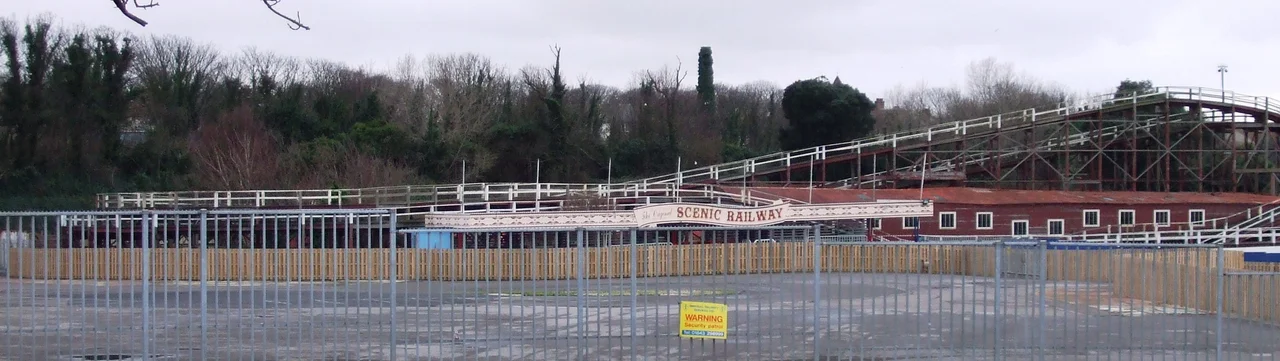

Scenic Railway, Dreamland Margate
On every run, between the first and second cars, a man rode the train with a long lever. He was the brakeman, and his job was to slow the carriages on the descents by physically applying brakes against the wooden track. It was 1920 when the Scenic Railway first opened at Margate's Dreamland park, and that was simply how a wooden roller coaster worked: human reflexes calibrated against gravity, sized to the bodies of riders sitting bolt upright in wooden cars and the courage of a man clinging on between them. The brakeman rode the Scenic Railway every day for over a century. He rode through fires in 1949 and 1957 that destroyed parts of the structure. He rode after the 2008 arson that gutted the trains. He rode again from 17 October 2015 when the restored coaster finally reopened. He stopped riding in August 2024, after a derailment, and in January 2026 Dreamland announced that the Scenic Railway would not run again.
Coney Island in Kent
John Henry Iles bought Dreamland in 1919 and wanted his own version of what he had seen at Coney Island in 1906. He paid LaMarcus Adna Thompson - the American who had patented the scenic-railway design back in 1884 - for the European usage rights. The coaster's mechanical parts came across the Atlantic from the United States, but the wooden structure was built from local timber by local carpenters working within the area Iles had specified on the Margate seafront. It opened in 1920 and carried half a million passengers in its first year. By the time Dreamland closed in 2005, the Scenic Railway was already one of only a handful of scenic railways anywhere in the world to survive in operating condition. It was also the oldest operating roller coaster in the UK and the second oldest of its type in the world. Grade II listing came in 2002. Grade II* status - meaning the structure was of more than local interest, that it represented a 'particularly significant' piece of national heritage - was granted in 2011.
Fires and Restoration
Fire kept finding the Scenic Railway. In 1949 it destroyed part of the ride; the replacement timber was sourced from the dismantled pier at Lowestoft, and the coaster reopened in 1950. In 1957 fire struck again. In April 2008 - during the long years when Dreamland sat derelict awaiting redevelopment - the original trains were destroyed in another fire, which investigators believed was started deliberately. The Grade II* upgrade in 2011 came despite this damage, because the rarity of the surviving structure outweighed what had been lost. Restoration began under the Dreamland Trust in September 2014, with new trains built and 320 tonnes of timber used to reconstruct the wooden frame. In December 2014, high winds knocked down part of the rebuild before it could be braced - setting back the reopening schedule. When Dreamland's gates reopened on 19 June 2015, the Scenic Railway was still not ready. Members and press got a preview on 16 October. The public finally rode it again on 17 October 2015, ninety-five years after Iles's brakeman had taken the first lever-pulled descent.
How It Works
The ride sits in a footprint roughly 580 by 120 feet - a flat oval double-loop with two cable-driven lift hills, each followed by a double-drop down a long undulating ramp. The track sits inside a trough lined with low wooden walls. Despite the name, this is not a side-friction coaster: the running wheels on the cars are flanged, like miniature railway wheels, and they ride on flat steel rails set into the timber structure. The trough walls are protective - they catch the cars sideways if the train tries to derail - but in normal operation the train makes no contact with them. The trains have three cars each, mounted on bogies like railway carriages, with wooden bodies and chassis. Twenty-eight riders can travel on each train. The brakeman rides between the first and second cars, on the bogie itself, with a large lever to apply the brakes. He is part of the experience, and he is part of the safety system. After the August 2024 derailing incident, the Scenic Railway sat closed through the entire 2025 season. The Department for Culture, Media and Sport told local councillors that operating decisions were a matter for the park's owner; Dreamland's owner LN-Gaiety - a Live Nation subsidiary - announced in late January 2026 that the ride would be 'retired,' despite Dreamland Heritage Trust funding meant to keep it running until 2037.
What Remains
The Scenic Railway is still there. Grade II* listing means it cannot be moved or demolished without exceptional cause. The wooden trestle still rises against the Margate sky, the cable lift mechanisms still in place, the trough still intact. Whether it ever runs again will depend on negotiations between Dreamland's owner, the Dreamland Heritage Trust, the council, and the Department for Culture, Media and Sport. The disappointment among local residents and roller-coaster historians is profound: this was a working museum, a piece of operating Edwardian engineering that connected modern riders to the rope-pulled wooden coasters that defined the form. There are now only seven scenic railways left running anywhere in the world. The Margate brakeman, between the first and second cars with his lever, has worked his last shift for now. The structure waits for whatever comes next - another restoration, another future, or merely the patient sentinel duty of being preserved while no longer running.
From the Air
Located at 51.385°N, 1.378°E on the Margate seafront within the Dreamland amusement park. From the air, the Scenic Railway's wooden trestle silhouette is visible as a flat-oval structure at lower altitudes, just inland from the Dreamland Cinema's distinctive Art Deco signage on Marine Terrace. London Manston Airport (EGMH) lies about 5 nm south. The Turner Contemporary gallery beside Margate harbour, immediately east, is the most prominent neighbouring landmark. The coast curves east toward North Foreland lighthouse, about 3 nm distant.
Nearby Stories
- Battle of Maldon 4 km away
- Dover Priory 6 km away
- HMS Hermes (1898) 7.7 km away
- Sissinghurst Castle Garden 9.4 km away
- Priestfield Stadium 11 km away
- Clacton Pier 13 km away
- 1382 Dover Straits Earthquake 19 km away
- Four Days' Battle 46 km away