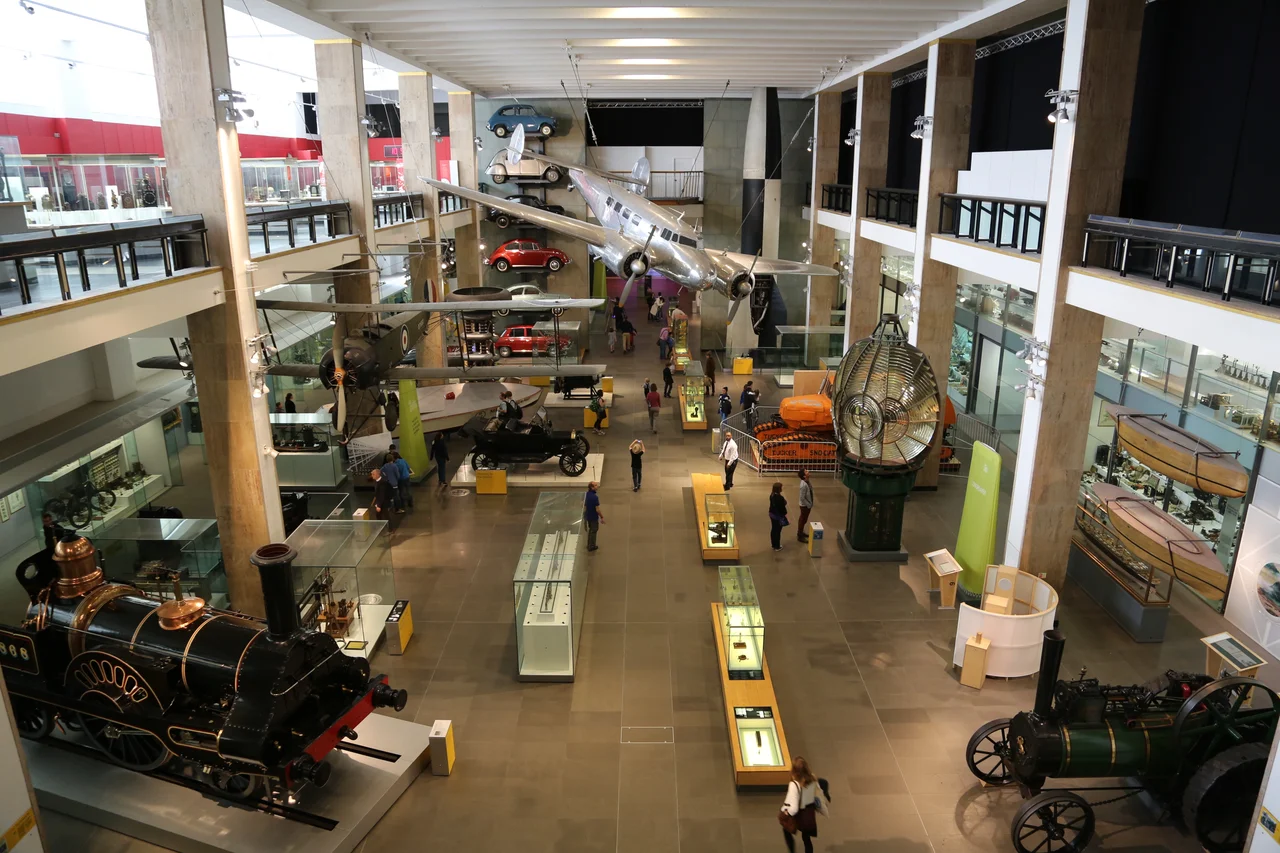

Science Museum, London
Puffing Billy turns 213 this year. The oldest surviving steam locomotive in the world sits on the ground floor of the Science Museum on Exhibition Road, three iron wheels and a vertical boiler that once hauled coal out of a Northumberland mine in 1813. A few steps away is Crick and Watson's original wire-and-metal model of DNA, the one they assembled in 1953 and the one that changed biology forever. Across the gallery hangs a V-2 rocket. The same technology took humans to the Moon - and the same technology, the museum's curators do not let visitors forget, was built by enslaved workers at Mittelbau-Dora. The Science Museum has been collecting the contradictions of modern progress since 1857, when it opened with the surplus from the Great Exhibition and a collection of patent models. It now draws 3.3 million visitors a year, free at the door.
Born from the Crystal Palace
When the Great Exhibition closed in 1851, the country was left with a problem and an opportunity: what to do with the wealth of objects Prince Albert's spectacle had drawn from across the empire. The answer was Albertopolis - a quarter of museums in South Kensington funded by exhibition profits. Bennet Woodcroft, a textile machinery inventor turned bureaucrat, founded what would become the Science Museum in 1857. It absorbed a Museum of Patents that contained machines visitors still queue to see: Robert Stephenson's Rocket, James Watt's beam engines, Richard Trevithick's pioneering locomotives. The Science Museum and the Victoria and Albert started as one institution and split in 1909, when Queen Victoria's insistence on naming the new Aston Webb building after herself and her husband restricted that title to the art galleries. The Science Museum got an independent charter, but never the grand building it was promised.
Apollo 10, Floor Two
On the second floor of Making the Modern World sits a stubby cone of charred metal called Charlie Brown. It is the command module from Apollo 10, the dress rehearsal mission for the Moon landing, which orbited the lunar surface thirty-one times in May 1969 before bringing Thomas Stafford, John Young, and Eugene Cernan home. NASA never used it again. They gave it to Britain in 1976. It sits next to the V-2 rocket whose technology made it possible. Doug Millard, the museum's curator of space technology, refuses to celebrate the V-2 without context: 'We got to the Moon using V-2 technology but this was technology that was developed with massive resources, including some particularly grim ones. The V-2 programme was hugely expensive in terms of lives, with the Nazis using slave labour to manufacture these rockets.' Two cones of metal, side by side. One was built by enslaved prisoners working in tunnels beneath a German mountain. One landed in the Pacific carrying three American men home. The same engineer designed both.
Wonderlab, Astronights, and the Queen's First Tweet
The third floor is where the museum's interactive nerve sits. Wonderlab - formerly Launchpad - has staff called Explainers who set things on fire, drop things from heights, and demonstrate why bicycles balance. Up to 380 children spend nights inside, sleeping on the floors of galleries among Stephenson locomotives and Apollo capsules, on what the museum calls Astronights. Adults get monthly Lates - silent discos among the engines, lectures on biotech, conversations with activists, attendance regularly topping 7,000. In 2014 Queen Elizabeth II opened the Information Age gallery and posted her first tweet from inside it: 'It is a pleasure to open the Information Age exhibition today.' The gallery traces six communications revolutions, from undersea telegraph cables to mobile phones. Power Up next door lets visitors play 150 video game consoles, from a 1970s Binatone TV Master to the PlayStation 5. Somewhere in that gallery, a child playing Pong sits ten yards from a working Difference Engine.
The Sponsorship Question
Not everything in the museum is uncomplicated. Wonderlab's title sponsor is Equinor, the Norwegian state oil company. Shell, BP, and Adani have all funded galleries. Each sponsorship contract reportedly contains a gagging clause - the museum cannot publish anything that would damage its sponsor's reputation. In 2021, more than 40 senior academics said they would not work with the museum because of those arrangements. In 2022, 400 teachers signed an open letter promising to boycott. The climate scientist Chris Rapley resigned from the museum's advisory board. Director Ian Blatchford has defended the policy publicly: 'Even if the Science Museum were lavishly publicly funded I would still want to have sponsorship from the oil companies.' Inside the galleries, meanwhile, the carbon-capture exhibition explores the science of warming the world. Two stories the museum tells at once, in adjacent rooms - the engines that built the modern world, and the planet they are changing. As contradictions go, it is one Bennet Woodcroft would probably have understood.
From the Air
Located at 51.4975°N, 0.1747°W on Exhibition Road, South Kensington, with the V&A on one side and the Natural History Museum on the other - three palatial buildings in a single row. Recommended viewing altitude 2,500-3,500 feet. Heathrow (EGLL) is 12 nm west; London City (EGLC) is 8 nm east-northeast. The Royal Albert Hall's distinctive oval dome sits 400 metres north, providing an unmistakable visual reference.
Nearby Stories
- Battle of Britain, Northfleet 1.1 km away
- Bayham Old Abbey 5.4 km away
- Catharine Macaulay 6.4 km away
- Hatfield rail crash 8.8 km away
- Chequers 8.9 km away
- Chelmsford Cathedral 10 km away
- Queen Victoria Hospital 13 km away
- Fishbourne Roman Palace 36 km away