
Scottish National Gallery
An eighteenth-century Scottish minister glides across a frozen Edinburgh loch on improvised skates, hands clasped behind his back, top hat firmly in place, expression patient and slightly amused. The painting is small - barely two feet tall - but it has become the unofficial face of Scottish art. Sir Henry Raeburn painted The Reverend Robert Walker Skating on Duddingston Loch in the 1790s. It hangs in the Scottish National Gallery on The Mound in Edinburgh, in a room shared with Raphaels and Titians and a Constable and a Monet. The Skating Minister has, for many visitors, become the reason to come.
A Playfair Temple Behind a Playfair Temple
William Henry Playfair designed two neoclassical temples on The Mound thirty-three years apart. The first, in 1822-26, became the Royal Institution and is now the Royal Scottish Academy. The second, opened in 1859, was the National Gallery of Scotland - now the Scottish National Gallery. Both are pale ashlar with Doric and Ionic columns, both crisp Greek revival, both crowning the artificial spit of land that runs between Princes Street and the Old Town. The gallery opened with collections built up by the Royal Institution since 1819 and supplemented by the new Royal Scottish Academy. From the air or from Calton Hill they read as a matched architectural pair - one of the great planned set pieces of European nineteenth-century urbanism.
Old Masters in the North
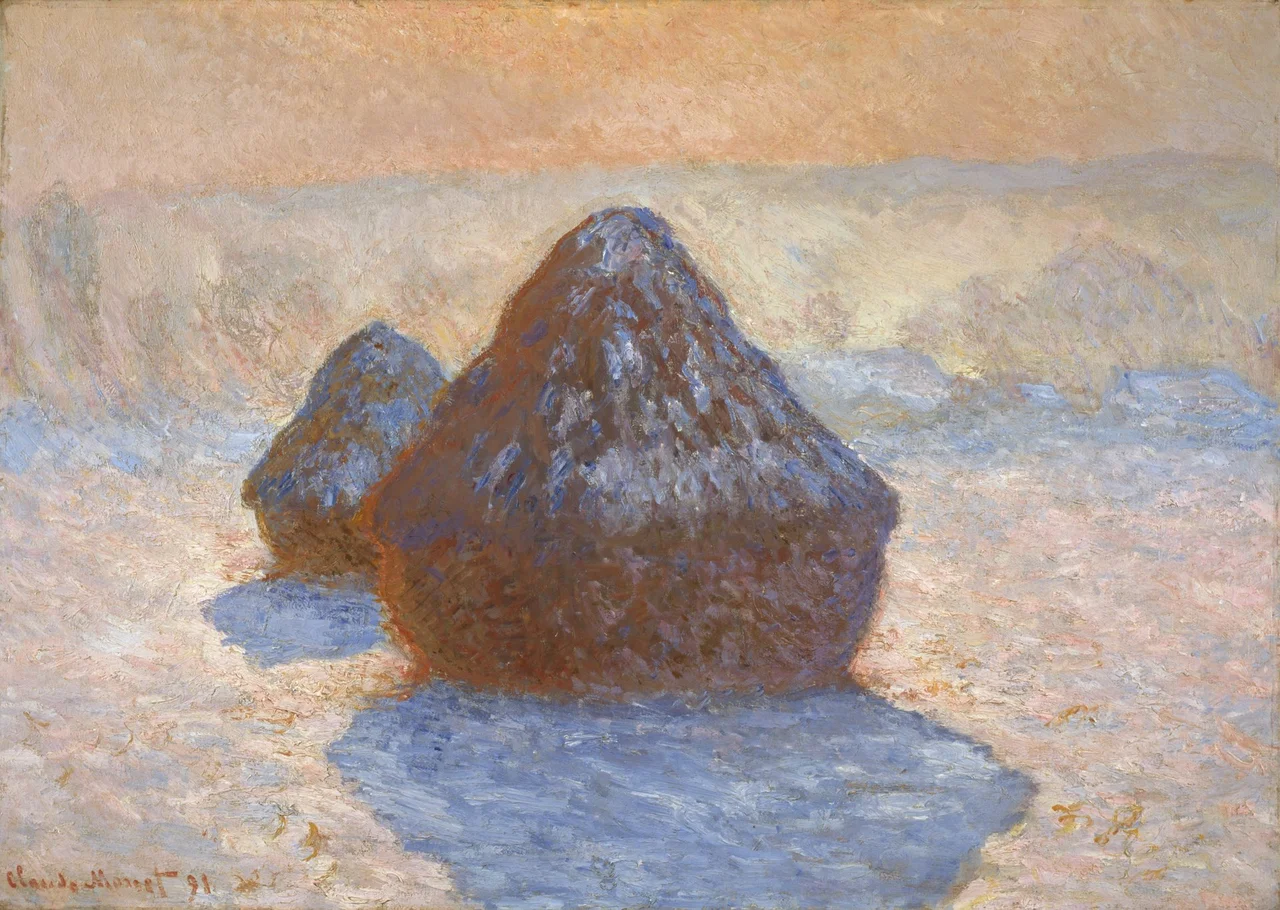
Scotland is not on most people's mental list of European Old Master destinations, and yet the collection is genuinely first-rate. Raphael's Holy Family with a Palm Tree from 1506. Titian's Diana and Callisto from 1559 - a masterpiece jointly purchased with the National Gallery in London in 2012 after a fundraising campaign that saved it for British public display. A Frans Hals portrait from around 1644. Botticelli, Velázquez, Bernini. The collection runs forward through Gainsborough's Portrait of Mrs Mary Graham (1775) and Reynolds's Ladies Waldegrave (1780), through Constable's Vale of Dedham (1828), into Frederic Edwin Church's American Niagara Falls (1867), and ends with Monet's Haystacks (1891) and Gauguin's Vision after the Sermon (1888) - a feverish painting of Breton women watching Jacob wrestle the angel.
Scottish Painting, On Its Home Ground
Among the international masters, the gallery holds a deep collection of Scottish art that anchors the institution's national mission. Beyond the Skating Minister, there is William Allan's dramatic Murder of David Rizzio (1833), retelling the killing of Mary, Queen of Scots' Italian secretary in front of her at Holyrood Palace in 1566. Edwin Landseer's Monarch of the Glen (1851), the most famous of all stag paintings, became a Victorian icon and an emblem of Highland imagination. Allan Ramsay's portraits of David Hume and other figures of the Scottish Enlightenment hang as a kind of intellectual family album. These works belong in Edinburgh because they were painted from Edinburgh, of Edinburgh subjects, by artists who knew the city's light - the long northern shadows, the soft blue-grey of Scottish skies.
The Playfair Project and the New Entrance
For a century and a half the gallery had the same problem as many nineteenth-century museums: it had been designed as a temple, and temples are awkward to enter and impossible to expand. The Playfair Project, completed in 2004, dug new underground space beneath The Mound and connected the National Gallery to the Royal Scottish Academy next door. Then in 2019-23 a further £22 million project rebuilt the gallery's east entrance, opening it to Princes Street Gardens and creating substantial new spaces for Scottish art on the lower levels. The refurbishment was delayed by unexpected structural defects discovered in 2020, but the result is a gallery that finally has the space its collection deserves. The Skating Minister glides on - but now from rooms that flow naturally between Scottish art and the international collection that surrounds it.
From the Air
Located at 55.9509 N, 3.1957 W, at the foot of The Mound in central Edinburgh, directly behind the Royal Scottish Academy and between Princes Street Gardens and the Old Town ridge. Nearest airport is Edinburgh (EGPH), 8 km southwest. From the air the gallery and the RSA in front of it form a pair of pale Greek-revival temples on the artificial spit between the green band of Princes Street Gardens (west) and East Princes Street Gardens. The castle rock rises immediately to the southwest. Best appreciated from 1,000-3,000 feet.
Nearby Stories
- Ardoch Roman Fort 2.2 km away
- Craignethan Castle 3.1 km away
- Haddington 3.8 km away
- Balvaird Castle 4.3 km away
- Battle of Kilsyth 9.4 km away
- Siege of St Andrews Castle 9.9 km away
- Neidpath Castle 11 km away
- Melrose Abbey 15 km away