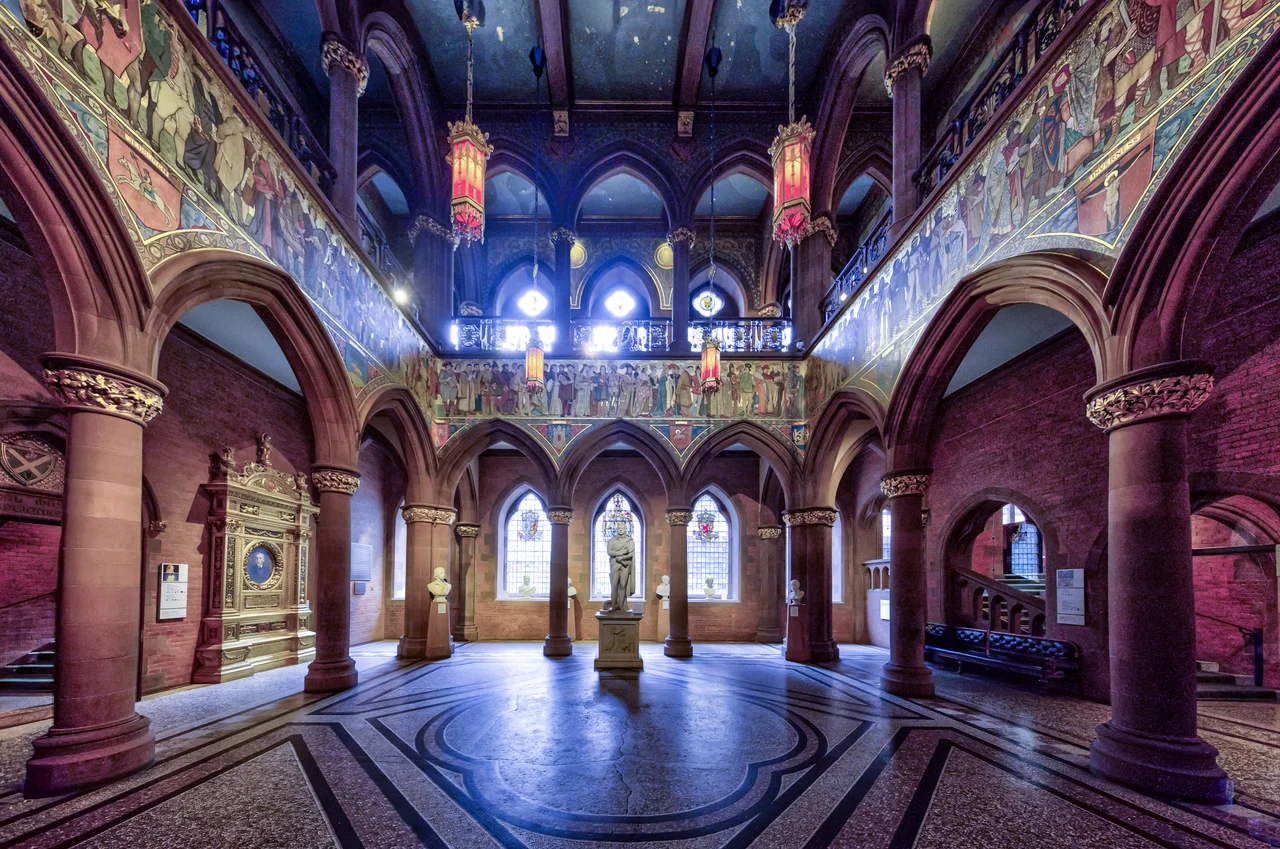

Scottish National Portrait Gallery
It is the first building in the world purposely built as a portrait gallery. The London National Portrait Gallery is older as an institution - founded 1856, this one came in 1882 - but London didn't move into its dedicated building until 1896. Edinburgh's beat it by seven years. The Edinburgh gallery's red sandstone facade rises on Queen Street like a Gothic ship grounded in Georgian water: ornate spires and pointed arches in a neighbourhood otherwise defined by restrained neoclassical terraces. Inside hang the faces of Scotland - kings, queens, philosophers, poets, scientists, athletes, comedians - a national family album running from a portrait of James IV in 1507 to Tilda Swinton in the present.
A Newspaper Owner's Gift
The gallery exists because John Ritchie Findlay, owner of The Scotsman newspaper, decided to pay for it. In 1882 he endowed the Queen Street site, commissioned the architect Robert Rowand Anderson, and put up £50,000 - then a substantial fortune. The result was completed in 1890, in a Gothic Revival style that combined thirteenth-century Gothic, Arts and Crafts touches, and an unusual debt to Spanish Gothic architecture. Findlay quietly insisted on certain changes: Anderson had wanted pairs of large Franco-Scottish tourelles flanking the facade, but Findlay preferred the smaller octagonal corner towers topped with crocketed pinnacles that the building has today. The red sandstone came from Corsehill Quarry near Annan in Dumfriesshire.
Shared with the Antiquaries
Originally the building did double duty. The Society of Antiquaries of Scotland - founded 1780 by the Earl of Buchan - shared the building with the portrait gallery for its first century. The Antiquaries occupied the western half, the portrait gallery the east, and a grand Main Hall down the centre served both. In 1985 the antiquities collection was amalgamated with the Royal Scottish Museum, eventually moving to the National Museum of Scotland on Chambers Street. The portrait gallery expanded into the whole building and then, in 2009, closed entirely for the first comprehensive refurbishment in its history. Page\Park Architects led a £17.6 million project that restored original layouts, added a glass lift for accessibility, and produced 60% more gallery space. Portrait reopened on 1 December 2011, with 849 works on display, 480 of them by Scots.
Mary, Tartan, and the Skating Minister's Cousins
The oldest painting in the collection is a portrait of James IV of Scotland from 1507. Mary, Queen of Scots is represented by two portraits, but neither was painted in her lifetime - the earliest dates to around 1610, more than twenty years after her execution in 1587. Her circle survives better. Her three husbands all have life portraits, and there are miniatures from 1566 of James Hepburn, 4th Earl of Bothwell and his first wife. The 1683 portrait by John Michael Wright of Lord Mungo Murray in belted plaid is one of the earliest tartan portraits in existence, painted before the wearing of tartan was politicised by the 1745 Jacobite Rebellion. Allan Ramsay's portraits of Scottish Enlightenment figures - David Hume among them - line another room. Henry Raeburn is represented by fifteen works, including his Walter Scott from 1822.
Tassie, Burns, and the Modern Era
Alexander Nasmyth painted the iconic 1787 portrait of Robert Burns that the gallery owns - the image from which most subsequent images of the poet derive. The largest single-artist holding in the collection is 58 works by the sculptor James Tassie (1735-1799), who perfected a distinctive format of large glass-paste medallion portraits in profile. Tassie was Adam Smith's friend and made the medallion of Smith that became, like the Nasmyth Burns, the source for nearly every later image of Smith. The collection continues to grow. John Bellany's portraits of Peter Maxwell Davies and Billy Connolly, John Byrne's of Tilda Swinton and Robbie Coltrane, photographs of Glasgow life by Thomas Annan - the gallery now holds 3,000 paintings, 25,000 prints and drawings, and 38,000 photographs. Scotland's face, in all its angles.
From the Air
Located at 55.9555 N, 3.1936 W, on Queen Street in Edinburgh's New Town, two blocks north of Princes Street. Nearest airport is Edinburgh (EGPH), 9 km southwest. From the air the red sandstone Gothic facade stands out vividly against the surrounding pale Georgian terraces of the New Town - look for a darker red-orange block on Queen Street with distinctive corner towers. Best appreciated from 1,000-2,500 feet, with Calton Hill visible to the east and Edinburgh Castle on the Old Town ridge to the south.
Nearby Stories
- Ardoch Roman Fort 2.2 km away
- Craignethan Castle 3.1 km away
- Haddington 3.8 km away
- Balvaird Castle 4.3 km away
- Battle of Kilsyth 9.4 km away
- Siege of St Andrews Castle 9.9 km away
- Neidpath Castle 11 km away
- Melrose Abbey 15 km away