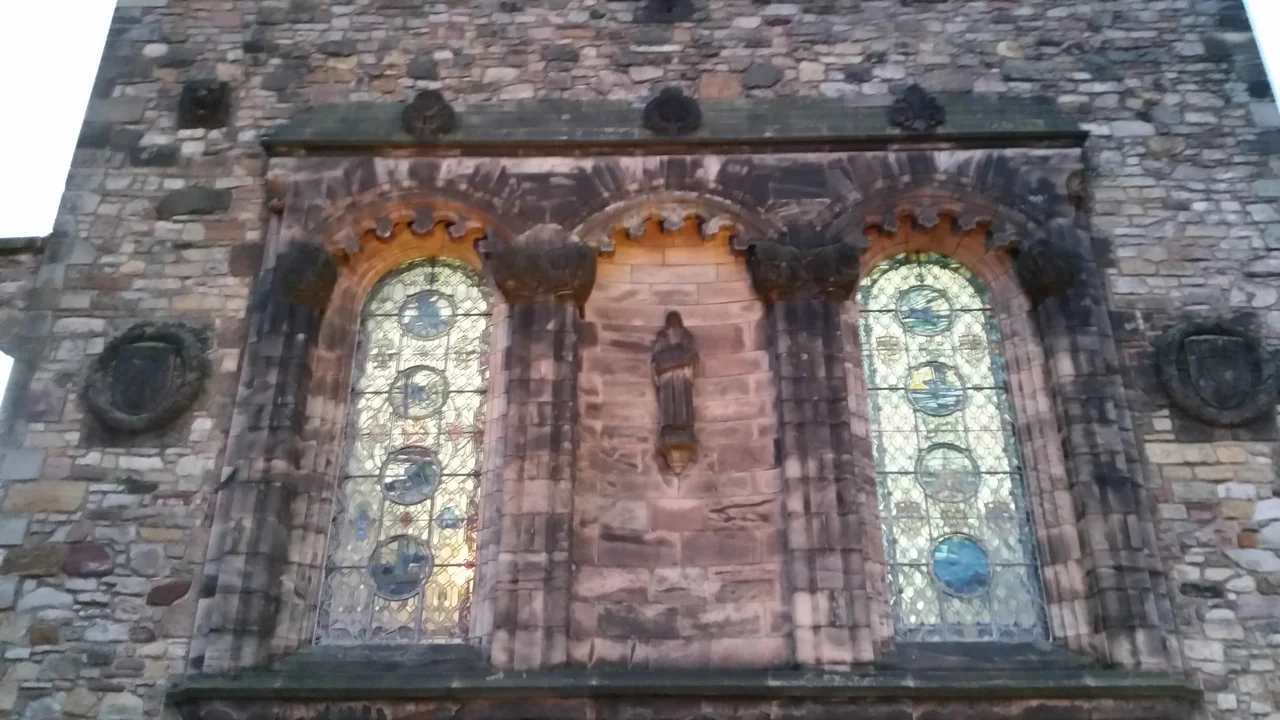

Scottish National War Memorial
At the heart of Edinburgh Castle, in a small dim hall built into the bones of an old barrack block, a sealed casket sits on an altar. The altar sits on the highest point of the Castle Rock, where the basalt itself rises through the floor. Inside the casket are the Rolls of Honour for the First World War: more than 147,000 names of Scottish soldiers killed between 4 August 1914 and 28 June 1919. Around the walls are open lists adding the names of those killed in every war since. The Scottish National War Memorial was opened in 1927 to remember individuals, not abstractions - which is why every name was written down, why every name is still being added, and why visitors keep their voices low.
Robert Lorimer's Quiet Argument
The architect Robert Lorimer was commissioned in 1919 to design a memorial inside the castle. His original scheme was larger and bolder, but it ran into opposition from the Cockburn Association and others who feared a grand new building would overwhelm the castle's existing fabric. After four years of negotiation, a more modest plan was agreed in 1923: convert the existing North Barrack Block in Crown Square into a shrine and hall of remembrance. Construction took four more years. The Prince of Wales - later Edward VIII - opened the memorial on 14 July 1927. Lorimer's final building is restrained from outside, almost invisible if you don't know to look. Inside, the restraint disappears.
Sculptors, Stained Glass, and a Calling of St Andrew
Lorimer assembled a team of Scotland's leading artists. Sculptor Alexander Carrick carved Courage on the entrance facade; Percy Portsmouth carved Freedom on the western front; Alice Meredith-Williams produced Truth and the relief of The Calling of St Andrew that sits above the centre window. Phyllis Bone, one of the most accomplished women sculptors of her generation, carved the heraldic unicorn outside, the niche capitals throughout, and the rain-spout lions. Inside, Douglas Strachan designed the stained-glass windows - a programme of glass that fills the interior with coloured light filtered through symbols of mourning, hope and resurrection. The wall monuments, commissioned individually, commemorate each Scottish regiment. The combined effect is dense, layered, deeply considered - every surface carrying meaning.
147,000 Names, and 50,000 More
The original purpose was to commemorate Scots and members of Scottish regiments killed in the First World War. The casket on the altar contains the full Rolls of Honour: over 147,000 individuals named, ranked, regimented. After 1945, the limiting dates were modified. Another 50,000 names were added for the Second World War, this time written into open volumes displayed in the Hall rather than sealed in the casket. Since then, every Scottish service death in every subsequent conflict has been added - Korea, Northern Ireland, the Falklands, Iraq, Afghanistan. The memorial itself has been left unchanged; only the lists keep growing. To read down a Rolls of Honour at random is to find ordinary place names attached to ordinary surnames - the village butcher's son, the railway clerk's brother, neighbours' children.
Their Name Liveth For Evermore
The phrase carved above the apse comes from Ecclesiasticus, chosen by Rudyard Kipling for British war cemeteries after 1918. "Their name liveth for evermore." It is the explicit promise the memorial makes: not that anyone will forget the wars, but that no individual will be lost in the totals. Scotland in 1918 was a country of about 4.8 million people. To lose 147,000 men was to lose a fraction of the male population so large that no community escaped untouched. Tiny island parishes lost a quarter of their young men; mainland villages lost their entire football teams. The casket sits on bedrock because Lorimer wanted the memorial built into the land itself - the same volcanic rock the castle was built on, the same rock Scotland is built on. The names rest on it, with the country.
From the Air
Located at 55.9485 N, 3.1998 W, in Crown Square at the heart of Edinburgh Castle, on the basalt plug that dominates Edinburgh's skyline. Nearest airport is Edinburgh (EGPH), 8 km southwest. From the air the castle itself is one of the most recognisable landmarks in Scotland; the War Memorial occupies the north side of Crown Square within the castle complex, on the highest point of the rock. Best appreciated at ground level, but the castle rock is unmistakable from any altitude over central Edinburgh.
Nearby Stories
- Ardoch Roman Fort 2.2 km away
- Craignethan Castle 3.1 km away
- Haddington 3.8 km away
- Balvaird Castle 4.3 km away
- Battle of Kilsyth 9.4 km away
- Siege of St Andrews Castle 9.9 km away
- Neidpath Castle 11 km away
- Melrose Abbey 15 km away